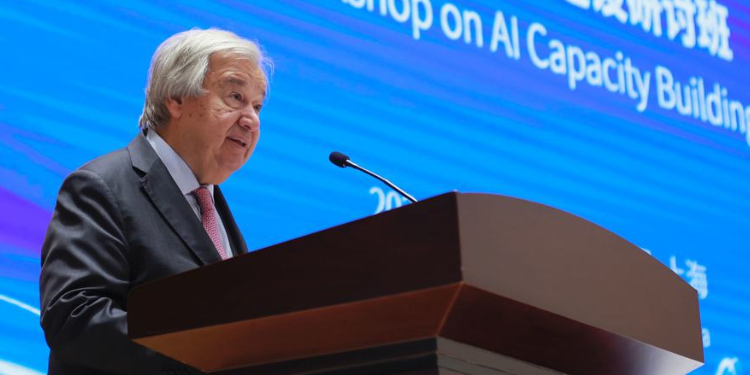
United Nations Secretary-General António Guterres has called for stronger international cooperation to ensure that artificial intelligence (AI) becomes a force for global development rather than a driver of deeper inequality.
Addressing world leaders, technology executives, policymakers and researchers at the opening of the World Artificial Intelligence Conference (WAIC) in Shanghai, Guterres described artificial intelligence as one of the defining technologies of the 21st century, capable of revolutionising healthcare, education, food production and economic growth.
At the same time, the UN Chief cautioned that without inclusive governance and shared responsibility, AI risks widening the gap between wealthy and developing nations while concentrating power in the hands of a small number of countries and technology companies.
As generative AI, automation, and machine learning continue to transform economies and society at a rapid pace, governments across the globe are scrambling to create legislative frameworks for AI.
Against this backdrop, Guterres argued that international cooperation not competition must guide the next phase of AI development.
“Technology that will shape the future of humanity must be shaped by all of humanity.”
António Guterres
He further noted that,“AI governance cannot be governed by a handful of countries or companies,” adding that “every nation needs a seat at the table.”
Over the past year, the UN has launched a number of programs aimed at giving countries, particularly those in the poor world, more opportunities to shape international standards for quickly growing technology.
The adoption of the Global Digital Compact by UN Member States, as well as the founding of the UN General Assembly-authorized Independent International Scientific Panel on Artificial Intelligence, have been among the most significant milestones. The council is designed to provide impartial scientific input on AI while also encouraging worldwide collaboration on future challenges and opportunities.
Earlier this month, governments, researchers and industry representatives also gathered in Geneva for the first Global Dialogue on AI Governance, where discussions focused on promoting transparency, shared standards and more inclusive decision-making in artificial intelligence policy.
Guterres stated that these initiatives represent significant progress, but that international commitments must now be translated into practical action capable of providing tangible benefits to countries that lack the infrastructure, expertise, and investment required to fully participate in the AI revolution.
The warning comes as global investment in artificial intelligence continues to grow, with the majority of processing power, specialised research facilities, and financial resources concentrated in a small number of countries.
According to the Secretary-General, this imbalance risks excluding vast portions of the world from one of history’s most profound technological transformations.
UN Chief Unveils Roadmap for Inclusive AI Development
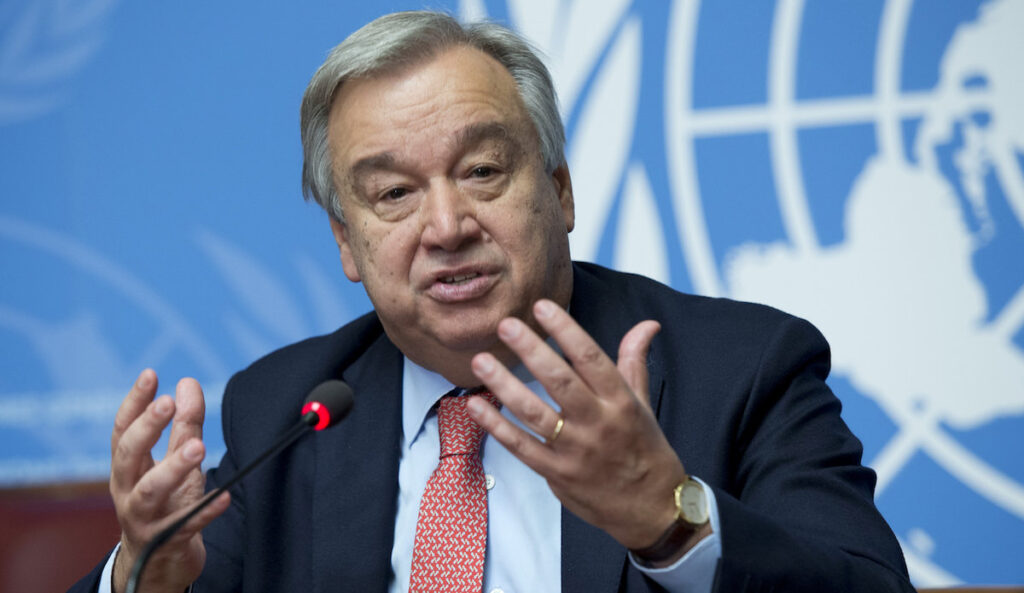
While highlighting artificial intelligence’s enormous potential to accelerate progress toward the Sustainable Development Goals (SDGs), Guterres warned that many developing countries remain at risk of being left behind unless deliberate efforts are made to bridge existing digital divides.
“One-third of humanity is still offline,” he noted, pointing to unequal access to digital infrastructure, computing capacity, technical expertise and investment as major barriers preventing many nations from benefiting from AI-driven innovation.
Without corrective measures, he warned, artificial intelligence could deepen existing inequalities instead of reducing them.
The UN Chief stated that if global governance does not keep up with technical innovation, “greater inequalities, greater divides in income, in opportunity, in security” could become the defining legacy of AI.
To help address those disparities, Guterres announced that more than 20 countries, including China, have already nominated institutions to participate in a UN-supported Global Network for Exchange and Cooperation on AI Capacity Building. The initiative is designed to strengthen technical cooperation, facilitate knowledge sharing and help developing countries build local expertise in artificial intelligence.
The Secretary-General also revealed plans to present recommendations for the creation of a Global Fund for AI, aimed at supporting capacity-building efforts and ensuring that lower-income countries can develop AI systems tailored to their own languages, cultures, priorities and development needs.
Beyond expanding access, Guterres outlined three priorities that he believes should guide the future of artificial intelligence governance.
The first is strengthening AI capacity in developing countries by providing the tools, skills and infrastructure necessary for inclusive innovation.
The second involves establishing internationally recognised safety standards and common approaches to testing, oversight and risk management, grounded in international law and respect for human rights.
“Human rights must be protected. Humans must keep control over every life-and-death decision.”
António Guterres
He also issued a strong appeal for greater protections for children as AI systems become increasingly integrated into education and everyday life.
The third priority centres on environmental sustainability. As artificial intelligence systems require growing amounts of electricity and computing power, concerns have increased over their environmental footprint and contribution to greenhouse gas emissions.
Guterres called on major AI developers to disclose the environmental impact of their technologies and transition their operations to renewable energy by 2030. He also encouraged governments to incorporate clean energy solutions for AI infrastructure into their national development and climate strategies.
Concluding his address, the Secretary-General emphasised that the decisions made by governments, businesses and international institutions over the coming years will determine whether artificial intelligence becomes a tool for shared prosperity or a source of deeper global division.
READ ALSO: Xi Urges International Cooperation On AI Development