U.S. President Donald Trump warned today that the U.S. will destroy one bridge or power plant each time Iran shoots at a ship in the Strait of Hormuz.
Trump’s latest threat to target civilian infrastructure came as the unpopular war spirals with no signs of abating, threatening further worldwide economic disruption and sending fuel prices up ahead of midterm U.S. elections this fall.
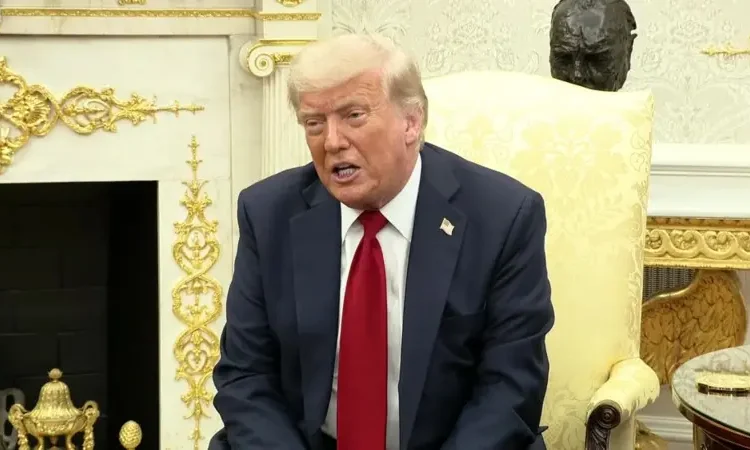
“From this point forward, any time the Islamic Republic of Iran shoots at a ship in the Strait of Hormuz, whether it be by Missile, Rocket, Drone, or any other device or weapon, the United States will bomb and destroy ONE BRIDGE OR POWER PLANT.”
Donald Trump
Both U.S and Iran have dug in on their dispute over the strait, a crucial waterway for global energy that remains largely closed because of Iranian attacks.
The closure of the strait, through which a fifth of the world’s traded oil and gas passed during peacetime, has jolted the world economy with effects far beyond the Middle East. A new threat by Iran-backed Houthi rebels in Yemen to target Saudi shipping in the Red Sea puts another trade chokepoint at risk.
With negotiations largely stalled, both sides have sought leverage by targeting civilian infrastructure. Iran has responded to U.S. attacks by targeting energy infrastructure and desalination plants that provide drinking water in parched neighboring Gulf countries. International law generally prohibits such attacks unless the infrastructure is being used for military purposes. United Nations Secretary-General Antonio Guterres decried such attacks as “unacceptable” on Tuesday.
Speaking from the Oval Office on Tuesday, Trump gave a dim view on possible talks, saying that the U.S. had “no interest in meeting.” He signaled that U.S. forces could soon target an under-construction Iranian nuclear site buried deep under a mountain.The site, known as Pickaxe Mountain, lies on the south side of Iran’s Natanz nuclear enrichment site, which was bombed by the U.S. during the 12-day war between Iran and Israel in 2025. However, Pickaxe Mountain has remained untouched as Iran continues to dig at the site.
Attacks And Retaliation Continues
The U.S. carried out another wave of strikes on Iran overnight into today, Wednesday, July 22, 2926, and air defenses opened fire over the capital, Tehran. The U.S. military said earlier today that it had completed an 11th night of strikes on Iran, with targets including aircraft hangars and drone storage sites.
Iran’s state-run IRNA news agency reported explosions across several provinces such as Bushehr, East Azerbaijan, Hamadan, Hormozgan, Khuzestan and Sistan and Baluchistan provinces.
That came after Iran attacked a tanker in the strait on Tuesday, forcing the crew to abandon the ship. According to Iran’s Health Ministry, U.S. strikes over the past 11 days have killed 53 people, including six women and three children, and wounded nearly 600 people. Iran’s paramilitary Revolutionary Guard insisted its retaliatory attacks would continue.
Iran also kept up attacks against U.S. allies in the region. Iran also launched attacks against Bahrain, Jordan and Kuwait. Iran launched a missile attack on a Jordanian city on Israel’s doorstep, and alerts were issued in Bahrain and Saudi Arabia.
Jordan’s military said that it intercepted four Iranian missiles over Aqaba, while two others fell in “uninhabited areas.” Plumes of smoke could be seen overhead in videos filmed by people in the nearby Israeli city of Eilat. Jordan said that it also intercepted four Iranian drones.
Iran has avoided striking Israel since hostilities resumed last month, apparently hoping to keep it from reentering the war. However, the attack on Aqaba, within sight of Israel’s Eilat, raised concerns over a further widening of the conflict after an agreement to halt hostilities collapsed.
Another missile alert sounded in Bahrain, and Saudi Arabia warned residents of the Persian Gulf city of Dammam to seek shelter. Saudi authorities later said the danger had passed, without elaborating.
Before the latest strikes, Iranian Interior Minister Eskandar Momeni visited Pakistan, a key mediator in the conflict, seeking to revive diplomacy. However, it was unclear what new arrangement might be reached to end the war, which lately has become a battle for control over the Strait of Hormuz.
According to state media, Iran’s Interior Ministry Spokesman Ali Zeinivand said “diplomacy isn’t called off” and that messages were still being exchanged, without elaborating.
The escalation pushed energy prices higher. The international benchmark for crude oil traded today above $92 a barrel and regular gasoline in the U.S. climbed to an average of $4 a gallon. With U.S. midterm elections approaching in the fall, polls have pointed to the unpopularity of the war among Americans, who have felt the pain of pricier gas and seen new casualties in a conflict that weeks ago seemed to be winding down.
READ ALSO: Nigeria’s Boko Haram Trials Fall Short of Justice Standards- Human Rights Watch