The Ghana Cocoa Board (COCOBOD) has officially relaunched the Free Fertiliser Distribution Programme at Sefwi Wiawso in the Western North Region, reaffirming government’s commitment to improving cocoa production, strengthening farm productivity and increasing the incomes of cocoa farmers.
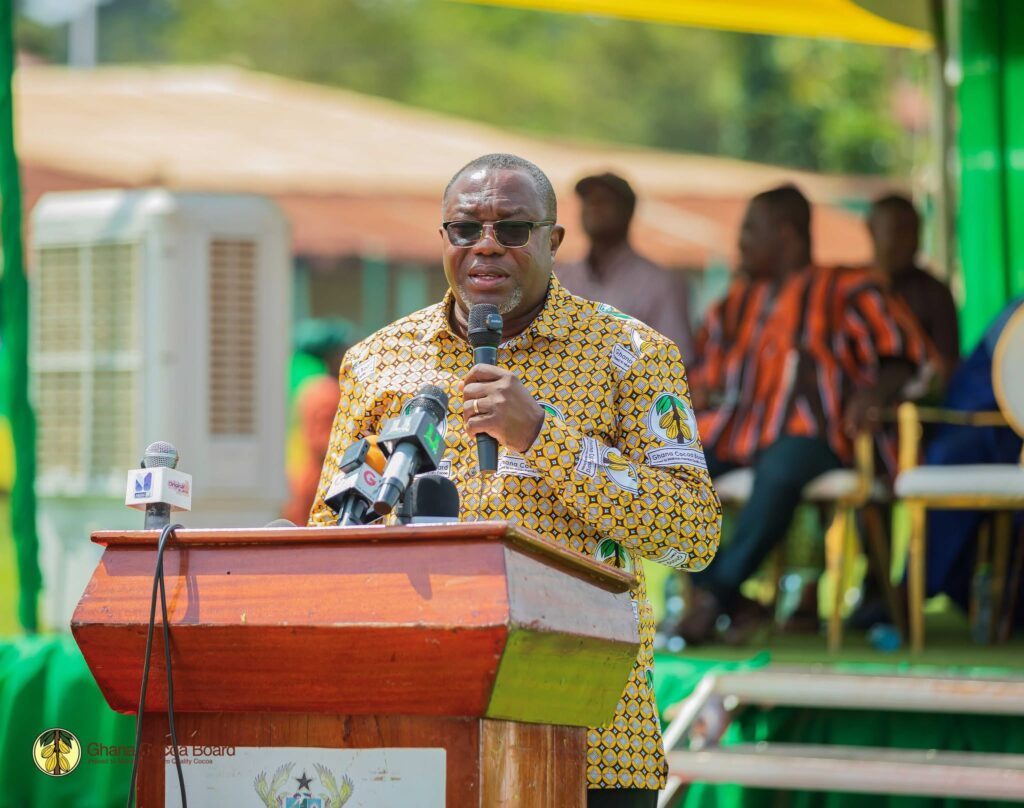
The initiative, launched by COCOBOD Board Chairman, Dr Samuel Ofosu-Ampofo, forms part of broader efforts to address declining productivity in the cocoa sector by reducing the financial burden associated with purchasing essential agricultural inputs.
Speaking at the relaunch, Dr. Ofosu-Ampofo urged farmers to apply the fertiliser appropriately, stressing that the effectiveness of the intervention would depend largely on its proper use and the adoption of recommended farming practices.
“We cannot expect increased national cocoa production without investing adequately in the farms and supporting the farmers who cultivate them.”
Board Chairman of Cocoa Board, Dr. Samuel Ofosu-Ampofo
Tackling Production Costs and Low Yields
The relaunch comes at a critical period for Ghana’s cocoa industry, which continues to face challenges involving declining production, ageing farms, deteriorating soil fertility, pest and disease outbreaks, labour shortages and changing climatic conditions.
According to COCOBOD, the programme represents a renewed commitment to making agricultural inputs more accessible to farmers and improving the conditions necessary for sustainable cocoa production.
The scale of the intervention is reflected in the quantities of inputs procured for nationwide distribution. More than 3.5 million bags of granular fertiliser have been purchased, with approximately 1.2 million bags already delivered to farmers.
The distribution package also includes 1.8 million litres of liquid fertiliser, 2.3 million litres of insecticides and 1.5 million kilogrammes of fungicides.
These inputs are intended to address different production constraints, including nutrient deficiencies and pest and disease pressures, which affect cocoa tree health and productivity.
COCOBOD Chief Executive Officer, Dr. Randy Abbey, has described the provision of free agricultural inputs as an investment in the future of the cocoa industry rather than simply a form of assistance to farmers.
“We are removing financial barriers to high yields. Free fertiliser is not a handout; it is an investment in farmers, in the soil, and in the foreign exchange earnings of this republic.”
CEO of Cocoa Board, Dr. Randy Abbey
The intervention is particularly significant given cocoa’s contribution to Ghana’s agricultural economy, rural employment and foreign exchange earnings. Improving productivity at farm level remains essential to strengthening the country’s capacity to supply international markets and maintain its position in the global cocoa industry.
Digital Tracking to Prevent Diversion
Beyond providing agricultural inputs, COCOBOD is introducing enhanced monitoring measures to address longstanding concerns about the diversion, illegal sale and unequal distribution of farm inputs.
“The days of diverting inputs meant for our farmers are over. Any officer, buyer, or individual found diverting, hoarding, reselling, or smuggling these inputs will be dealt with according to the law.”
CEO of Cocoa Board, Dr. Randy Abbey
Strengthening Farm Level Productivity
The fertiliser programme forms part of a wider package of agricultural support measures intended to improve cocoa farm management and increase production.

Alongside fertiliser and crop protection chemicals, COCOBOD has supplied approximately 27,000 new pneumatic and motorised spraying machines within the year, bringing the total number available to farmers to about 67,000.
An additional 5.7 million litres of pre-mixed fuel have also been supplied to support spraying operations and the application of liquid agricultural inputs.
These complementary interventions are intended to improve the efficiency of farm operations while helping farmers address productivity constraints that cannot be resolved through fertiliser distribution alone.
Agricultural research has consistently established that soil fertility management, effective pest and disease control, appropriate farm maintenance and access to quality planting materials are important determinants of cocoa productivity.
However, the benefits of fertiliser application depend on using the correct quantities, applying inputs at appropriate stages of crop development and following recommended agronomic practices.
For this reason, farmer education and agricultural extension services will remain important to ensuring that the inputs translate into measurable improvements in farm performance.
Dr. Ofosu-Ampofo stressed that increasing cocoa production would require sustained investment in farms and coordinated efforts to address the underlying challenges affecting farmers.
“Equally, we cannot achieve sustainable productivity if we do not address the underlying challenges of soil fertility, pest and disease management, access to improved planting material and effective extension services.”
Board Chair of Cocoa Board, Dr. Ofosu-Ampofo
The relaunch at Sefwi Wiawso consequently represents more than the resumption of free fertiliser distribution. It reflects a broader effort to restore productivity, strengthen input delivery systems and improve the economic conditions of cocoa-growing households.
READ ALSO:Asiama Reveals Bold Reforms Transforming Ghana’s Banking Sector