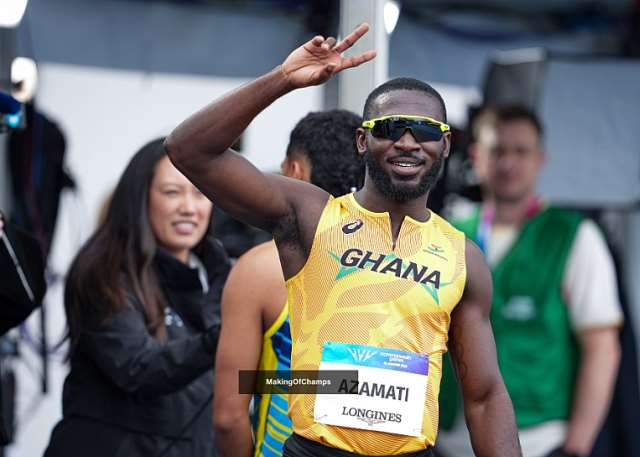
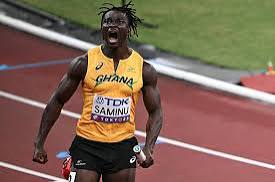
Benjamin Azamati and Abdul Rasheed Saminu could hardly have asked for a better start to their 2026 Commonwealth Games campaign after producing the two fastest times in the men’s 100m opening round, a performance that has elevated Ghana from hopeful participants to genuine medal contenders.
On a day that showcased both promise and disappointment for Team Ghana, Azamati stopped the clock at a seasonal best 10.00 seconds with a legal wind reading of +1.2m/s to finish as the fastest qualifier. Saminu followed closely with an equally impressive 10.01 seconds under a +1.9m/s wind, also matching his season’s best to secure second overall in the time ranking.
Although the qualifying round is primarily about progressing safely rather than chasing fast times, the Ghanaian pair achieved both.
Their performances were not merely enough to advance to the semi-finals but also served as an early statement to a field that includes some of the Commonwealth’s most accomplished sprinters.
England’s Eugene Jones and Australia’s Ethan Nketia shared third overall after clocking 10.07 seconds, with Lesotho’s Mosito Koneshe posting the same time. Wales’ Jerome Azu, Nigeria’s Favour Oghene Tejiri Ashe, Antigua and Barbuda’s Cejhae Greene and Jamaica’s Ryiem Watson also secured progression, but none matched the pace set by the Ghanaian duo.
The immediate reward for the Azamati and Saminu is a place in the semi-finals. The bigger significance, however, lies in what those performances reveal about Ghana’s preparations and its prospects of ending a long wait for a sprint medal at the Commonwealth Games.
More importantly, the Ghanaian sprinters achieved their times without appearing to exhaust themselves, a factor that could prove crucial as the competition intensifies through successive rounds.
Fastest Qualifiers, But Harder Tests Await
Producing the fastest qualifying times often creates momentum, but history has shown that championships are rarely won in the heats. The challenge now shifts from demonstrating speed to reproducing it under increasing pressure.
The men’s 100m is arguably the most unforgiving event in athletics. A poor reaction time, a slight technical error or a lapse in concentration can erase the advantage built through months of preparation.
While Azamati and Saminu have positioned themselves perfectly, the semi-finals and final will require flawless execution.
Their performances nevertheless underline an encouraging trend. Both athletes matched their season’s best times at exactly the moment it mattered, suggesting their training programmes have been designed to peak for the Commonwealth Games rather than earlier competitions.
That is often the hallmark of successful championship planning. Athletes who arrive in peak condition at major events are generally better placed to sustain their performances through multiple rounds than those who have already reached their highest level weeks earlier.
For Ghana, another encouraging aspect is the presence of two genuine contenders rather than reliance on a single athlete. Having both Azamati and Saminu among the fastest qualifiers increases the likelihood of at least one reaching the final, while also creating healthy internal competition that can drive performance.
A Day of Contrasting Fortunes
While the men’s sprint team celebrated an ideal start, the women’s 100m brought disappointment for Ghana.
Deborah Acheampong’s campaign ended in the heats after she finished third in Heat 8 with a time of 11.66 seconds, missing out on qualification for the semi-finals.
“The race didn’t go as planned,” she admitted afterwards, reflecting honestly on an outing that fell below expectations.
Although her exit reduces Ghana’s representation on the track, it also highlights the difference between emerging athletes gaining valuable championship experience and established competitors expected to challenge for medals.
Away from athletics, Ghana found success inside the boxing ring, where Precious Akai Nettey advanced to the quarter-finals of the men’s 70kg division after defeating Elijah Qiotaka.

The victory continues Ghana’s strong tradition in Commonwealth boxing and ensures the country remains competitive across multiple sports as the Games progress.
History Provides Context for Today’s Performances
Ghana has long enjoyed a distinguished history at the Commonwealth Games, particularly in boxing and athletics. From the country’s earliest appearances, boxing has consistently produced medals, while athletics has delivered some of Ghana’s most memorable performances on the international stage.
However, sprint medals at major global championships have become increasingly difficult to secure as the standard has risen dramatically across the Commonwealth. Nations such as England, Jamaica, Australia, Canada and South Africa regularly produce world-class sprinters, making every medal a fiercely contested achievement.
That is why Azamati’s and Saminu’s performances deserve careful attention rather than premature celebration.
Being the fastest qualifiers does not guarantee a place on the podium, but it demonstrates that Ghana possesses athletes capable of matching the best in the field. The emphasis now shifts to consistency. Championship medals are earned by delivering elite performances repeatedly within a short period, not by producing one outstanding race.
If both sprinters can maintain their composure, sharpen their starts and reproduce the form they displayed in the heats, Ghana has a realistic opportunity to place two athletes in the final for the first time in many years.
Should that happen, it would not simply represent individual success. It would signal the continued growth of Ghanaian sprinting and reinforce the country’s resurgence as a force capable of challenging for medals on one of the Commonwealth’s biggest sporting stages.
READ ALSO: Netanyahu Departs For Washington Despite ICC Arrest Warrant