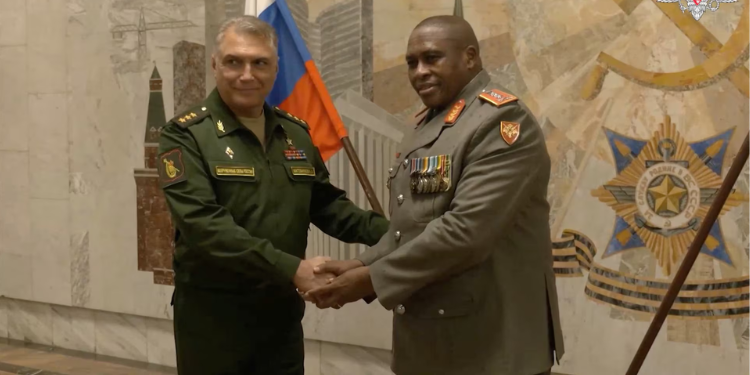
South Africa’s Chief of the Army, Lieutenant General Lawrence Mbatha, has held high-level talks with senior Russian military officials in Moscow, culminating in an agreement to strengthen cooperation between the two countries’ land forces as Pretoria continues to balance its longstanding ties with Russia alongside its declared neutral position on the war in Ukraine.
The meeting, held during Mbatha’s second official visit to Russia, underscores the enduring defence relationship between Pretoria and Moscow despite heightened geopolitical tensions surrounding Russia’s invasion of Ukraine.
According to Russia’s Ministry of Defence, discussions between the two sides focused on enhancing military collaboration through joint initiatives intended to improve operational capabilities and deepen institutional cooperation.
“The two sides discussed joint projects at the (Russian army’s) General Headquarters aimed at enhancing the combat readiness of both countries’ armies. Agreements were reached on further strengthening cooperation between the land forces in various areas.”
Russia’s Ministry of Defence
The announcement reflects continued engagement between the armed forces of both countries at a time when Russia is seeking to reinforce strategic partnerships with countries across Africa, Asia and Latin America while facing diplomatic isolation from many Western nations over the conflict in Ukraine.
Mbatha’s visit began with a ceremonial tribute at Moscow’s Tomb of the Unknown Soldier, where he paid his respects before proceeding to formal discussions with Colonel General Alexander Matovnikov, Russia’s deputy commander-in-chief of the land forces.
During the meeting, Matovnikov praised South Africa’s political and military leadership for maintaining a principled position on international affairs.
He thanked Pretoria for its “firm position” on Russia and a shared commitment to building a multipolar world order.
Although South African authorities have not publicly released detailed information about the agreements reached during the talks, the visit signals continued military engagement between two countries whose defence relationship dates back several decades.
Russia has historically maintained close ties with South Africa, particularly through its support for liberation movements during the struggle against apartheid. Since the advent of democracy, the relationship has evolved to include military exchanges, defence training, diplomatic engagement and cooperation within multilateral organisations.
South Africa on the other hand has consistently maintained that its foreign policy is guided by principles of dialogue, peaceful conflict resolution and strategic non-alignment.
The government has repeatedly resisted pressure from Western governments to condemn Russia outright over the war in Ukraine, arguing instead that negotiations remain the most effective path toward ending the conflict.
That position has attracted both criticism and support internationally, with some Western governments questioning South Africa’s neutrality while others acknowledge Pretoria’s efforts to maintain communication with all parties involved in the conflict.
BRICS Partnership Continues to Shape Pretoria’s Foreign and Defence Policy
The latest military engagement also highlights the broader strategic partnership between South Africa and Russia through the BRICS grouping, which includes Brazil, Russia, India, China and South Africa, alongside newer member states admitted in recent years.
The bloc has increasingly promoted closer economic, political and security cooperation among emerging economies while advocating reforms to global governance institutions that many members argue no longer reflect current geopolitical realities.
For South Africa, maintaining constructive relations with Russia forms part of a broader foreign policy strategy that seeks to strengthen partnerships across both the Global South and traditional Western allies.
Successive South African administrations have emphasised that engagement with Moscow should not be interpreted as hostility toward Europe or the United States but rather as part of an independent foreign policy aimed at preserving strategic autonomy.
Military cooperation between Pretoria and Moscow has periodically included exchanges of senior officers, professional military education, defence diplomacy and participation in joint activities.
One of the most notable examples occurred in 2023 when South Africa hosted multinational naval exercises involving Russia and China, a move that generated international debate amid the ongoing war in Ukraine.
Mbatha’s latest visit suggests both governments remain committed to sustaining those defence links despite continuing global tensions.
Russia has also sought to expand its military and security partnerships across Africa in recent years through defence agreements, training programmes and equipment cooperation with several countries on the continent.
For Moscow, strengthening relationships with African armed forces forms part of a broader effort to deepen political influence and diversify international partnerships beyond Europe.
South Africa, meanwhile, continues to stress that military diplomacy is a normal component of bilateral relations and that engagement with foreign armed forces does not alter its commitment to neutrality regarding international conflicts.
READ ALSO: Mancini Returns to Take Italy Coaching Job After Turbulent Search