

Professor Stephen Kwaku Asare, legal scholar and CDD-Ghana Democracy and Development Fellow, has proposed a system of concurrent voter and party registration as a potential replacement for Ghana’s delegate-based primary elections, following the Supreme Court’s declaration that such systems are unconstitutional.
Professor Asare outlined his proposal in written commentary addressing what should come next after the landmark ruling. He opened his remarks by acknowledging that while the Supreme Court has settled the constitutional question, the practical work of designing a replacement system now falls to policymakers and political parties.
“One possibility is a system of concurrent voter and party registration. When citizens register to vote, they could simultaneously indicate their political party affiliation”.
Professor Stephen Kwaku Asare, Legal Scholar and CDD-Ghana Democracy and Development Fellow
He explained that under this system, a citizen’s voter identification would then serve as their credential for participating in that party’s primary elections, eliminating the need for separate party membership registration processes.
He added that party affiliation could subsequently be updated during periodic voter registration exercises or within specific windows established ahead of primary elections.
Electoral Commission to Administer Primaries
Under Professor Asare’s proposed framework, the Electoral Commission would take on responsibility for scheduling and administering party primaries in consultation with the parties themselves, shifting the financial burden of conducting these elections from individual parties to the broader public electoral process.

Professor Asare argued that this approach would deliver several concrete benefits for Ghana’s internal party democracy, expanding participation while reducing the outsized influence smaller delegate blocs have historically wielded over candidate selection.
“Most importantly, it would return the choice of candidates to the ordinary party member rather than to a limited electoral college. It would also provide a uniform, transparent, and independently administered process that minimizes disputes over party registers and voting procedures”.
Professor Stephen Kwaku Asare, Legal Scholar and CDD-Ghana Democracy and Development Fellow
Weighing Alternative Models
Professor Asare acknowledged that other models exist, including one-member-one-vote primaries conducted using party-controlled membership registers, describing this as a potential improvement over the delegate system while flagging a significant limitation.
“If party executives retain broad discretion to admit, suspend, or recognize members, the risk is that the old electoral college simply reappears in a different guise. Instead of limiting the vote through delegates, it could be limited through control of the membership register. Internal democracy cannot depend on a membership list that can be manipulated from above”.
Professor Stephen Kwaku Asare, Legal Scholar and CDD-Ghana Democracy and Development Fellow
Professor Asare argued that his proposed system would strike an important balance, preserving each party’s freedom to shape its own ideology and policies while ensuring that participation within the party rests on objective, independently verifiable criteria.
A Constitutional Conversation, Not a Closed Debate
Professor Asare was careful to note that the Supreme Court’s ruling opens a broader policy discussion rather than settling every detail of what comes next, leaving considerable room for various stakeholders to shape the eventual outcome.
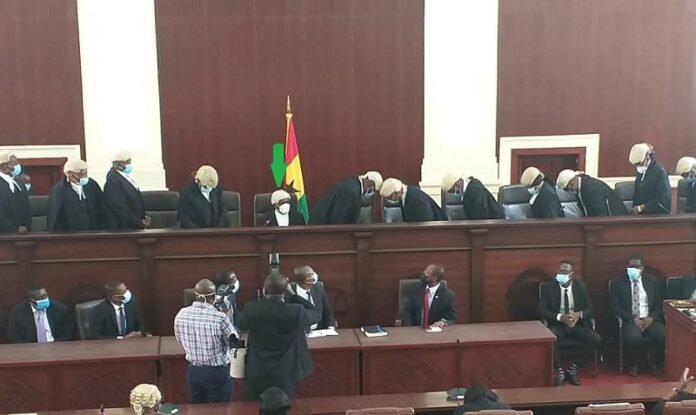
He described the ruling as a defining moment in Ghana’s constitutional development, one that compels a broader rethink of how parties fulfil their obligation to practise internal democracy.
Professor Asare closed his commentary on an optimistic note, framing the ruling as an opportunity to reconnect political parties with the citizens they are meant to represent.He extended recognition to the individuals behind the original legal challenge that led to the ruling, framing their action as necessary medical intervention for a flawed system.
“It is often said that the sick must seek medical attention. On that note, GOGO salutes Dr Frimpong-Boateng and Dr Nyaho Tamakloe for taking our ailing internal democracy to the Supreme Court. The diagnosis was made. The treatment has been prescribed. Now the healing begins”.
Professor Stephen Kwaku Asare, Legal Scholar and CDD-Ghana Democracy and Development Fellow
Pollster Raises Concerns Over Potential Misuse
Reacting to Asare’s proposal, Mussa Dankwa, Pollster and Executive Director for Global InfoAnalytics, expressed general support while raising a practical concern about how such a system might be perceived by ordinary citizens.
“One possibility is a system of concurrent voter and party registration. I support this but knowing our people, some may think it could be used against them by the politicians and they could be right. We are very vindictive.”
Mussa Dankwa, Pollster and Executive Director for Global InfoAnalytics
Responding directly to Mr Dankwa’s concern, Professor Asare acknowledged that initial resistance to the proposal was likely, but drew a comparison to how Ghanaians eventually embraced mobile money despite early scepticism.

Professor Asare’s proposal, alongside the exchange with Dankwa, reflects the early stages of a broader national conversation likely to unfold in the coming months as Parliament, the Electoral Commission, political parties and civil society organisations work to determine how Ghana’s political parties will select candidates going forward.
With the Supreme Court having settled the constitutional question, the practical details of implementation and how quickly various stakeholders can reach consensus will likely shape the credibility and durability of whatever system ultimately replaces the delegate structures the ruling has now outlawed.