The European Union has mobilised additional firefighting resources to Belgium and Spain as several countries across the continent continue to battle wildfires amid hot and dry conditions.
Through the EU Civil Protection Mechanism, two Swedish firefighting aircraft have been deployed to Belgium, while the Netherlands, Norway and Germany have each provided two helicopters to support efforts to contain a major wildfire in the eastern part of the country.
In Spain, 104 firefighters and 36 vehicles from France have joined local emergency crews battling multiple fires. The European Commission said it is also continuing to provide satellite mapping through its Copernicus emergency service to help authorities monitor and respond to the fires.
The latest deployments highlight the growing importance of cross-border cooperation as wildfires put pressure on national firefighting services across Europe. The European Commission said the assistance demonstrates the bloc’s civil protection system, under which member states can request additional resources when national capacities are under pressure.
One of Belgium’s largest wildfires in recent years has continued to burn in the High Fens area of Liège province, close to the German border.The fire, which spread into a pine forest over the weekend, has burned an estimated 30 square kilometres of woodland.
Firefighters have been supported by aircraft from Norway, Sweden, Germany and the Netherlands, while police have used drones to monitor the affected areas. Cooler temperatures and overnight rainfall have provided some relief to emergency crews, although authorities warned that parts of the fire remain difficult to access.
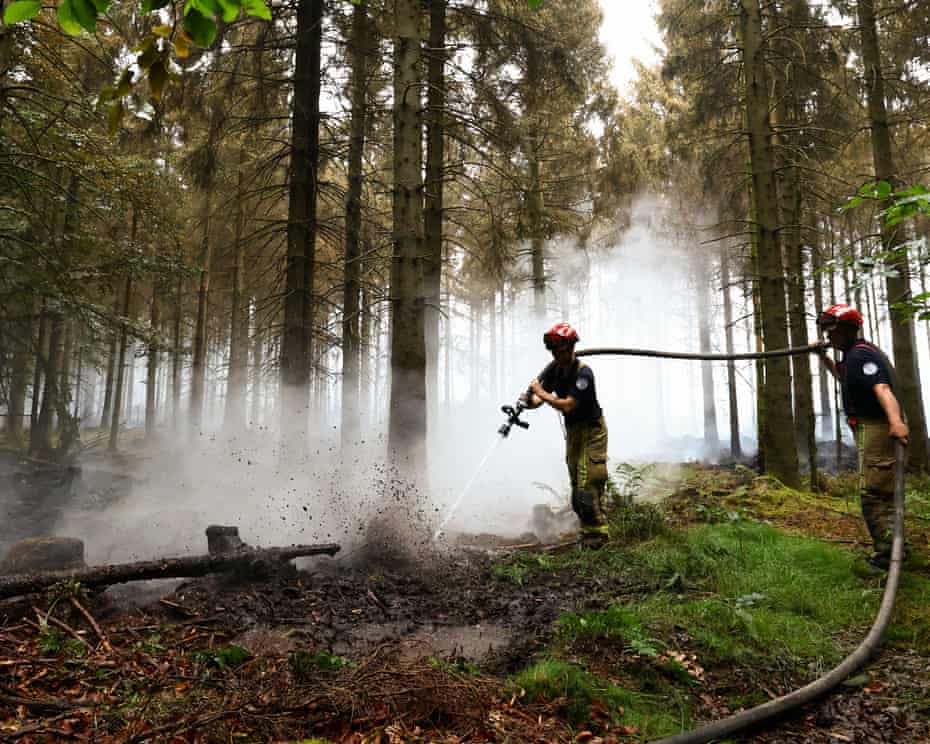
Nicolas Yernaux, spokesperson for Wallonia’s regional public services, said firefighters had managed to contain the blaze in areas where crews could operate but that a section of the forest remained inaccessible. “We managed to maintain the fire where the firemen are situated but there’s still a place which is totally inaccessible, where the fire is still going on in the direction of Monschau in Germany,” Yernaux said.
He added that the rainfall had helped dampen the risk of smouldering areas reigniting, although it had not significantly affected the centre of the fire. Evacuation orders remained in place as a precaution for hundreds of residents living near the affected area.
Belgian King Philippe also interrupted his summer holiday to visit the emergency coordination centre overseeing the firefighting operation.

The Head of Belgium’s firefighting service, Marc Gilbert, said the country needed additional resources to prepare for major fires, calling for urgent recruitment and closer integration of firefighting resources across the EU.
Fires Continue Across Southern Europe
The wildfire situation extends beyond Belgium and Spain, with Greece, France and Portugal also dealing with active or recently contained fires. In Greece, investigators examined areas of the island of Salamina following a fast-moving wildfire that killed two people, injured nine others and destroyed several homes on Sunday.
The fire department also deployed crews and aircraft to a separate blaze in Spata, east of Athens. Authorities said that fire was brought under control within about 30 minutes. Separately, an 80-year-old man was arrested in the northern town of Kavala on suspicion of deliberately starting a vegetation fire. Greek authorities said there had been 302 fire-related arrests since the beginning of the year, including 31 cases involving alleged deliberate arson and 271 linked to negligence.
In southwestern France, authorities said a wildfire in the Landes region had been brought under control after four days of firefighting. Around half of the more than 600 residents evacuated during the blaze were allowed to return to their homes. The fire had burned approximately 17 square kilometres during a period of extreme heat, although falling temperatures were expected to provide more favourable conditions for firefighters.
Portugal is also dealing with several wildfires, with hundreds of firefighters deployed across affected areas. Near Dine, a village close to the Spanish border, five firefighters were reportedly injured after their vehicle caught fire while responding to a blaze. Other fires were reported near Boticas and Chaves.
The latest fires come after a series of outbreaks across Europe in recent weeks, with authorities warning that hot temperatures, dry vegetation and limited rainfall can increase the risk of rapid fire spread. In Croatia, a wildfire at a coastal holiday resort on Friday killed one person, injured about 40 others and forced approximately 1,200 people to evacuate. helicopters when national resources are insufficient.
The European Commission has also warned of areas experiencing “very extreme” wildfire conditions, reflecting the continued risk posed by dry landscapes and high temperatures.
Scientists have linked the increasing frequency and intensity of extreme heat and other weather events to human-caused climate change. Warmer conditions can dry vegetation and soils, creating circumstances in which fires can start more easily and spread more rapidly.
For European authorities, the immediate priority remains containing active fires, protecting communities and supporting evacuated residents.
READ ALSO: 91-Day T-Bill Becomes Investors’ Top Choice as Yields Fall