
TVET Service representative, Franklin Kobina Eshun, has called for stronger awareness creation around Technical and Vocational Education and Training (TVET) at the basic education level, arguing that limited exposure to technical career pathways during early schooling continues to shape narrow career aspirations among Ghanaian children.
Mr Eshun explained that a great deal of responsibility rests with the TVET Service and the Commission to intensify awareness creation efforts, while also stressing that career guidance and counselling structures at the basic level require significant strengthening to properly introduce children to the full range of career options available to them.
According to Mr Eshun, children growing up through the basic education system are typically exposed to a narrow set of career paths, primarily oriented toward professions outside the technical and vocational space.
He argued that this early conditioning shapes how children come to view their future options, often without adequate awareness of the breadth of opportunities that exist within TVET.
“Our career guidance and counselling officers at the basic level will have to do some more work for us, even though TVET service and the commission would also have to do some work for ourselves in awareness creation.”
Mr. Franklin Kobina Eshun
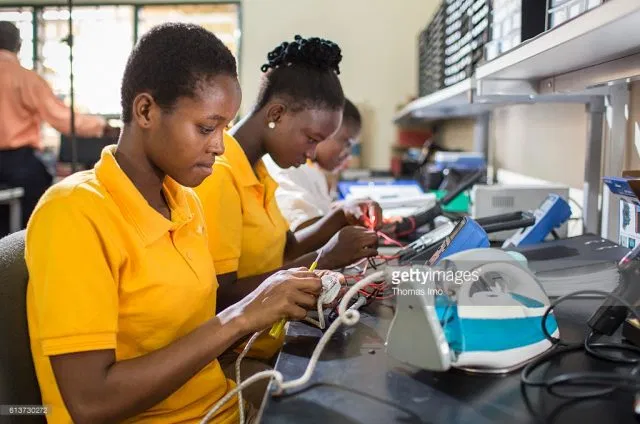
He maintained that addressing this gap requires deliberate intervention starting from the earliest stages of schooling, rather than waiting until students reach the secondary level, by which point career perceptions have often already solidified around a limited set of familiar professions.
Curriculum Content Exists, But Implementation Falls Short
Responding to the concerns raised, a contributor to the discussion explained that subjects related to technical and vocational skills are, in fact, already embedded within the current basic education curriculum, beginning as early as the primary level through creative arts and extending into pre-technical skills components introduced at the junior high school level.
He explained that the curriculum itself contains well-documented content covering various technical and vocational competencies, describing the theoretical framework as comprehensive and well-structured.
However, he was candid in acknowledging that the practical implementation of this curriculum content remains significantly constrained by the availability of resources needed to deliver hands-on, experiential learning to students.
“The new curriculum is very beautiful. Trust me, things are in there. But the challenge is the resources. So the teacher is handicapped.”
Mr. Franklin Kobina Eshun
He explained that without adequate resources, teachers are often left to deliver technical subject content purely through theory, undermining the practical, skills-based learning experience that TVET education is fundamentally designed to provide.
Beyond resource limitations, the discussion also touched on how students are assessed within the current system, with concerns raised that existing examination approaches do not sufficiently promote practical competence at the basic education level.

This combination of limited resources and assessment methods weighted toward theoretical knowledge was identified as a significant factor undermining the effective delivery of technical and vocational education content already present within the curriculum.
Call For Stronger Policy-Level Commitment
The discussion further emphasised that meaningful change in how TVET is delivered and perceived at the basic level cannot rest solely with classroom teachers, who have limited capacity to address systemic resource gaps on their own. Instead, participants stressed that policymakers hold primary responsibility for ensuring that the necessary investments and structural reforms are made to translate curriculum content into practical, resourced learning experiences for students.
In response to these concerns, it was acknowledged that discussions are already underway between relevant institutions, including collaboration between TVET and the Ghana Education Service, both of which operate under the same ministry, to intensify career guidance and counselling efforts at the basic level.
It was further noted that public perception of TVET has gradually shifted in recent years compared to previous decades, when technical and vocational education carried a considerably more negative public image.
While progress has been made, it was maintained that significant work remains to fully normalise TVET as a viable and respected educational pathway from the earliest stages of schooling.
Call For Structured Career Guidance Resources
A further recommendation raised during the discussion centred on the need for TVET authorities to develop structured guidance documentation outlining the range of subjects, opportunities, and pathways available within the TVET space, similar to resources already available for students pursuing more traditional academic tracks.

Such documentation, it was argued, would better equip both teachers and students to make informed decisions about subject selection and career direction from an earlier stage.
The overall discussion reinforced a broader consensus that while curriculum reforms have laid meaningful groundwork for strengthening technical and vocational education in Ghana, translating that framework into practical, resourced, and widely understood educational pathways remains an ongoing and unfinished undertaking requiring sustained investment and coordinated policy attention.
READ MORE: Health Minister Clarifies Separation of Board and Management Roles in Healthcare