The Minority Caucus of Parliament has cautioned that technical accounting mechanisms cannot be weaponized to evade public accountability following massive financial losses linked to the domestic gold purchase operations.
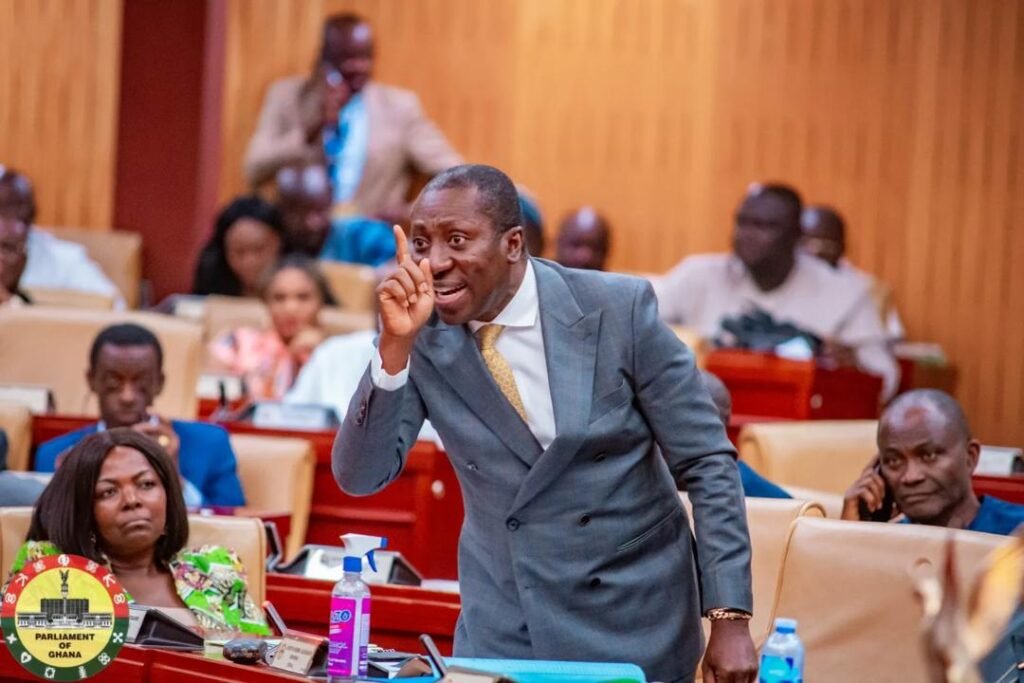
Addressing a press briefing in Accra by the minority leader, Hon. Alexander Afenyo-Markin, the caucus stated that the accounting location of a loss does not change its economic reality, emphasizing that regardless of which internal ledger records the deficit, the Ghanaian taxpayer ultimately carries the financial burden.
The Parliamentary Minority argued that attempting to insulate the Ghana Gold Board (GoldBod) from scrutiny simply because losses were absorbed on the Bank of Ghana’s balance sheet undermines transparent governance and risk management over state-managed natural resource trade.
“If Gold Board was legally an agent of Bank of Ghana, there may be a technical accounting basis for recognizing the underlying trade losses at the Bank of Ghana rather than recording them as Gold Board’s own corporate losses. But Bank of Ghana is not interested only in which ledger the loss entered. We must ask who designed the arrangement, who approved it, who executed it, who controlled the risk, and why safeguards failed to prevent losses of this magnitude.”
Hon. Alexander Afenyo-Markin,

The caucus explained that if GoldBod operated as a legal agent for the central bank, a technical accounting basis might exist for placing trade losses on the Bank of Ghana’s books rather than recording them as corporate losses for GoldBod.
However, they insisted that isolating the ledger location fails to resolve the structural flaw where one state institution manages commercial purchasing, aggregating, assaying, and exporting, while another supplies capital and absorbs the downside risk.
They noted that this framework creates a dangerous misalignment of incentives, allowing the operational entity to collect transaction fees and enjoy upside volume without carrying an equivalent share of financial failure.
Structural Misalignment and Governance Failures
The opposition lawmakers pointed out that when state-backed commercial programs lack clear risk boundaries, public funds are exposed to severe market vulnerabilities.
They asserted that the separation of operational management from direct financial risk removes crucial incentives for prudent decision-making.

According to the caucus, an arrangement where GoldBod earns transaction-based fees while the central bank provides the underlying capital creates a classic agency problem.
They further stressed that “incentives can become dangerously misaligned” when operational decisions are insulated from downside performance.
The caucus stated that robust governance demands answering who designed, approved, and executed the trade pipeline, rather than relying on legal shields. Parliament, they insisted, is fully entitled to determine whether the risk allocation itself was prudent from the outset.
IMF Confirmation and Fiscal Realities
Highlighting the scale of the financial impact, the Minority referenced official evaluations from the International Monetary Fund (IMF) detailing the true cost of the program.
Despite assertions that GoldBod made no corporate loss, the IMF’s full-year assessment confirmed that the domestic gold purchases program generated an equivalent of 22 billion Ghanaian cedis in overall losses.
The caucus noted that these massive drawdowns arose directly from trading activities, operational fees, assay charges, and sharp exchange rate movements.
The caucus maintained that these disclosures validate their long-standing calls for greater transparency and oversight.
They emphasized that “the 22 billion outcome raises serious questions about whether those protections were adequate” to safeguard public assets.
By ignoring the broader financial erosion, regulatory authorities risk compromising the integrity of state-led gold monetization schemes.
Economic Impact and Taxpayer Strain
The realization of a GHC22 billion financial loss carries profound macroeconomic consequences for Ghana’s developing economy.
A deficit of this magnitude directly worsens the central bank’s balance sheet, diminishing its net equity and restricting its operational capacity to execute effective monetary policy.
When central bank reserves are eroded by trading differentials and unhedged exchange rate exposure, the institution’s ability to defend the national currency or buffer against external price shocks becomes significantly constrained.
Ultimately, these unrecovered losses shift back to the domestic fiscal framework, compounding national debt liabilities and squeezing funding for critical socio-economic infrastructure.
In an environment where the Ghanaian taxpayer is already navigating tight fiscal consolidation, absorbing GHC22 billion deficits from misaligned commodity trading risks worsening inflation, elevating sovereign risk perceptions, and weakening investor confidence across the extractive sector.
READ ALSO: PwC Names Ghana’s Six Most Powerful Banks