
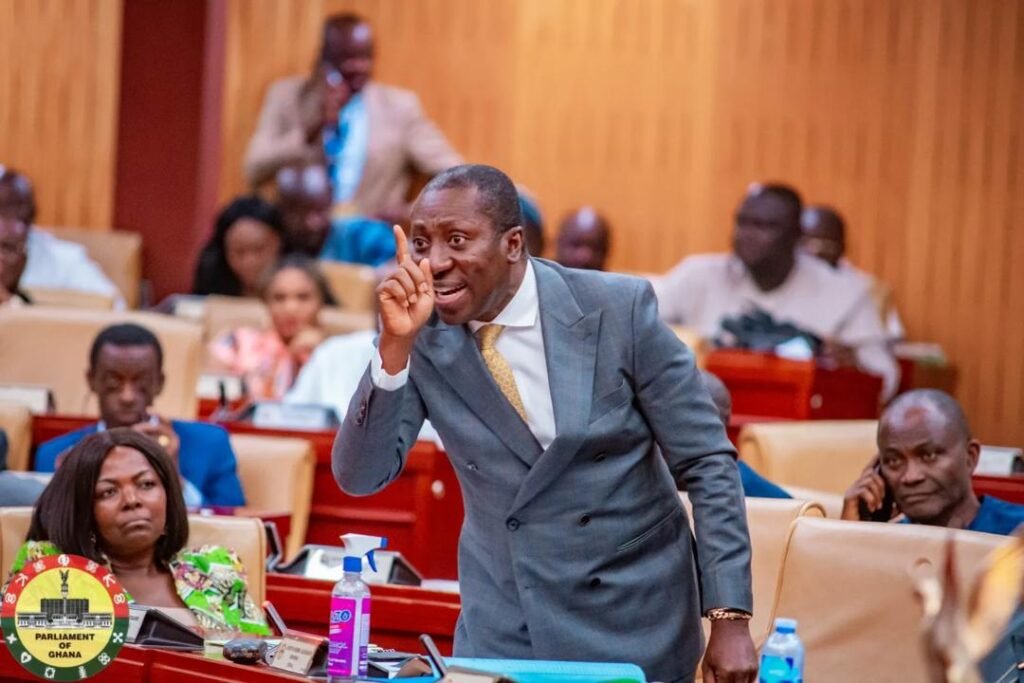
The Minority Caucus in Parliament led by Hon. Alexander Afenyo-Markin has raised red flags over the institutional architecture governing Ghana’s gold trading framework, alleging that a structural mismatch between regulatory authority and financial risk has generated a severe moral hazard.
According to the caucus in a press briefing in Accra, the Ghana Gold Board (Goldbod) operates under an arrangement where it captures fee-based revenue from buying, assaying, and aggregating precious metals, while offloading the underlying commercial and transaction losses directly onto the Bank of Ghana (BoG).
This flawed operational model, the opposition lawmakers argue, incentivizes volume expansion over fiscal discipline, creating a scenario where high transaction turnover enriches the intermediary agency even as the overall program erodes state capital.
“If an institution earns transaction-based income for purchasing, assaying, and aggregating gold, while the financier bears the underlying trading losses, then increasing transaction volumes may increase the agent’s revenue even where the overall program destroys value for the principal. Any responsible government, confronted with this 22 billion loss, should immediately investigate whether the incentive structure encouraged excessive volumes, inadequate pricing discipline, or insufficient attention to trading costs. We, therefore, reject any attempt to answer the public concerns merely by pointing to Gold Coast’s reported surplus.”
Hon. Alexander Afenyo-Markin

Expanding on these concerns, parliamentarians emphasized that Goldbod’s own mandate confirms its central command over weighing, grading, valuation, pricing, and export procedures within the domestic extractive corridor.
By enjoying full statutory authority over operations without carrying the accompanying commercial exposure, the agency operates in a risk-free environment that insulates its balance sheet from market volatility.
The opposition further maintains that relying solely on Auditor General reports showing a reported surplus for Goldbod presents a skewed financial picture. They contend that because critical transaction costs and forex losses were absorbed by the central bank rather than factored into Goldbod’s cost accounting, the perceived profitability of the board remains a illusion that masks deep-seated structural vulnerabilities.
Operational Inefficiencies and Disconnect in Public Sector Governance
The broader critique leveled by the parliamentary opposition focuses on the complete breakdown of commercial accountability across the state-backed gold acquisition chain.
When an entity possesses total operational discretion over discounts, international offtaker selection, and price determination but shifts all transactional liabilities to a central financier, classic principal-agent distortions emerge.
Industry analysts note that this setup removes essential checks and balances, allowing inefficiencies in grading and pricing to linger unaddressed because the managing board faces no financial penalty for operational mistakes.
Furthermore, governance experts point out that insulated revenue models routinely undermine cost containment efforts within public mineral trading enterprises. When fee margins are guaranteed regardless of final sale realized values, there is little motivation to implement rigorous internal risk management or enforce tight pricing spreads.
The resulting disconnect leaves state balance sheets highly susceptible to external market shocks while shielding the operational intermediary from standard corporate accountability.
Fiscal Burden and Broader Economic Vulnerabilities
The real-world consequences of this asymmetric trading framework extended far beyond state accounting ledgers, hitting macro-economic stability hard.
As the central bank absorbed an estimated 22 billion Ghana Cedi loss connected to the domestic gold purchase scheme, its net equity position faced severe strain, complicating broader monetary policy implementation.

This huge fiscal absorption diluted public resources, fueled debt accumulation, and added downward pressure on national currency dynamics by exacerbating foreign exchange mismatches across the broader economy.
In the resource sector, unaligned purchasing incentives distort the local gold ecosystem, pushing prices away from realistic market fundamentals and risking unintended support for unmonitored mining networks.
By decoupling operational profit from actual downside risk, the program created systemic vulnerabilities that destabilized local extractive value chains. The accumulating financial drag eventually restricted sovereign policy space, proving that unchecked moral hazard in resource management poses direct risks to national economic resilience.