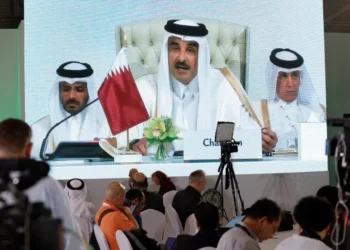
Qatar has said that mediators seeking to revive negotiations between the United States and Iran are waiting for Tehran and Oman to finalise an agreement on transit through the Strait of Hormuz before pushing the two sides back to the negotiating table.
Qatar’s Foreign Ministry Spokesperson, Majed al-Ansari, said that countries involved in mediation efforts were closely watching discussions between Iran and Oman over arrangements for shipping through the strategically important waterway.
The development comes as tensions surrounding the Strait of Hormuz remain high and diplomatic efforts to end the conflict between Washington and Tehran face significant uncertainty. Oman has been negotiating with Iran over the reopening and management of transit through the Strait of Hormuz, a critical route for global energy supplies.
Iran has repeatedly said that it is unwilling to engage in direct negotiations with the United States, leaving Oman and other regional actors to help establish conditions for possible future talks. Iranian officials said on Monday that discussions with Oman were approaching an agreement.
The timing is significant because a 60-day Memorandum of Understanding between Washington and Tehran expired on Monday. The agreement had established a period for negotiations toward a wider settlement, although its implementation was disrupted by renewed military action. The expiration of the memorandum has further complicated efforts to establish a new framework for talks.
The diplomatic uncertainty has been accompanied by increasingly sharp rhetoric from US President Donald Trump, who has threatened Oman over its role in the negotiations. Oman has maintained a neutral position throughout the conflict and has traditionally played a mediating role in disputes involving Iran and the United States. The country is also a US ally and has not historically engaged in direct conflict with Washington. Trump’s latest remarks have nevertheless raised concerns because of Oman’s involvement in discussions over the Strait of Hormuz.
Trump Depicts Strait Of Hormuz As “New US Territory”
The US President shared an image on social media depicting the Strait and surrounding territory with the caption, “New US Territory.” The post appeared to repeat an earlier threat in which Trump suggested that the waterway could become US territory following what he described as an Iranian surrender. The remarks prompted a sharp response from Iran’s Deputy Foreign Minister for legal and international affairs, Kazem Gharibabadi. “Soon, Trump’s delusion regarding the Strait of Hormuz will either be corrected, or we will correct the delusions of this delusional man,” Gharibabadi wrote.
Iranian officials have consistently rejected US claims that Washington controls the waterway. Major-General Mostafa Izadi, Deputy Commander of Iran’s Islamic Revolutionary Guard Corps, said that the Strait of Hormuz remained under Iranian control. “The enemy does not know what to do and is in a state of helplessness,” Izadi said.
Trump later appeared to distance himself from his own earlier claims that Washington was communicating with Iranian officials. In a subsequent Truth Social post, the US President said that there were “no conversations taking place, or scheduled,” with Iran.
He also said that the US naval blockade remained in “full force and effect” while claiming that the Strait of Hormuz was “open and operating.” Trump further said that mines in the waterway had either been removed or detonated. The comments marked a shift from his statement a day earlier that Washington was engaged in back-channel discussions with Iran’s Islamic Revolutionary Guard Corps.
Iran has rejected that claim, with Iranian officials maintaining that no negotiations are taking place with US representatives. The conflicting statements have added to uncertainty surrounding the prospects for diplomacy at a time when regional governments are attempting to prevent further escalation.
The Strait of Hormuz has become one of the central issues in the dispute between Washington and Tehran because of its importance to international shipping and energy markets. Any prolonged disruption to the waterway could affect oil and gas shipments and increase pressure on global energy prices. Iran has linked the reopening of the strait to broader conditions, including the lifting of US military pressure and the removal of restrictions affecting Iranian ports.
For Qatar and other mediators, an agreement between Oman and Iran could provide a potential starting point for renewed diplomatic efforts between Washington and Tehran. However, the sharp differences between the two governments remain a major obstacle. Tehran continues to reject direct talks with Washington, while Trump has maintained that economic and military pressure must be used to force Iran to change its position.
The expiration of the 60-day memorandum has further narrowed the existing diplomatic framework, although regional mediators continue to explore ways of bringing the two sides back into negotiations.
READ ALSO: Assad Cousin Sentenced To Death In Syria