
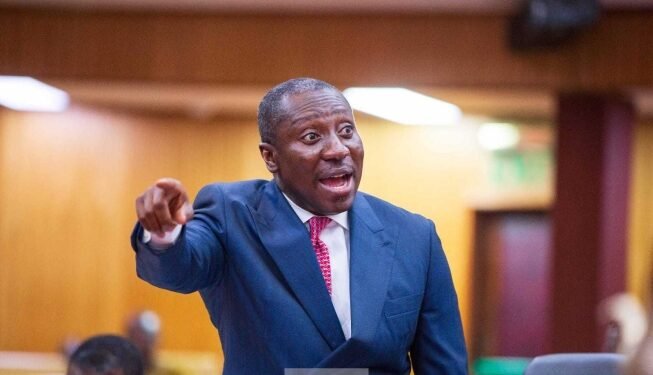
Minority Leader Alexander Kwamena Afenyo-Markin has warned that officials of the Ghana Gold Board could face what he described as ‘scary bail conditions‘ in future if the standards now applied to former government appointees hold.
The Effutu Member of Parliament issued the warning at a press conference in Accra on Tuesday, 18 August 2026.. Hon. Afenyo-Markin drew a direct comparison between the conditions attached to bail for former officials under investigation and the treatment GoldBod executives might expect should political power change hands.
He tied the warning to what he claimed were losses of some GH¢22 billion at the Board, and argued that the precedent the current administration is setting will be difficult to defend when it applies to its own people.
A warning aimed at the present, not the past
The Minority Leader’s argument turned on reciprocity. Standards applied to officials of one administration, he said, do not disappear when the administration changes, and those imposing them today should consider how they will operate tomorrow.

He suggested that GoldBod executives in particular should weigh that prospect, given the sums he attributes to the Board’s operations. The comparison shifts the Minority’s argument onto new ground.
Until now, the caucus has framed its objection to bail conditions as a matter of fairness to those currently charged. Hon. Afenyo-Markin’s warning converts it into a prediction about officials who have not been charged with anything.
The GH¢22 billion claim
The figure the Minority Leader attached to GoldBod is the sharpest element of the warning, and it is his own characterisation rather than a finding by any investigative body.
No prosecuting authority has published a loss figure for the Board, and no GoldBod official faces charges. The claim therefore rests on the Minority’s assessment of the Board’s trading operations rather than on any official audit made public.
GoldBod has operated as the state’s sole buyer and exporter of artisanal gold since its establishment, and its purchasing programme has drawn scrutiny over the gap between cedi advances to buyers and dollar proceeds from exports.

Analysts examining that mismatch have described it as a deliberate policy choice aimed at curbing smuggling and capturing foreign exchange rather than as a loss in the accounting sense.
The bail conditions at the centre of the dispute
The Minority has objected for months to conditions attached to bail for people connected to the previous administration, describing them as excessive and as evidence of political persecution.
Hon. Afenyo-Markin restated that position, arguing that the government’s approach to investigations and bail should be measured against established legal principles rather than political considerations.
Bail conditions in Ghana are set by the courts rather than by the executive, which complicates the Minority’s framing. A prosecutor may propose terms, but the sums and sureties that have drawn criticism were imposed by judges exercising discretion.
The government has defended its programme of investigations as accountability work aimed at recovering state resources lost under the previous administration.
The Minority has not disputed the principle of investigation. Its objection concerns method, and specifically whether the conditions imposed on accused persons before any trial amount to punishment in advance of a verdict.
Hon. Afenyo-Markin’s intervention adds a third element to that exchange. He is not arguing only that current practice is wrong, but that it will be turned on those who established it.
A warning with a political timeline
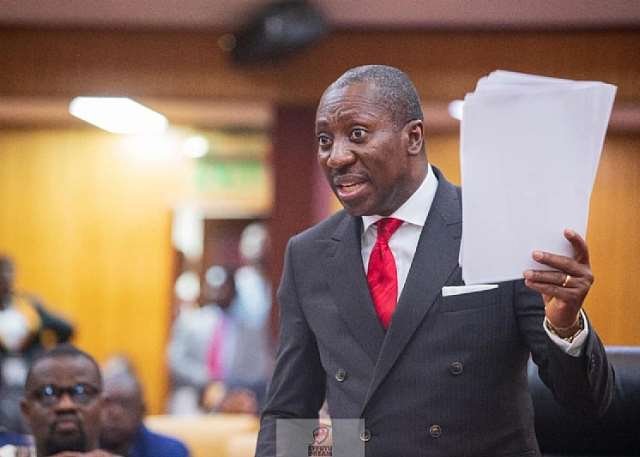
The threat carries an implicit date. The Minority Leader’s scenario assumes a change of government, which cannot occur before the 2028 general election, and assumes that his party would then pursue officials of the current administration with the same instruments.
That framing invites an obvious question about whether the Minority objects to the standards themselves or reserves the right to apply them later. Hon. Afenyo-Markin did not address it, and his argument that current practice offends established legal principles sits uneasily beside a warning that it will be repeated.
No investigative body has announced an inquiry into the Board’s leadership, and its executives face no proceedings. The Minority Leader’s remarks place them in a political frame rather than a legal one.
For a state entity whose purchasing programme already draws technical scrutiny from the International Monetary Fund and domestic analysts, a warning about future prosecutions adds pressure of a different kind.
It also puts a number into public circulation that GoldBod will now be asked to answer. While the Board had responded to previous allegations by the Minority Leader, it had yet to respond to this latest claim at the time of filing.
READ ALSO: Flick Sets High Bar, Says Barcelona are Prepared To Challenge on All Fronts