The Management of the Ghana Education Service (GES) has firmly dismissed a publication circulating on social media alleging that the Director-General had cancelled the Free Senior High School (Free SHS) policy and directed parents to pay a compulsory GH¢1,500 for chop boxes and trunks, describing the claims as entirely false.
Addressing the matter, GES Management stated categorically that the publication in circulation is false and should be disregarded by the public, moving swiftly to clarify the record following concerns that the misleading information could cause unnecessary alarm among parents and guardians.
Management was unequivocal in stating that it has not cancelled the Free SHS policy, nor has the Director-General issued any directive requiring parents or guardians to pay any money for chop boxes, trunks, or any other item, directly refuting the core claim contained in the circulating publication.
GES further clarified that, beyond the falsehood of the specific claim, the Director-General does not even possess the authority to unilaterally cancel a national education policy such as Free SHS, underscoring the structural impossibility of the allegation as presented in the viral publication.
Public Urged Not to Make Any Payments
Considering the false claims, GES urged parents, guardians, students, and the general public not to make any payments to anyone in connection with the circulating publication, warning that doing so could expose them to financial loss based on entirely fabricated information.
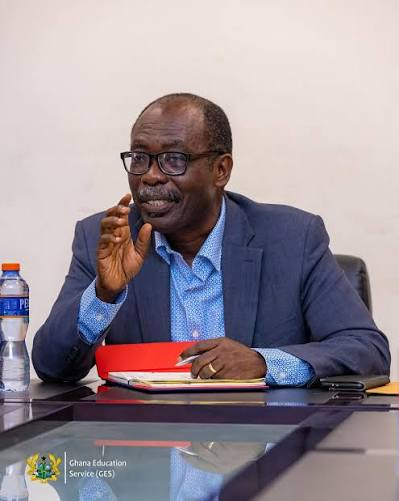
“The Free SHS policy remains fully in force, and neither the Director-General nor the Ghana Education Service has directed parents to pay GH¢1,500 for chop boxes, trunks, or any other item. We urge the public to disregard this false publication and rely only on official GES communications for accurate information.”
GES
The Service’s direct appeal reflects concern that, left unaddressed, the misinformation could lead unsuspecting parents to make unnecessary payments under the mistaken belief that they were complying with a genuine directive from the Service’s leadership.
Public Advised Relying on Official Channels
GES advised the public to rely only on official communications issued through the Service’s authorised channels, and to treat unverified publications circulating on social media with appropriate caution, particularly where such publications touch on sensitive matters like school fees or changes to established government policy.
This guidance reinforces a broader pattern seen across public institutions in Ghana, where officials increasingly find themselves needing to directly counter misinformation spreading rapidly through social media platforms before it can cause tangible harm to the public.
The Service further urged members of the public and media organisations to desist from creating, publishing, or circulating false information capable of causing unnecessary anxiety and confusion among parents, students, and the general public.
This appeal appears directed not only at the original source of the false publication, but also at any subsequent platforms or individuals who may have contributed to its spread without verifying its accuracy.
Broader Pattern of Misinformation Around Education Policy
The circulating publication adds to a recurring pattern in which false or misleading claims about Ghana’s education policies have periodically surfaced on social media, often targeting sensitive issues such as school fees, admissions, or changes to flagship government programmes like Free SHS.
Given the programme’s significance to millions of Ghanaian families relying on free secondary education, such misinformation carries the potential to cause disproportionate anxiety among parents already navigating the demands of the new academic year.
With GES having now publicly and unambiguously refuted the claims, attention turns to whether the false publication will continue to circulate despite the Service’s clarification, and whether further action might be taken to trace its origin.
In the meantime, GES’s swift response signals the Service’s intent to protect public confidence in the Free SHS policy and prevent the spread of financially damaging misinformation, while reinforcing its call for the public to verify claims through official channels before acting on information encountered on social media.
READ MORE: Lack Of Resources Hindering Practical TVET Education – MR. Eshun