Eduwatch’s latest Education Alert Policy Brief has raised concerns over a substantial gap in Ghana’s education financing, warning that current spending levels remain well below what is required to meet key education-related Sustainable Development Goal (SDG) targets by 2030.
The Brief, Volume 39 in Eduwatch’s ongoing policy series, examines concerns raised in the International Monetary Fund’s (IMF) 2026 Article IV Consultation Report on Ghana, highlighting persistent leakages across the education pipeline even as the country has expanded access through its Free Senior High School and Technical and Vocational Education and Training (Free SHS/TVET) policy.
According to the report, the IMF’s 2026 Article IV Consultation comes at a crucial transition point, following Ghana’s completion of the sixth and final review of its US$3 billion Extended Credit Facility programme in July 2026, and the country’s transition to a new 36-month Policy Coordination Instrument.
Eduwatch noted that the IMF estimates Ghana would require education spending equivalent to about 5.8 percent of its Gross Domestic Product (GDP) by 2030 to meet education-related SDG benchmarks, while the country currently spends approximately 3.1 percent of GDP on education, pointing to a substantial gap between current expenditure levels and the resources required to meet national development ambitions.
According to the IMF, education and health constitute Ghana’s largest development spending needs, reflecting persistent gaps in service coverage and essential inputs.
Secondary Education Access Still Below Target
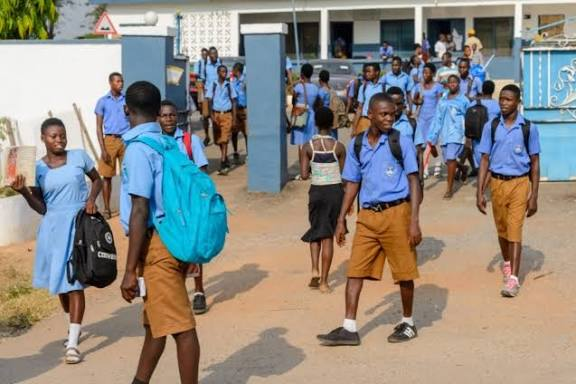
Beyond the financing gap, the Brief highlights concerns around secondary education enrolment, which remains below the relevant SDG benchmark despite significant improvements achieved through Free SHS/TVET.
It notes that Ghana’s Secondary Gross Enrolment Ratio stood at approximately 75.7 percent in 2024, substantially above the Sub-Saharan African average of about 46 percent, though slightly below the global average of roughly 77 percent.
Despite this comparatively strong regional performance, the report notes that Ghana remains approximately 24 percentage points below the 100 percent benchmark required for universal secondary education access by 2030, with only a few years remaining to close the gap.
Where Children Are Being Lost in the Pipeline
The Brief identifies several points at which children are lost within the education system before ever reaching secondary school. It notes that the first leakage occurs when children never enter or prematurely exit basic education, citing 2021 Population and Housing Census data showing that about 1.2 million children aged 4 to 17 were not attending school, while 9.5 percent of children within this age group had never attended school at all.
A second leakage occurs between primary school and Junior High School (JHS) completion, with recent UNESCO estimates placing Ghana’s JHS completion rate at approximately 79 percent in 2024, suggesting that about one in five children do not complete this level of education.
“JHS completers who do not transition into SHS/TVET: Ghana produces close to 600,000 Basic Education Certificate Examination candidates annually, yet not all ultimately transition into the public Free SHS/TVET system.”
Eduwatch
The Brief further cites Eduwatch estimates showing that public-sector transition efficiency declined from about 92 percent in 2024 to 82 percent in 2025, pointing to a growing challenge in effectively absorbing qualified candidates into the Free SHS/TVET system.
Among its key recommendations, the Brief calls for Ghana to establish a robust JHS-to-Secondary Transition Tracking System capable of accounting for the destination of every JHS completer, including those who enter private secondary schools, TVET institutions, apprenticeships, or other pathways, as well as those who drop out entirely.
“information gap limits the ability of policymakers to distinguish between learners continuing through alternative pathways and those who have effectively dropped out of education and training.”
Eduwatch
Recommendations For Strengthening the Education Pipeline
The Brief recommends progressively increasing education financing while simultaneously improving expenditure efficiency, equity, and accountability, arguing that additional resources must be accompanied by improvements that translate into measurable gains in access, completion, quality, and learning outcomes.
It also calls for strengthening basic education access, retention, and completion through sustained investment in foundational learning, equitably distributed teachers, school infrastructure, teaching and learning materials, and school feeding programmes.
Additionally, the Brief urges that education financing be made more equity-responsive, with resource allocation increasingly informed by deprivation levels, infrastructure deficits, and out-of-school incidence across districts.
Free SHS/TVET Not A Standalone Solution
The Brief concludes that Free SHS/TVET should be situated within a broader education access strategy rather than treated as a stand-alone solution to secondary education participation.
Stressing that achieving universal secondary education will depend on Ghana’s ability to get every child into basic school, retain them through JHS, and ensure effective transition into secondary or other recognised education pathways.
It maintains that the lesson from the IMF’s concerns is not that Free SHS has failed, but that the policy alone cannot address leakages occurring earlier in the education pipeline, underscoring the need for coordinated financing and implementation efforts across the entire education system rather than focused solely at the point of secondary school entry.
READ MORE: NaCCA Clarifies Its Role in Curriculum, and Textbook Approval