
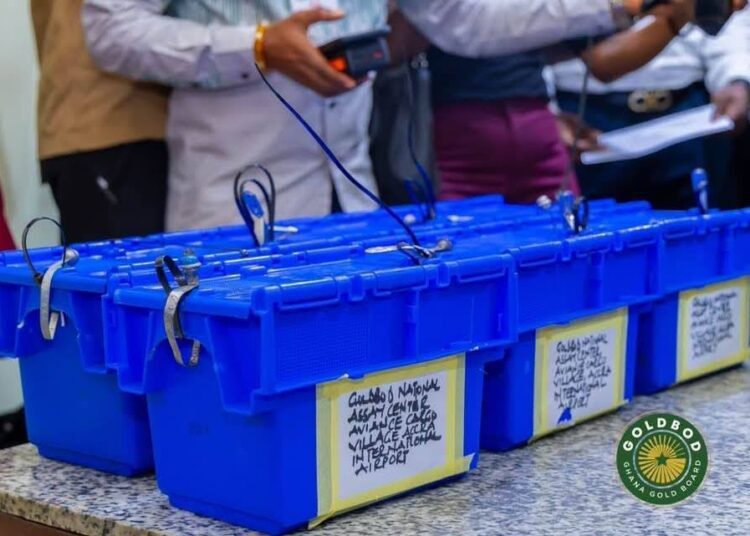
The Ghana Gold Board (GoldBod) has announced the mandatory adoption of X-Ray Fluorescence (XRF) assay as the standard method for determining gold purity in all gold purchases across Ghana.
The landmark directive takes effect from September 1, 2026, as part of a sweeping initiative aimed at improving accuracy, consistency, and transparency across the nation’s gold trading value chain.
“Under the Compliance Notice issued by the Board on Monday, August 17, 2026, XRF assay will become the standard basis for determining the purity of gold doré purchased by GoldBod and its licensed buyers. The directive effectively removes the water density method as the definitive basis for determining gold purity. Licensed buyers have consequently been strongly advised to acquire suitable XRF equipment, train personnel in its proper use and maintain appropriate records of XRF measurements for every purchase.”
Ghana Gold Board (GoldBod)
Under the statutory Compliance Notice issued by the Board, 2026, XRF assay will become the legally binding basis for determining the purity of gold doré purchased by GoldBod and its licensed buyers.

The regulatory shift officially eliminates the traditional water density method as the definitive standard for assessing precious metal purity throughout the country.
Consequently, licensed gold buyers have been strongly advised to acquire suitable XRF testing equipment, train operational personnel in its proper usage, and maintain detailed, systematic records of XRF measurements for every commercial transaction.
Operational Standards and Regulatory Enforcement
The transition framework outlined by the state regulator addresses practical challenges while maintaining a zero-tolerance stance on deliberate non-compliance.
GoldBod explicitly stated that where a buyer is unable to deploy XRF technology due to genuine operational or logistical constraints, the traditional water density method may be used strictly as an indicative measurement.

However, in such specific instances, the gold doré must be purchased at a minimum 0.5 percent purity discount. Following this initial acquisition, GoldBod will conduct a primary XRF assessment that will form the absolute basis for the final purity determination and monetary payment.
To ensure that standard purity testing is decentralised and executed at the point of origin, the Board has directed licensed Aggregators to acquire appropriate XRF machines and deploy them directly to their Tier 1 and Tier 2 buyers.
Furthermore, GoldBod has prescribed a strict permissible purity differential of plus or minus 0.05 percent between successive XRF reports for the exact same gold consignment or transaction.
Any variance exceeding this strict threshold must undergo exhaustive secondary verification and technical reconciliation before the deal is finalized.
Strict compliance will be enforced as part of the primary licensing conditions under the Ghana Gold Board Act, 2025 (Act 1140), with regulatory breaches risking administrative sanctions and license revocation.
The Imperative for Modernizing Ghana’s Gold Assaying
The mandatory transition from density-based testing to energy-dispersive X-Ray Fluorescence spectroscopy addresses a critical structural vulnerability within West Africa’s artisanal and small-scale gold mining (ASM) sector.
Historically, local gold trading relied heavily on specific gravity measurements—a century-old method that calculates density by weighing gold in air and then in water.

While rudimentary and inexpensive, the water density technique is highly susceptible to severe error and intentional manipulation.
Natural gold doré contains varying ratios of silver, copper, iron, and trace impurities, which significantly distort specific gravity readings.
Fraudulent operators have long exploited these technical limitations by introducing heavy metal alloys, tungsten cores, or unnatural silver proportions, leading to systemic mispricing, operational disputes, and significant financial revenue leakage for both local aggregators and state reserves.
Implementing mandatory XRF assaying provides a non-destructive, rapid, and mathematically precise elemental analysis of gold samples down to fractions of a percent within seconds.

By measuring the characteristic fluorescent X-rays emitted from a sample when excited by a primary X-ray source, aggregators receive an immediate, objective breakdown of exact karatage and alloy composition without altering the metal.
For an economy where small-scale mining generates billions of dollars in hard currency and stabilizes the local foreign exchange market, establishing an unquestionable assaying benchmark at source is vital.
The reform is expected to strengthen the overarching integrity of gold valuation at the point of purchase, shield smallholder sellers from arbitrary under-valuation, and guarantee absolute transparency across Ghana’s formal gold export pipeline.
Sanctions, Compliance, and National Economic Impact
By embedding XRF compliance directly into the legal operational frameworks of Act 1140, GoldBod is closing the gap between informal bush trading and institutional international refining standards.

Aggregators who fail to equip their supply networks risk complete exclusion from the formal market, as GoldBod tightens its regulatory grip on precious mineral exports.
In the long run, eliminating assay discrepancies at the buying counter safeguards public reserves, minimizes trade arbitration, and consolidates Ghana’s position as Africa’s premier, transparent gold hub.
READ ALSO: Minority Engaged In Propaganda To Distort Peace, Sagnarigu MP Declares