The United States and Canada have reached a last-minute agreement to delay steep tariffs on billions of dollars worth of Canadian goods, giving exporters a temporary reprieve and easing fears of a renewed trade war between the two closely linked economies.
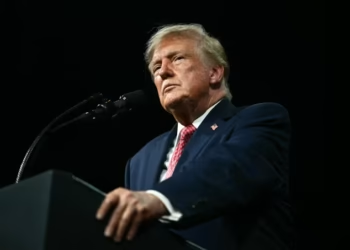
U.S. President Donald Trump announced the deal shortly before a proposed 50% tariff on Canadian imports was due to take effect at midnight. Canadian Prime Minister Mark Carney confirmed shortly afterwards that Washington had agreed to suspend the tariffs until August 22, giving negotiators additional time to finalise an agreement.
The agreement followed talks between Trump and Carney on Tuesday, as both governments attempted to resolve weeks of difficult trade negotiations. Trump said in a post on Truth Social that he had agreed to the pause after the two sides reached a deal “subject to finalization of documents.” Neither leader immediately provided detailed terms of the agreement.

Trump appeared to connect the latest development to his longstanding interest in reviving the Keystone XL pipeline, a major energy infrastructure project that was cancelled during the administration of former President Joe Biden. “The great Keystone XL Pipeline, long ago killed by Sleepy Joe Biden, may be awoken from the grave!” Trump wrote.
The proposed pipeline was designed to transport about 830,000 barrels of crude oil per day from Alberta, Canada, to Nebraska in the United States. Biden revoked a key permit for the U.S. portion of the project in 2021, citing environmental and economic concerns, effectively bringing the project to an end.
The tariffs would have affected approximately $20.2 billion worth of Canadian exports, covering a broad range of products including electronics, industrial machinery, furniture, dairy products and wine. The proposed duties were particularly significant because many of the affected products normally qualify for preferential or duty-free treatment under the United States-Mexico-Canada Agreement, or USMCA.
The agreement, negotiated during Trump’s first administration, has allowed most trade between the three countries to remain free of tariffs. The latest measures therefore represented a significant escalation in trade tensions between Washington and Ottawa.
Trump had announced the tariffs last month, citing what his administration described as Canada’s “discriminatory treatment” of U.S. automobiles, dairy products and alcoholic beverages. The proposed measures also relied on Section 338 of the Tariff Act of 1930, an authority that had not previously been used by a U.S. President in the manner outlined by Trump’s administration.
Canada Welcomes Temporary Reprieve

Carney welcomed the agreement but cautioned that negotiations were not yet complete. “While substantial progress has been made in the negotiations, there is important work still to be done,” he said.
He added that Canada would continue pursuing measures aimed at strengthening its domestic economy. “While we continue this work, Canada remains focused on building a stronger, more independent, and more competitive economy at home,” Carney said in a statement issued by his office.
The latest agreement follows weeks of intense negotiations, with Canadian officials travelling to Washington to seek exemptions and concessions from the Trump administration. Carney has previously described the discussions as “nasty”, “delicate” and “intense”, reflecting the difficulty of reaching agreement on issues ranging from agricultural policy to energy and market access.
The Canadian government has also faced domestic political challenges in negotiating with Washington. Any major trade agreement would need to take into account the interests of Canada’s provinces, which have considerable influence over areas affected by the dispute.
Eight of Canada’s 10 provinces have blocked sales of U.S.-made alcoholic beverages since early last year in retaliation for tariffs and other trade measures introduced by Trump. Washington has cited those restrictions as one of the reasons for its latest tariff threats.
Another major source of tension is Canada’s supply-management system, which regulates production and imports of dairy, eggs and poultry through quotas and other restrictions.
Trump’s administration has repeatedly criticised the system, arguing that it limits access for U.S. agricultural producers. Canadian provincial leaders have so far shown little willingness to make major concessions on the system, adding another complication to negotiations between the two governments.
For Canadian exporters, the suspension provides additional time to avoid the immediate disruption that a 50% tariff could have caused.Canada remains heavily dependent on the U.S. market, with approximately 70% of Canadian exports destined for the United States. The U.S. also sends a significant share of its exports north, with roughly 30% of American exports going to Canada.
READ ALSO: Ablakwa Secures Visa Waiver, Doubled Scholarships, and Defence Ratification in Russia