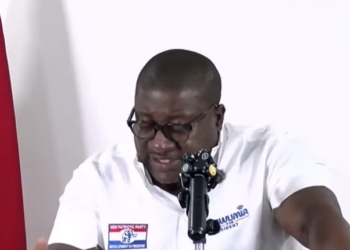
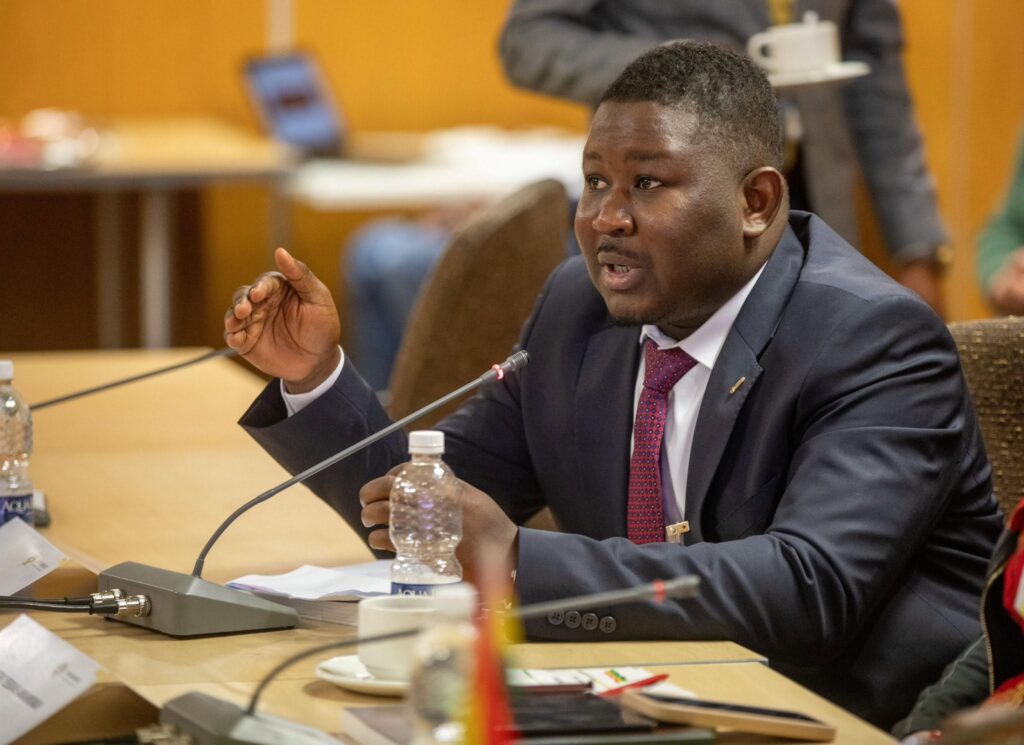
Member of Parliament for Sagnarigu, Honourable Attah Issah has rejected the Minority’s presentation, accusing the Caucus of using figures from different financial assessments to create a misleading impression about the programme.
“I listened to the minority press conference, and I am quick to say that they are just engaged in more propaganda that is seeking to destroy their own peace.”
Honourable Attah Issah

The Finance Ranking Member argued that the debate requires careful examination of the figures contained in the Bank of Ghana’s financial statements and assessments by international institutions. He urged the public to distinguish between accounting losses recorded in financial statements and broader economic costs calculated under different methodologies.
Addressing the Minority press conference held earlier in the day, Honourable Issah accused the Caucus of presenting the GoldBod figures in a manner that could confuse the public. According to him, the argument surrounding the Bank of Ghana’s negative equity fails to separate the financial position inherited from 2024 from developments recorded in 2025.
The Sagnarigu MP explained that the Bank of Ghana’s negative equity stood at GH¢61.8 billion in 2024 before rising to about GH¢91 billion in 2025. He therefore argued that attributing the entire negative equity position to the Gold Purchases Programme in one year produces an inaccurate account of the central bank’s financial position.
Referencing the International Monetary Fund report, the Finance Ranking Member pointed to differences between audited financial statements and the methodology used in the IMF’s economic assessment. He noted that the distinction was important in understanding figures associated with the Gold Purchases Programme.
Analysing the IMF assessment, Honourable Issah explained that the US$1.7 billion figure cited in discussions around the programme represented an analytical assessment of economic costs. He listed service and financing costs, discounts, trading outcomes and exchange rate differentials among the factors considered in the calculation.
The political argument therefore encompasses a single financial figure to the interpretation of economic policy. From his perspective, presenting the IMF estimate as though it was an audited commercial loss attributed directly to GoldBod oversimplifies the financial assessment.
He also argued that the 2025 Bank of Ghana loss figure should be understood within its accounting context. The Finance Ranking Member maintained that the reported loss involved accounting treatment and should be assessed alongside the economic outcomes associated with the programme.
Analysing the wider purpose of the Gold Purchases Programme and its place within the government’s economic strategy, Honourable Issah acknowledged that the programme carries costs while arguing that its impact should be measured against its contribution to foreign exchange reserves and currency stability.
Gold Purchases And Influence Towards Economic Stability
The Finance Ranking Member argued that the programme’s contribution to foreign exchange liquidity and the performance of the cedi should form part of the national discussion.
Discussing the programme’s history, Honourable Issah recalled that the Domestic Gold Purchases Programme existed under the previous administration with objectives linked to reserve accumulation and the Gold for Oil initiative. He pointed to figures from 2021 through 2024 to argue that the financial costs associated with gold purchasing were present before the establishment of the current GoldBod structure.
According to the Sagnarigu MP, records cited in the debate showed losses of GH¢74.44 million in 2021, GH¢1.37 billion in 2023 and GH¢5.67 billion in 2024 under the Domestic Gold Purchases Programme. Referencing the IMF assessment, he noted that the Fund also calculated substantial programme losses for 2024.
The comparison, however, was presented as part of a wider argument about scale and operational costs. Honourable Issah explained that purchasing significantly larger quantities of gold would naturally require greater financial resources to manage the operation.
On policy objectives attached to the programme, the Finance Ranking Member recalled that the earlier framework sought to strengthen the cedi and support fuel price stability through the Gold for Oil arrangement.

He argued that the current GoldBod structure should also be assessed against its contribution to the foreign exchange market. In his view, the availability of gold through the programme has provided additional liquidity that supports the country’s reserves and currency management.
The MP pointed to a reported 42 percent appreciation of the cedi against major trading currencies as evidence of the wider economic environment in which the GoldBod programme should be assessed. He also linked the discussion to relative stability in fuel pump prices before the effects of the Iran conflict began influencing international markets.
Another policy development highlighted in the discussion was Parliament’s February 2026 decision concerning the GANREP programme and the role of the Bank of Ghana in gold purchasing operations. Honourable Issah explained that the decision sought to enable the central bank to step away from direct involvement in the Gold Purchases Programme.
READ ALSO: GMet Demands GH¢59 Million Aviation Revenue Arrears From GCAA