
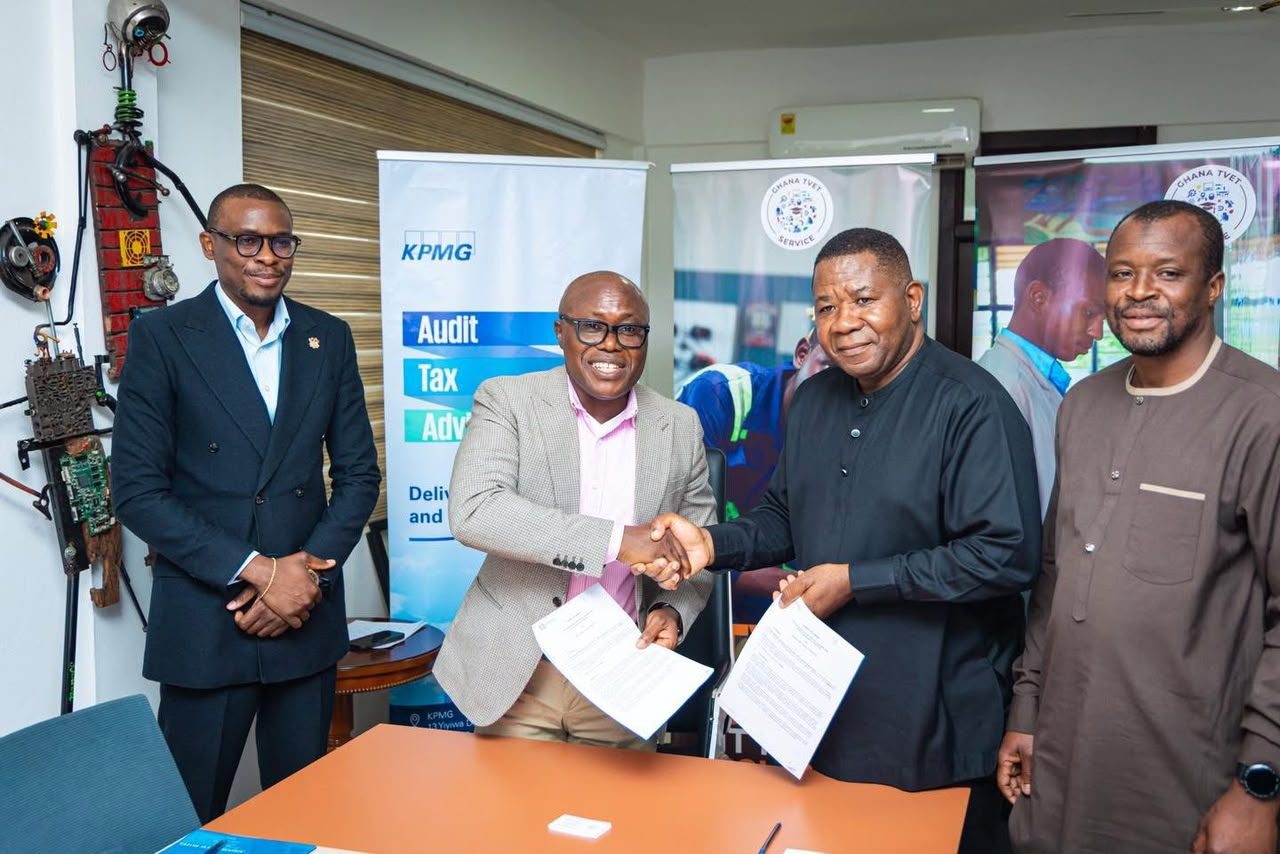
Ghana TVET Service (GTVETS) has signed a landmark partnership with UNESCO, KPMG and Microsoft to train at least 100,000 Technical and Vocational Education and Training (TVET) facilitators in artificial intelligence and digital competencies, marking one of the country’s most ambitious skills-development initiatives to date.
The agreement, formalised through a Memorandum of Understanding (MoU), places facilitator training at the centre of a national push to build a future-ready TVET system capable of keeping pace with rapid technological change.
According to a statement announcing the partnership, the initiative responds to a clear and pressing gap in Ghana’s training ecosystem.
Facilitators are widely regarded as the strongest determinant of training quality, yet a significant number currently lack the technological competencies required to operate effectively in increasingly digitised workshops, laboratories and classrooms.
“As the world advances through digital innovation, the true measure of progress will be how well our skills systems keep pace,”
TVET
Organisers of the initiative stressed that the programme is not solely about technical proficiency. Facilitators will also be trained in the judgement required to deploy AI tools responsibly, including how to manage learner data appropriately and navigate emerging risks such as misinformation and algorithmic bias.
Addressing a Critical Gap
Ghana TVET further cautioned that as AI moves deeper into curricula and workplace training, the risks associated with unethical use, ranging from plagiarism to the mishandling of sensitive learner information, make well-informed facilitators essential rather than optional.

“not only with digital and AI skills, but also the judgement to use them responsibly.”
TVET
Under the terms of the MoU, each partner has been assigned a distinct role in delivering the programme. GTVETS will lead national implementation, coordinating rollout across the country’s TVET institutions.
UNESCO will provide policy leadership, ensuring the initiative aligns with international standards for AI use in education and training. KPMG will support programme design and systems strengthening, bringing technical and organisational expertise to the partnership. Microsoft, meanwhile, will contribute digital infrastructure and AI-powered tools to underpin the training.
Describing the significance of this division of labour, the joint statement said: “this collaboration sets the pace for future-ready TVET at national scale,” framing the partnership as a model for how government, international bodies and the private sector can combine strengths to address large-scale skills gaps.
A National Effort at Scale
The scale of the commitment, training at least 100,000 facilitators, positions the initiative among the largest coordinated efforts to modernise technical and vocational training in Ghana.
TVET facilitators occupy a central position in the country’s skills pipeline, shaping the competencies of learners who go on to work in industries ranging from manufacturing and construction to emerging digital sectors.
By equipping this workforce of trainers with both technical AI skills and an understanding of associated risks, the partnership aims to ensure that the benefits of AI-enabled learning are matched by safeguards against its misuse.
This includes protecting learner data, guarding against biased or unreliable AI outputs, and maintaining academic and professional integrity within training institutions.
Implications for Ghana’s Skills Ecosystem
Industry observers note that the partnership arrives at a moment when TVET systems worldwide are under pressure to adapt quickly to AI-driven shifts in the labour market.
Countries that fail to equip their trainers with relevant digital competencies risk producing graduates who are unprepared for increasingly automated and technology-intensive workplaces.
By bringing together a government implementing agency, a United Nations policy body, a global professional services firm and a major technology company, the MoU reflects a broader trend of multi-stakeholder collaboration in addressing national skills challenges.

Each partner’s contribution, spanning implementation, policy alignment, systems strengthening and digital infrastructure, is intended to create a training model that is both sustainable and adaptable as technology continues to evolve.
As implementation begins, attention will turn to how quickly the programme can reach its target of 100,000 trained facilitators, and how effectively the resulting skills translate into improved outcomes across Ghana’s technical and vocational education institutions nationwide.
READ MORE: Ghana’s Education System Needs Better Implementation, Education Expert Argues