The United Arab Emirates has suspended trade and financial transactions with Iran indefinitely after accusing Iranian forces of launching two ballistic missiles toward the country, further straining relations between the two regional neighbours amid continuing tensions in the Gulf.
The UAE Ministry of Foreign Affairs announced the decision in a statement, saying the suspension was necessary in response to what it described as escalating developments that threatened regional peace and security. “All trade, commercial exchanges and financial transactions with Iran have been halted until further notice,” the ministry said, citing “escalations that undermine peace and security in the region.”
The move represents a significant escalation in the UAE’s response to the latest confrontation with Iran and could affect commercial activity between the two countries if the restrictions remain in place.
The trade suspension followed a statement from the UAE Ministry of Defence that its air-defence systems had detected two ballistic missiles launched from Iran. According to the ministry, one missile fell outside the UAE’s territorial waters, while the other landed within them. UAE authorities said the missiles were targeting maritime traffic, linking the incident to wider concerns over security in and around the Gulf and the Strait of Hormuz.
In a subsequent statement, the ministry said the UAE would respond firmly to any action threatening its territory or maritime routes. The incident has heightened concerns about the security of shipping in a region that is vital to global energy supplies.
The Strait of Hormuz, which connects the Persian Gulf with the Gulf of Oman, is one of the world’s most important waterways for the transportation of oil and other commodities.Iran has not accepted responsibility for the alleged missile attack.

Tehran Rejects UAE Accusations
The latest dispute comes against the backdrop of a wider conflict involving Iran, the United States and Israel, which has also placed considerable pressure on Gulf states. Iranian officials have previously insisted that their military actions are directed at US and Israeli targets rather than neighbouring Gulf countries. Tehran has also rejected accusations that it has deliberately targeted commercial shipping belonging to Gulf states.
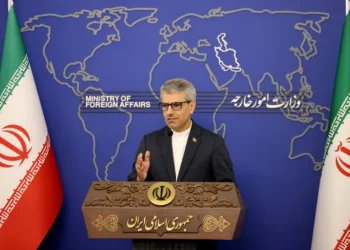
Iranian Foreign Ministry Spokesman Esmaeil Baghaei rejected the UAE’s earlier accusations concerning attacks on two vessels belonging to Abu Dhabi National Oil Company, or ADNOC, in the Strait of Hormuz. Baghaei described the allegations as “baseless” and suggested that the incidents could have been a “false flag operation” intended to blame Iran during the conflict.

He also warned that such accusations were inconsistent with the principle of good relations between neighbouring countries. According to Baghaei, the allegations “contradict the principle of good neighbourliness.”
He urged regional countries to avoid relying on what he called unfounded claims against Tehran and argued that any assessment of recent developments should also take into account the actions of the United States and Israel.
During the first six weeks of the conflict, Iran carried out numerous retaliatory attacks against US-linked targets across the Gulf. The UAE was among the Gulf countries most affected during that period, with Iranian forces reportedly launching hundreds of ballistic and cruise missiles as well as thousands of drones.
Iran said the attacks were intended to target US military assets and facilities in the region. The UAE has hosted American military personnel and maintains close security and economic ties with Washington. At the same time, Abu Dhabi has traditionally sought to maintain diplomatic and commercial relations with Tehran.
The reported missile launch marks the first such attack targeting the UAE since May, according to the information provided by UAE authorities.The development also follows accusations by Abu Dhabi that Iran was responsible for attacks on two ADNOC-linked vessels operating in the Strait of Hormuz. Tehran has denied involvement in those incidents.
The indefinite suspension of trade, financial transactions and commercial exchanges could have implications for businesses operating between the two countries, depending on how broadly the UAE implements the measure. The decision also illustrates the difficult position faced by Gulf states as the conflict between Iran and its adversaries increasingly affects regional security and maritime activity.
For the UAE, maintaining the safety of its territory and shipping routes remains a central concern. For Iran, regional military pressure and the presence of US forces remain major security issues.The latest developments have also intensified uncertainty surrounding the Strait of Hormuz, through which a significant share of global oil shipments normally passes. Any prolonged disruption could affect energy markets and international shipping.
The dispute highlights the widening economic and security consequences of the regional conflict, as Gulf countries attempt to protect their territory and commercial interests while avoiding deeper involvement in the confrontation between Tehran and Washington.
READ ALSO: Ablakwa Secures Visa Waiver, Doubled Scholarships, and Defence Ratification in Russia