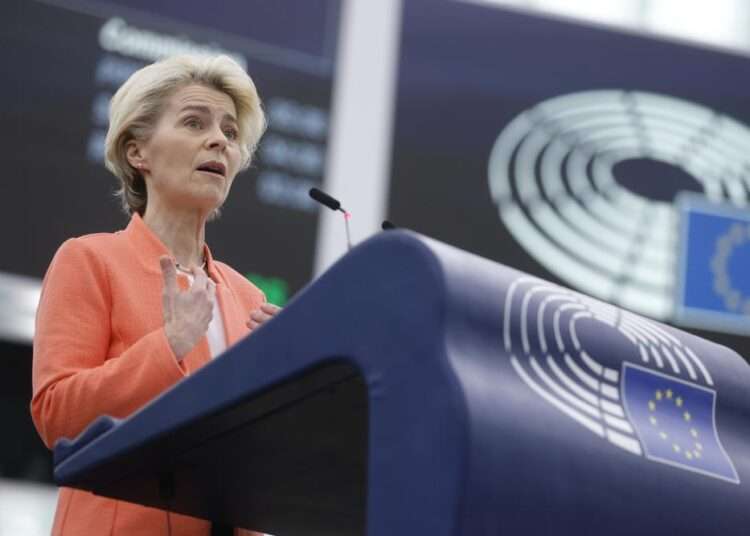
European Commission President Ursula von der Leyen has warned of an escalating campaign of threats against the European Union after Romania destroyed a naval drone near a major offshore gas project in the Black Sea.
Von der Leyen described the incident as part of a broader pattern of hybrid threats aimed at unsettling European citizens and testing the unity of the bloc, although she did not directly name Russia in her remarks.
“An escalating campaign of threats is underway, unsettling our citizens and seeking to divide our Union. This is hybrid warfare.”
Ursula von der Leyen
Her comments came after Romania’s military destroyed a marine drone that had been detected only a few hundred metres from the Neptun Deep platform, a major offshore gas project in the Black Sea.

Romanian Defence Minister Radu Miruță said that the drone was spotted close to the Neptun Deep extraction works, located about 80 miles east of Constanța. Following an assessment by Romanian authorities, a Romanian F-16 fighter jet was ordered to destroy the drone. “Following the analyses carried out and in coordination with the President of Romania, in order to protect the lives of the several hundred people working on the platform and to secure the critical infrastructure, the decision was made to destroy the drone,” Miruță said in a Facebook post.
The Neptun Deep project is one of Romania’s most significant offshore energy developments and is expected to play an important role in the country’s future gas production. Miruță said that Romanian authorities had checked with Kyiv and confirmed that the vessel was “not of Ukrainian origin,” raising further concerns about possible Russian involvement amid heightened tensions in the Black Sea.
The incident follows other drone-related security concerns near the same gas project. Earlier this month, Romanian army divers destroyed two Gerbera-type drones that were drifting in the country’s Black Sea exclusive economic zone close to the Neptun Deep development.
Responding to the latest incident, von der Leyen said that the European Union was facing an increasingly complex security environment, arguing that preserving peace in Europe now also requires the capacity to deter what she described as provocation and aggression. “The founding mission of our Union is to preserve peace. Today, that also means having the capacity to deter provocation and aggression,” von der Leyen said.
She pointed to the European Union’s Readiness 2030 agenda, which she said is mobilising up to €800 billion to strengthen Europe’s defence capabilities. According to von der Leyen, initiatives including the European Drone Defence Initiative and the Eastern Flank Watch are intended to expand European defence production and provide member states with capabilities needed to respond more quickly to emerging threats.
“With the European Drone Defence Initiative and the Eastern Flank Watch, we are scaling up production in Europe to deliver capabilities Member States need. So we can respond to emerging threats with speed, unity and resolve.”
Ursula von der Leyen
Ukraine Accuses Russia Of Widening Regional Risks
Ukraine’s Foreign Minister, Andrii Sybiha also raised concerns about security threats beyond Ukraine’s borders, saying that Russia had violated the airspace of both Moldova and Romania during overnight attacks on Ukraine. “These are not isolated incidents. They are part of Russia’s deliberate and systemic terrorist attacks,” Sybiha said.
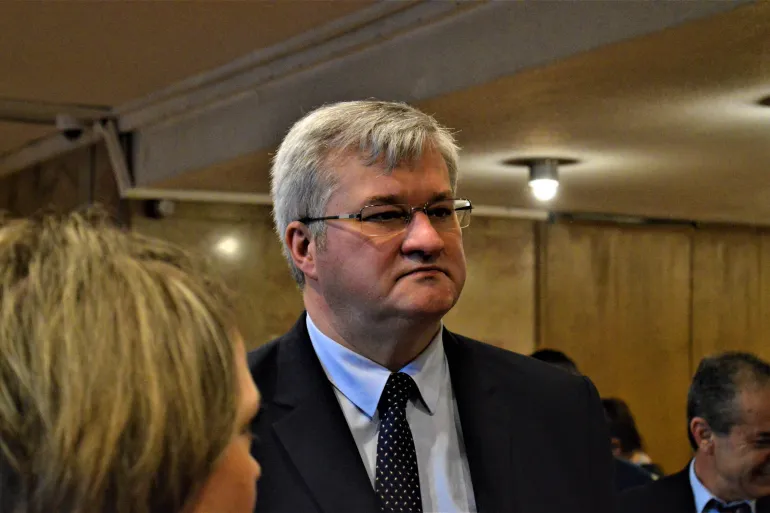
He warned that Moscow was increasingly testing the resolve of NATO and its partners by violating the sovereignty of neighbouring countries and expanding the risks associated with the war beyond Ukraine. “The aggressor state is increasingly testing the resolve of NATO and its partners, violating the sovereignty of neighbouring states and deliberately expanding the risks posed by its war far beyond Ukraine,” he said.
Sybiha said that he would work with counterparts in Moldova and Romania to develop what he described as a stronger and more effective regional response.
“Our collective response must be stronger than Russia’s attempts to test our unity and resolve. The security and stability of the entire region are at stake.”
Andrii Sybiha
Romania, a member of both the European Union and NATO, has repeatedly reported incidents involving drones and other military debris near or within its territory and exclusive economic zone since Russia’s full-scale invasion of Ukraine. The proximity of the latest drone to the Neptun Deep platform is likely to heighten concerns about the vulnerability of offshore energy infrastructure, particularly as European countries seek to strengthen energy security and reduce dependence on Russian supplies.
While Romanian officials have not publicly identified who was responsible for the naval drone, the confirmation that it was not of Ukrainian origin has added to speculation about its source. For now, the incident is expected to reinforce calls for closer coordination among European and NATO partners as countries on the alliance’s eastern flank confront growing security risks linked to the continuing war in Ukraine.
READ ALSO: Iran Dismisses Trump’s New Sanctions Threat