
Philip Tieku, Star Oil’s Chief Executive Officer, has argued that Ghana cannot solve its fuel quality problems without first addressing the welfare of the truck drivers and pump attendants who move and dispense the product, describing driver welfare as the precondition for tackling fuel siphoning and adulteration rather than a separate concern.
Speaking at SYPALA 2026 in Accra, the chief executive said most fuel entering Ghana through the country’s largest importers already meets national quality standards on arrival, meaning the real vulnerability in the supply chain lies not with imported product but with the people who handle it between the depot and the pump.
The chief executive traced quality failures to three points in the supply chain. Truck drivers have been known to siphon fuel in transit and, to disguise the resulting shortfall, sometimes adulterate the remaining product with inferior substitutes.
He indicated that station owners operating under commercial pressure occasionally source off-specification product from illicit suppliers outside the knowledge of the sponsoring oil marketing company.
And station attendants and managers who fail to monitor underground tanks for water infiltration can allow contamination to go undetected. “If you want to deal with quality of fuels in Ghana, you must deal with truck driver welfare,” the chief executive said, arguing that poor pay creates the incentive for exactly the behaviour that compromises fuel quality.
A Regulatory Change Became a Business Opportunity
Star Oil built its response around a 2022 regulatory change introduced by the National Petroleum Authority, which required major fuel storage companies to deliver product to truck drivers based on temperature-compensated quantities rather than raw volume.
The executive explained that fuel expands and contracts with temperature, so a driver receiving fuel at the depot’s ambient temperature, often warmer than the underground tanks at delivery stations, would previously see an apparent shortfall once the fuel cooled and contracted on arrival, a gap drivers were sometimes blamed for or tempted to cover through siphoning.
Star Oil automated the temperature-compensation calculation using its existing technology platform, requiring only that a driver take a temperature reading upon arrival at a station to determine the correct expected quantity relative to what was collected at the depot.
Where a driver delivers the full temperature-compensated volume, without siphoning any of it, the company pays that driver 50 percent of the resulting overage, net of applicable taxes.
“This became a game changer for us,” the chief executive said, describing the incentive as one the company could afford because customers themselves purchase fuel at room temperature rather than the depot’s compensated baseline, leaving Star Oil a surplus even after paying the bonus.

Pay Above Industry Rates, and a Driver Who Can Afford a Holiday
The executive said the scale of the incentive scheme depends entirely on automation that manual processes could not support.
Star Oil handles approximately 4,200 unique fuel deliveries across 270 stations every month, each requiring its own temperature-compensation calculation, a volume the executive said makes manual administration of the bonus scheme impossible.
Star Oil now pays its truck drivers more than double the industry-approved rate, extending the same temperature-compensation bonus to third-party contractor drivers who move roughly half the company’s total haulage volume alongside its own fleet.
The chief executive pointed to one driver, identified only as Grace, as an illustration of the scheme’s impact, saying she has been able to travel to Dubai on holiday, an outcome the chief executive said would have been unimaginable for a truck driver under the industry’s previous pay structure.
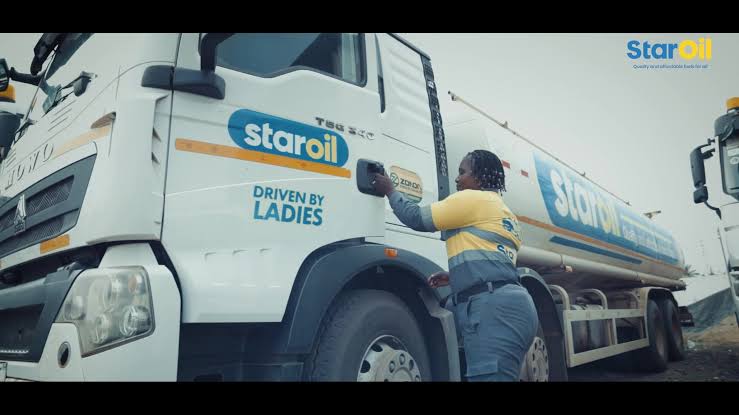
The company has also deliberately recruited women into driving roles, sourcing some from Metro Mass Transit and others trained by Zen Petroleum for mining supply operations, arguing that drivers trained outside the industry’s historically tolerant culture around siphoning have helped reset expectations for male colleagues.
Attendants Paid Three Times the Industry Average
Star Oil extended a similar welfare-based strategy to pump attendants, who the executive said represent the company’s most direct point of contact with customers.

Where some competitors pay attendants around GHS 800 a month, the executive said Star Oil pays its attendants at roughly three times the industry average, built around a performance system tied to monthly sales targets that allows top-performing attendants at high-volume stations to earn substantially more through bonuses layered on top of base pay.
The executive also drew a structural distinction from competitors operating the dealer model, in which pump attendants are employed directly by individual station owners rather than the sponsoring oil marketing company, leaving them without formal employment protections such as leave or maternity benefits and largely at the discretion of the station owner managing them.
Star Oil employs its attendants directly, extending the full range of standard employment benefits that the dealer-operated structure typically does not provide.
READ ALSO: Kofi Bentil: Governments That Rely on Aid Won’t Listen to Citizens