
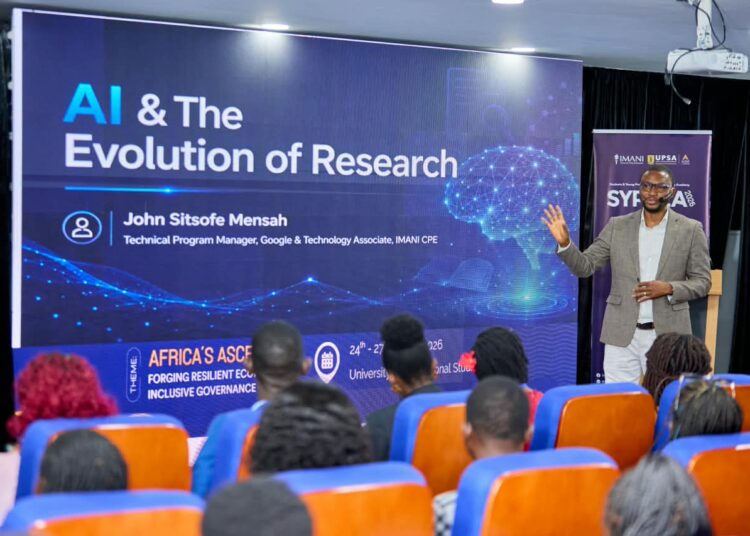
Researchers and policy analysts using artificial intelligence should treat the technology with what amounts to zero trust, supplying it with bounded source material and auditing everything it produces.
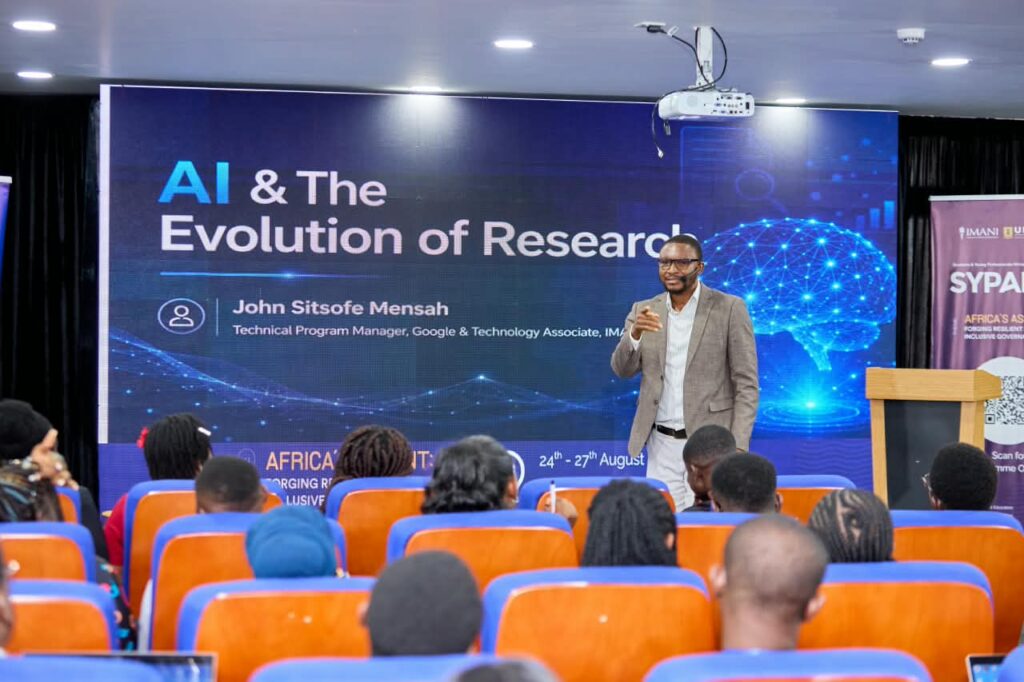
Technology Policy Analyst at the IMANI Centre for Policy and Education, John Sitsofe Mensah, set out the approach on the third day at the 2026 Students and Young Professionals African Liberty Academy at the University of Professional Studies, Accra.
His session dealt with AI and the evolution of research, and the framework he offered responds to a problem now surfacing across newsrooms, think tanks and government departments. AI tools produce fluent, confident text whether or not the underlying facts exist, and the burden of catching that falls entirely on the person who asked the question.
The first rule Sitsofe Mensah gave the cohort was to stop asking AI systems open questions and start handing them explicit source text. An ungrounded prompt invites the model to fill the space from whatever it holds, which is precisely where fabricated figures and invented citations enter research.
Supplying the document is only half of it. The second half is telling the system where its boundaries lie. Sitsofe Mensah described this as fencing the work in, marking out the territory the analysis may cover and making clear that everything beyond it is off limits.
Negative Constraints Do the Heavy Lifting
The instructions that matter most, on his account, are the prohibitions. Analysts should tell the system explicitly that it may not extrapolate and may not introduce external statistics into its output, so that every number it returns can be traced back to the supplied document.
A second constraint governs absence. Where the source material does not specify a timeline or a figure, the system should be required to say so plainly rather than estimate, infer or quietly fill the gap. That instruction converts a silence in the document into visible information, which is often the finding itself.
The third constraint concerns scope. If the provider gives a strategy document, the analysis is confined to the strategy document and may not reach for a spreadsheet, a news report or anything else the model might otherwise draw on.
Sitsofe Mensah demonstrated the method live. He asked participants to have AI tools extract all quantitative targets, timelines and financial figures from the African Union’s Continental Artificial Intelligence Strategy into a table, and separately to identify the regulatory mandates it contains, under the constraints he had just described.
The first obstacle proved instructive. Several participants found their tools unable to locate the strategy at all. One reported that the system responded by acknowledging the clarity of the task while stating that it did not have the actual document, and only retrieved it after being directed to search for it.
Others resolved the problem by going to the AU site, downloading the strategy and supplying it directly. That gap between a tool that gestures at a document and a tool working from the document itself is the whole argument for grounding.
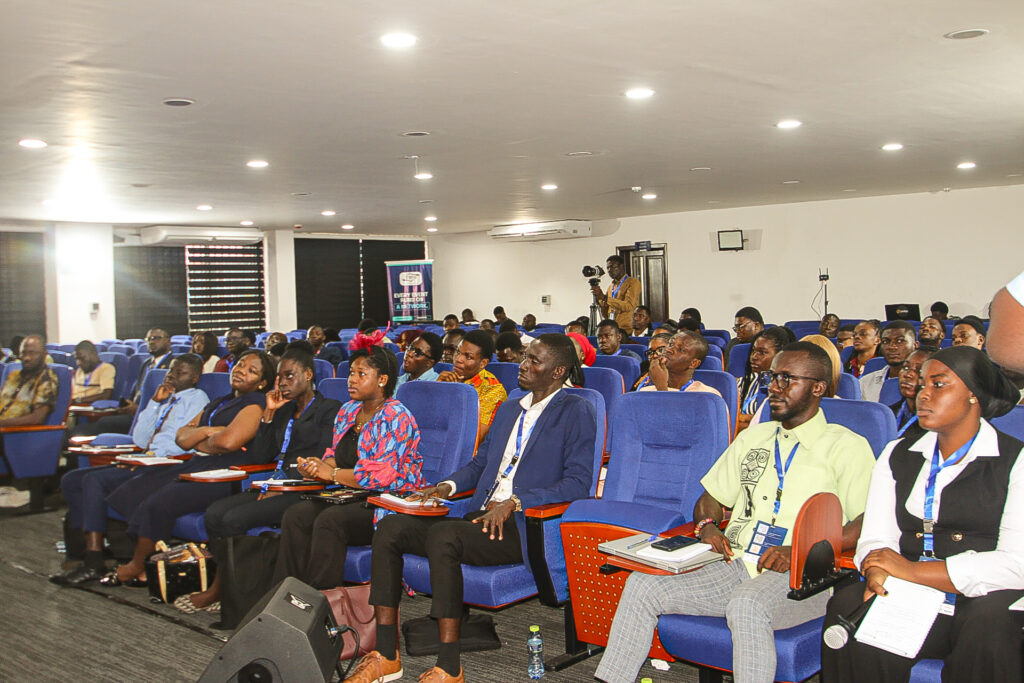
Participants who supplied the file got a table of targets and timelines they could check against the original. The exercise also surfaced a substantive finding, that many of the strategy’s targets carry timelines but no attached financial figure.
Audit the Output
Grounding the input does not settle the reliability of what comes back. Sitsofe Mensah had participants assign the AI a second and separate role, that of a technology auditor, and instructed it to stress-test the results from the first stage and check for internal conflicts.
The sequence matters. Rather than accepting a first-pass analysis, the analyst uses a second pass to interrogate it, then verifies the surviving claims against the source. What emerges from that process can support an authoritative recommendation, because each element of it is traceable.
Sitsofe Mensah’s framing was that facts, not assertion, are what make a policy position defensible, and that asking better questions of the source is what produces recommendations capable of solving real problems.
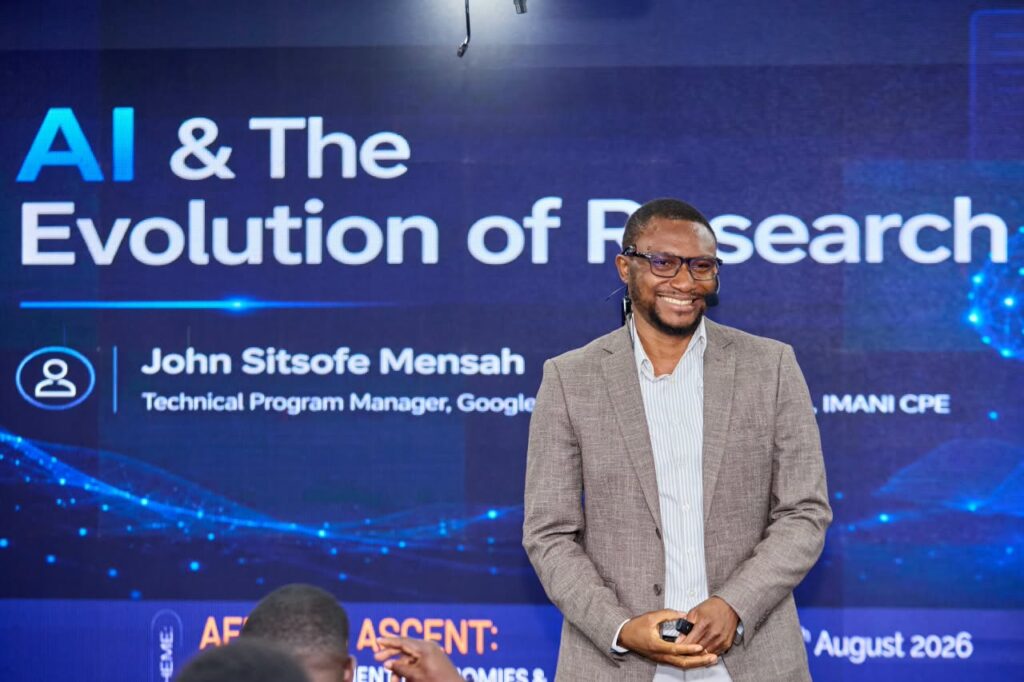
Sitsofe Mensah also raised the privacy dimension, distinguishing between models that run on a user’s own device at the edge of the network and those that send material elsewhere for processing.
On-device models keep their work local and do not communicate with the outside world, which matters for anyone handling confidential material. Tasks routed to external systems are different.
Once information leaves the device, it passes through a chain of intermediaries, and at various points along that chain material can be exposed that the user never intended to disclose. For researchers working with unpublished data, draft policy documents or identifiable sources, the choice of tool is therefore a disclosure decision rather than a technical preference.
Institutionalising the Framework
Closing the session, Sitsofe Mensah pulled the elements into a framework participants could adopt as standing practice. Never feed ungrounded prompts. Always supply explicit, bounded source text. Apply zero trust constraints that prohibit the system from wandering outside the domain under analysis. Audit whatever comes back.

The relevance extends well beyond the room. Ghanaian newsrooms, civil society organisations and public institutions are all folding AI into research and drafting workflows, largely without written rules on grounding, verification or the handling of sensitive material.
A framework of the kind Sitsofe Mensah set out costs nothing to adopt and gives an organisation something to point to when a figure in a published report turns out to have no source behind it.
READ ALSO: Ghana’s Resource Nationalism Needs Evidence, Not Politics, IMANI VP