

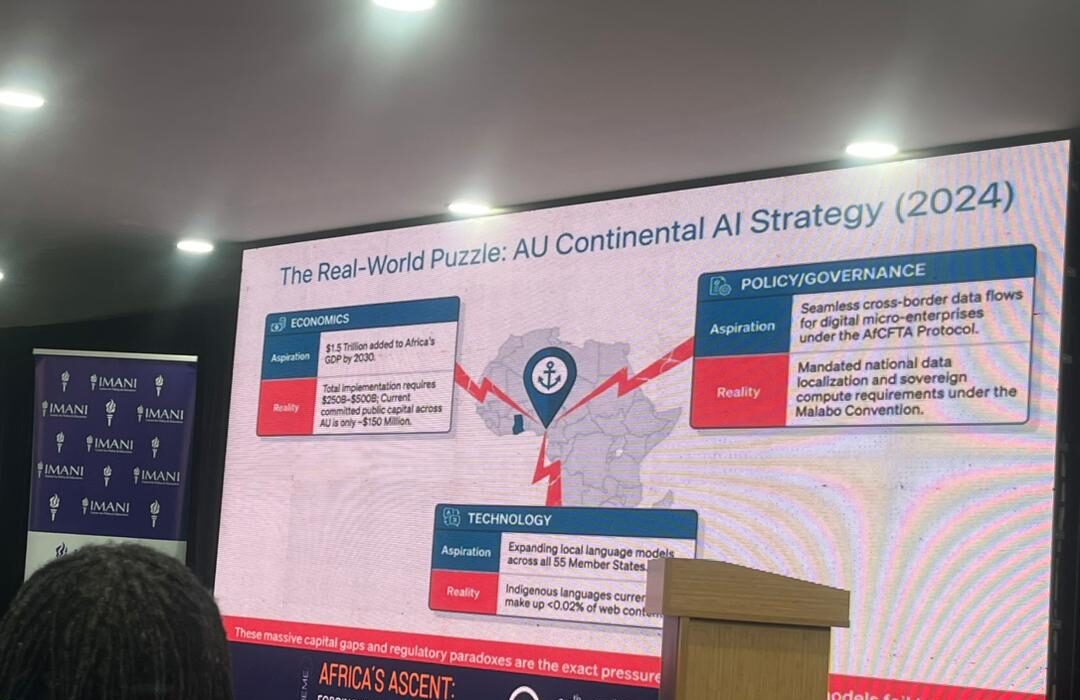
African governments have committed roughly $150 million in public capital to the African Union’s Continental Artificial Intelligence Strategy, a programme whose implementation the strategy itself prices at between $250 billion and $500 billion.
Technology Policy Analyst at the IMANI Centre for Policy and Education, John Sitsofe Mensah, put that gap before participants at the 2026 Students and Young Professionals African Liberty Academy at the University of Professional Studies, Accra, on Wednesday.
The shortfall sits beneath an ambition to add $1.5 trillion to Africa’s GDP by 2030. Sitsofe Mensah’s argument is that the arithmetic has never been reconciled, and that the continent risks missing the strategy’s targets not because the plan is wrong but because nobody has paid for it.
Aspiration Against Reality
Sitsofe Mensah structured his critique around three paired gaps, each setting what the strategy promises against what currently obtains.
The economic pair is the starkest. The $1.5 trillion GDP ambition rests on infrastructure the continent does not have and skills it has not yet built, and the committed public capital covers a fraction of one per cent of the estimated cost.
Independent research tracking the strategy’s first eighteen months found AI funding heavily concentrated, with the large majority flowing to Kenya, Nigeria, South Africa and Egypt while the remaining member states saw little.

The governance pair goes to a contradiction inside African policy itself. The strategy anticipates seamless cross-border data flows for digital micro-enterprises operating under the African Continental Free Trade Area Protocol.
Yet the Malabo Convention mandates national data localisation and sovereign compute requirements, obligations that cut directly against the free movement of data the trade agenda assumes.
Countries are drafting national AI strategies that, in practice, build walls around their own data estates, Sitsofe Mensah said. Both objectives cannot be pursued at full strength, and unless the tension is resolved the continental market for AI-enabled services the strategy depends on will not form.
The point lands close to home for Ghana, which has positioned itself as an AfCFTA hub while the rules governing data across African borders remain unsettled.
Africa’s Languages Are Missing From the Web
The technology pair concerns whose languages the machines will speak. The strategy envisages expanding local language models across all 55 member states. Indigenous African languages currently make up less than 0.02 percent of web content, the raw material on which such models are trained.
That imbalance sets a hard ceiling on what can be built. Without deliberate investment in African-language corpora, models serving African users will continue to be trained overwhelmingly on material produced elsewhere.
The document under scrutiny has a direct Ghanaian connection. The AU Executive Council endorsed the Continental Artificial Intelligence Strategy at its 45th Ordinary Session in Accra on 18 and 19 July 2024, a month after African ICT and communications ministers approved it.
The strategy sets out five focus areas covering the harnessing of AI benefits, capability building, risk mitigation, investment stimulation and cooperation, with fifteen action areas beneath them. Implementation runs from 2025 to 2030.
The first phase, covering 2025 and 2026, is meant to establish governance structures, produce national AI strategies, mobilise resources and set up AI advisory boards and centres of excellence, with a review in 2027 informing the execution phase that follows. That first phase is now in its final months.
Reading the Strategy Against Itself
Sitsofe Mensah reached his conclusions through an exercise he then had participants repeat. He asked them to use AI tools to extract every quantitative target, timeline and financial figure from the strategy into a single table, and separately to identify the regulatory mandates it contains.
The gaps proved to be the finding. Participants located targets attached to timelines but repeatedly without any financial figure beside them. Continental workforce provisions carried a 2024 timeline and no money.
Implementation across the fifteen action areas carried a 2025 to 2026 timeframe and no money. The commencement activities of phase one, spanning governance frameworks, national strategies, resource mobilisation and capacity building, carried the same period and again no allocation.
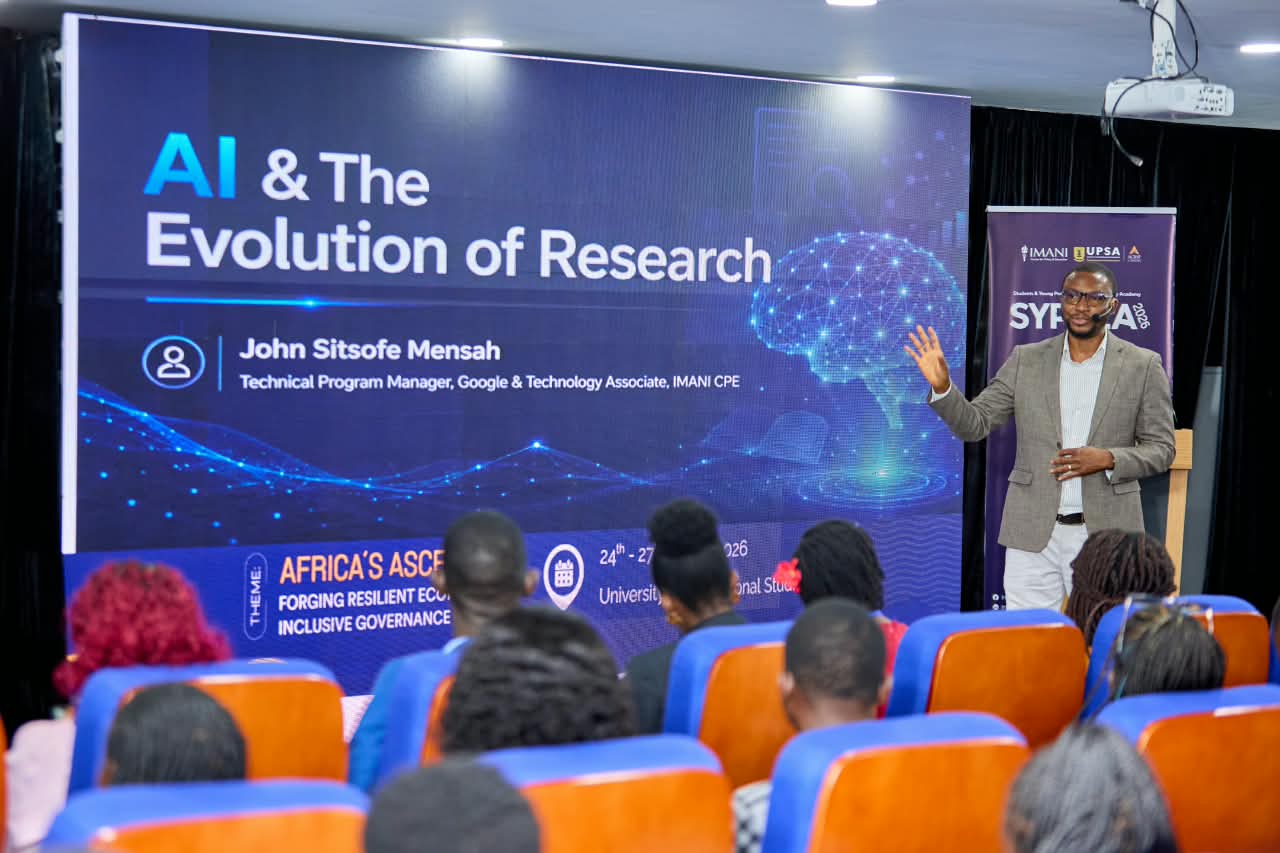
Sitsofe Mensah told the cohort that such an analysis can be turned into a written intervention addressed to a communications minister or issued as an open letter to a president, setting out what a strategy claims, what has been committed, and why the two do not meet.
With phase one closing this year and a review due in 2027, African governments will shortly have to answer that question on paper.
READ ALSO: Africa’s Mineral Share Is 1.8%, Not 30%, Bright Simons