BOSTenergies has significantly strengthened its financial position after a year of substantial revenue growth, higher profitability and tighter cost management, with the company recording its first-ever dividend payment to the Government of Ghana in 2025.
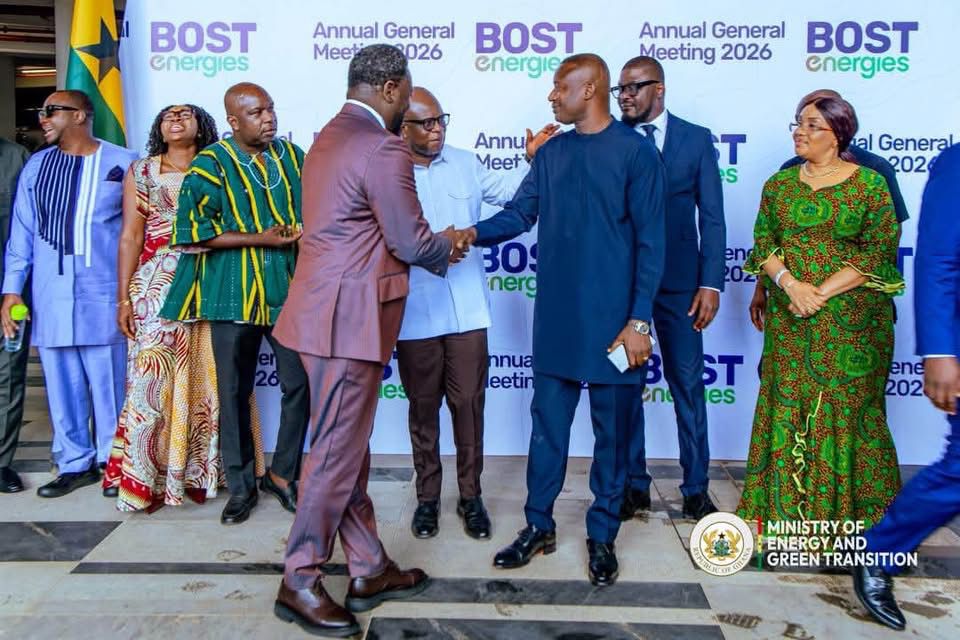
The performance was highlighted at the company’s 2026 Annual General Meeting, where the Minister for Energy and Green Transition, Dr. John Abdulai Jinapor, commended the Board and Management for what he described as a major improvement in commercial and operational performance.
The company’s own account of its 2025 results reinforces the scale of the turnaround.
Revenue rose from GH¢1.2 billion in 2024 to GH¢3.81 billion in 2025, representing 195% year-on-year growth.
Profit after tax increased from GH¢398 million to GH¢683.96 million, while total assets expanded by 50% to GH¢3.99 billion.
Shareholder equity more than doubled from GH¢677 million to GH¢1.47 billion, while administrative expenses declined by 28%.
The combination is significant because the improvement was not driven simply by higher turnover.
BOSTenergies also reported stronger profitability alongside lower administrative expenditure, suggesting that a larger scale of commercial activity was accompanied by tighter control over overheads.
Revenue Growth Accompanied By Stronger Cost Discipline
The financial results present a company operating with a substantially larger revenue base while reducing administrative costs, a combination that has implications for both profitability and the capacity to reinvest.
Dr. Jinapor used the figures to emphasise that the quality of the performance should be assessed not only by the increase in revenue but also by what happened to expenditure during the same period.

“It means that you are spending less and achieving more, which means there is efficiency.”
Dr. John Abdulai Jinapor, Minister For Energy And Green Transition
The point is particularly relevant to Ghana’s state-owned energy companies, where financial performance has often been constrained by high operating costs, accumulated obligations and the need for shareholder support.
In BOSTenergies’ case, the 195% increase in revenue was accompanied by a 72% increase in profit after tax.
Although profit growth did not match the pace of revenue growth, the business still generated an additional GH¢285.96 million in profit after tax compared with 2024.
That means the company was able to convert a significantly larger volume of revenue into higher absolute earnings while also reducing administrative expenses.
For an energy-sector enterprise, such a trajectory matters beyond the income statement.
Stronger profitability can improve the ability to maintain infrastructure, finance working capital, absorb market volatility and contribute directly to government revenues.
“Your profit after tax increased from GH¢398 million to GH¢684 million. A+. But even your expenses… reduced.”
Dr. John Abdulai Jinapor, Minister For Energy And Green Transition
The company described the outcome as the product of stronger commercial activity, disciplined financial management and an emphasis on operational efficiency.
Those factors will become increasingly important if the gains are to survive changes in petroleum-market conditions.
First Dividend Changes BOSTenergies’ Relationship With Government
Perhaps the most consequential development was not the size of the revenue increase but the decision to distribute part of the earnings to government.
BOSTenergies paid GH¢34.2 million to the Government of Ghana, equivalent to 5% of its 2025 net profit.
The payment represents the company’s first-ever dividend to its shareholder and marks a shift from the pattern of state-owned enterprises requiring financial support towards one in which a commercially profitable entity is contributing resources back to the state.
Dr. Jinapor stressed the distinction between declaring a profit and having sufficient cash to make a distribution.
“It’s one thing declaring profit, it is another thing paying dividends.”
Dr. John Abdulai Jinapor, Minister For Energy And Green Transition
That distinction is important in assessing BOSTenergies’ financial recovery.
Accounting profit does not automatically mean that equivalent cash is available for distribution, particularly in businesses with substantial working-capital requirements.
The Minister said his assessment of the company’s cash-flow position was encouraging, suggesting that the dividend was supported by an improved underlying liquidity position rather than being simply an accounting achievement.
The dividend also carries a wider governance significance.
For government as shareholder, the financial performance of a state-owned enterprise is ultimately measured not only by whether the entity reports earnings but by whether those earnings translate into sustainable cash generation, investment capacity and shareholder returns.
BOSTenergies’ first dividend therefore provides an early test of whether the company can move towards becoming a consistent contributor to public finances.
Balance Sheet Expansion Provides Room For Growth
The improvement extended beyond the income statement.
Total assets reached GH¢3.99 billion, a 50% increase, while shareholder equity more than doubled to GH¢1.47 billion.
The growth in equity is particularly important because it strengthens the company’s capital base and provides a larger financial cushion against future market pressures.

The stronger balance sheet could also improve BOSTenergies’ capacity to support its commercial operations without relying excessively on external or shareholder financing.
For an energy-sector company, balance-sheet resilience matters because operations are exposed to commodity-price movements, foreign-exchange conditions, financing costs and changes in domestic demand.
A larger equity base does not eliminate those risks, but it can improve the company’s ability to absorb them.
The company itself characterised 2025 as a defining year, arguing that the financial results established a stronger foundation for continued investment, operational excellence and resilience.
That assessment is reasonable, but the more important question is whether the improvement represents a structural change rather than a particularly strong financial year.
Efficiency Gains Must Become A Sustained Strategy
The 28% reduction in administrative expenses provides an encouraging signal, but maintaining efficiency will require more than reducing overheads in a single financial period.
BOSTenergies will need to preserve cost discipline while expanding its commercial activities and investing in infrastructure.
Cutting expenditure becomes less meaningful if it subsequently restricts maintenance, staffing, technology or operational capacity.
The company therefore faces a balancing act: retain the efficiency gains while ensuring that investment is sufficient to support long-term growth.
Dr. Jinapor urged the Board and Management to maintain the trajectory, pointing specifically to operating profit, gross profit, comprehensive income, earnings per share and other measures that shareholders use to assess performance.
“I want to encourage you to be on that trajectory.” Dr. John Abdulai Jinapor, Minister For Energy And Green Transition
That warning is important because the sharp increase in revenue should not become the sole benchmark for future performance.
Sustained improvement would require profitability and cash generation to grow alongside turnover, while the company continues to manage operating costs.
Financial Recovery Carries Wider Energy-Sector Implications
BOSTenergies’ performance also fits into a broader conversation around the financial sustainability of Ghana’s state-owned energy institutions.
The energy sector carries substantial infrastructure and working-capital requirements, making financial weakness at state-owned enterprises capable of creating pressure elsewhere in the public sector.
Conversely, financially stronger companies can contribute to energy security while reducing their dependence on government support.

Dr. Jinapor linked BOSTenergies’ performance to what he described as a broader improvement among state-owned entities under the government’s “reset agenda.”
“Something must be happening, and it is leadership.”
Dr. John Abdulai Jinapor, Minister For Energy And Green Transition
Whether that broader improvement can be sustained will depend on the quality of governance, commercial discipline and investment decisions across individual enterprises.
For BOSTenergies, the immediate achievement is clear: revenue has expanded sharply, profit has increased, administrative costs have fallen, the asset base has strengthened and government has received its first dividend.
The harder test begins now.
A single strong financial year can improve confidence, but a sustained pattern of profitability is what ultimately establishes institutional resilience.
BOSTenergies will therefore need to demonstrate that the 2025 results can be repeated while continuing to support Ghana’s petroleum supply chain and wider energy-security objectives.
The first dividend offers an important signal that the company is moving in that direction.
The next measure of success will be whether that dividend becomes the beginning of a sustainable shareholder-return model rather than a one-off milestone.
READ ALSO: Ghana Secures $30 Million Grant for Damongo Tech University