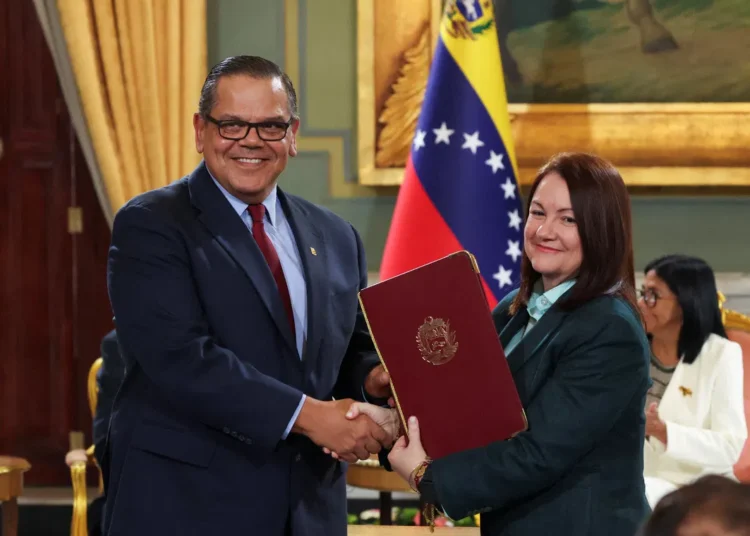
Chevron and other international energy companies have signed multibillion-dollar agreements to expand oil production in Venezuela, in a major investment push overseen in Caracas by interim President Delcy Rodriguez and U.S. Energy Secretary Chris Wright.
The agreements will allow Chevron and Italy’s Eni to expand their operations and increase their stakes in Venezuelan oil projects, while U.S. energy company GE Vernova will assist with efforts to repair the country’s damaged electricity grid.
The contracts are separate from a recently announced agreement between Caracas and Washington that gives U.S.-led companies access to 17 Venezuelan oilfields, representing roughly one-fifth of the country’s total reserves.
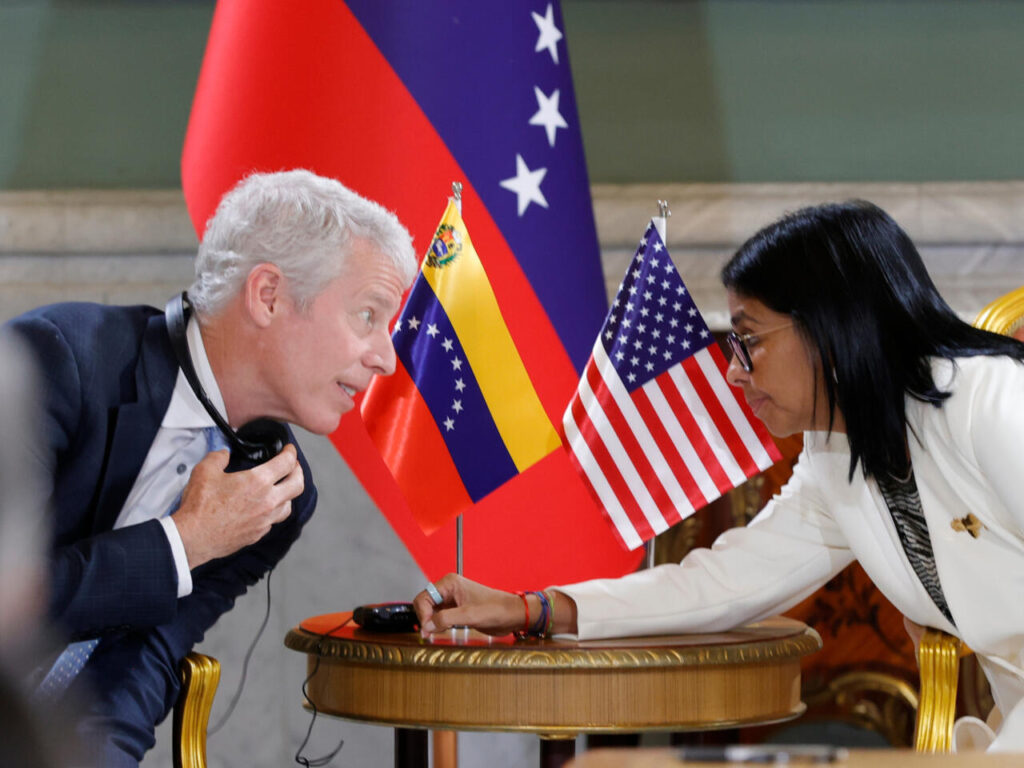
Most of the newly signed contracts concern projects that had already been under negotiation between the companies, Venezuela’s Oil Ministry and state oil company PDVSA following an oil reform approved in January.
Wright travelled to Caracas for the signing ceremony and described the agreements as an important step toward improving Venezuela’s economic prospects.
“The deals signed by Venezuela with the US’s Chevron and GE Vernova, as well as Italy’s Eni, were critical in starting this ball rolling of peace, opportunity, and prosperity.
“We are trying to work at what I call Trump-speed. President Trump didn’t want a nudge or a slow drift in a positive direction. He wanted to see as fast as possible transformation in Venezuela.”
Chris Wright
Chevron, the second-largest U.S. oil company and Venezuela’s largest private oil producer, valued its agreement to develop two additional fields in the Orinoco Belt at about $7 billion. The project is expected to more than double its output over the next five years, potentially making a significant contribution to Venezuela’s efforts to revive its long-declining oil industry.
Eni, meanwhile, said it had secured exclusive rights to explore the giant Junin 5 oilfield, further expanding the Italian company’s presence in Venezuela. GE Vernova’s agreement focuses on the country’s electricity infrastructure.
Venezuela’s power grid has suffered from years of underinvestment, equipment failures and economic difficulties, resulting in frequent outages in parts of the country. The company’s involvement is expected to support efforts to restore and modernise electricity generation and distribution infrastructure.
The new energy agreements have nevertheless raised questions about Venezuela’s control over its natural resources. Critics in both Venezuela and the United States have accused the Trump administration of using political and economic pressure to gain access to the country’s vast oil reserves.
Those concerns have intensified following the broader Caracas-Washington agreement, under which a U.S.-led company would receive concessions lasting up to 100 years over 17 Venezuelan oilfields. Critics have described the arrangements as an erosion of Venezuelan sovereignty, particularly following the U.S. military operation that resulted in the capture and removal of former President Nicolas Maduro. They have also accused Washington of threatening Rodriguez with similar action if her government fails to comply with U.S. demands.
Accusations Of US Taking Venezuela’s Oil Rejected
Wright rejected accusations that the United States was taking Venezuela’s oil. “The U.S. is not stealing Venezuelan oil,” he told reporters, adding that all the US is doing is “taking an idle, underground asset that isn’t doing anything for Venezuelan people, and bringing the money, the technology to develop it.”
The U.S. administration has argued that increased foreign investment could help restore Venezuela’s oil industry, generate employment and improve public services while bringing previously underdeveloped resources back into production. Wright said that Venezuela’s total oil production could reach 2 million barrels per day by the end of the decade, compared with approximately 1.25 million barrels per day currently.
Even if that target is achieved, production would remain substantially below Venezuela’s historical peak. The country produced more than 3 million barrels per day in the late 1990s, before years of economic deterioration, declining investment, infrastructure problems and sanctions contributed to a sharp fall in output.
Venezuela nevertheless possesses the world’s largest proven crude oil reserves, making its energy sector particularly attractive to international companies seeking long-term access to oil resources.
Meanwhile, Rodriguez defended the agreements as necessary to attract the investment and technology required to revive the industry. She rejected suggestions that Caracas was surrendering control over the country’s natural wealth.
According to her, greater oil production would provide broader economic benefits for Venezuelans. “More oil translates into more jobs, higher wages, better public services, hospitals, schools and food,” she said.
The interim President has estimated that Venezuela could generate about $209 billion in profit from the agreements over 25 years, although the eventual economic returns will depend on production levels, oil prices, investment costs and the terms under which the projects operate.
The agreements represent a significant change in Venezuela’s approach to its oil industry, which has traditionally been dominated by PDVSA. The government is now seeking greater participation from foreign energy companies as it attempts to restore production capacity and attract billions of dollars in new investment.
READ ALSO: COCOBOD Pays GH¢2.68bn to Complete 2026 DDEP Obligations, Clears GH¢162m Cocoa Bills