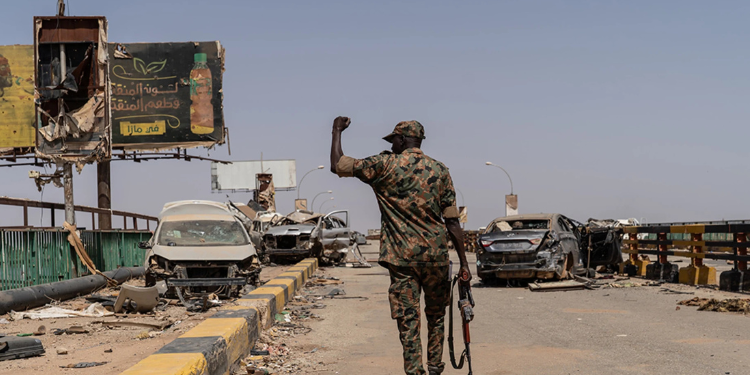
The UN Independent International Fact-Finding Mission for the Sudan has revealed that foreign recruitment and external support networks are fuelling the war in Sudan, strengthening the military capabilities of the country’s warring parties and enabling increasingly sophisticated military operations with devastating consequences for civilians.
In a report, “Fuelling Sudan’s conflict: weapons, fighters and external support networks,” the Mission documented how transnational networks operating across several countries have helped recruit, train and deploy foreign personnel to support the Rapid Support Forces (RSF), while facilitating the transfer of weapons, ammunition, military technology and logistical assistance.
The report also found reasonable grounds to believe that the Sudanese Armed Forces (SAF) used foreign-supplied drones in operations that harmed civilians and civilian objects, highlighting how international military assistance has increasingly expanded the reach and lethality of Sudan’s conflict.
The findings raise fresh concerns over the international dimensions of a war that has already produced a devastating humanitarian crisis. Rather than remaining confined to Sudan’s battlefields, the conflict is being sustained by networks stretching across borders, involving recruiters, private entities, logistics intermediaries and suppliers that have helped move personnel and military equipment into the country.
The Mission indicated that states linked to these supply chains are under strict international legal obligations to exercise due diligence, investigate and halt illicit mercenary and supply networks operating from or through their territories, prevent violations and enforce the United Nations arms embargo.
According to the report, up to 2,000 former Colombian military contractors were deployed alongside RSF units in Darfur and Kordofan. These personnel directly operated combat drones, artillery and advanced weapons, providing the paramilitary force with additional military expertise and capabilities.
The Mission further found reasonable grounds to believe that private entities, logistics intermediaries and recruiters operating from countries including Colombia and the United Arab Emirates used transit locations in Chad, southeastern Libya and Bosaso in Somalia to facilitate the movement of personnel, training, weapons and logistical support to the RSF.
The networks, according to the Mission, demonstrate the increasingly internationalised nature of Sudan’s war, where military capabilities are being shaped not only by the resources available within the country but also by foreign personnel, technology and supply chains.
According to Mohamed Chande Othman, Chair of the Fact-Finding Mission,“this external support has not brought greater protection for civilians. Instead, civilians are paying the price through attacks on homes, hospitals, schools, markets and places of refuge.”
The Mission warned that attacks directed against civilians and civilian objects constitute war crimes, placing greater emphasis on the responsibilities of those who enable the conflict through financing, recruitment, weapons transfers and logistical assistance.
Among the documented incidents were RSF drone strikes in Kalogi, South Kordofan, which killed 114 people, including around 60 children. SAF strikes in Ad-Da’ein, East Darfur, meanwhile, killed at least 70 people and destroyed a major hospital.
The Mission also documented repeated RSF drone strikes in El Obeid, North Kordofan, particularly between July and August 2026. The attacks progressively damaged essential infrastructure in a city already facing severe pressure and partial siege.
The strikes repeatedly affected electricity, fuel, and other infrastructure serving El Obeid, worsening existing constraints on water, healthcare, transportation and civilian movement.
The Mission found reasonable grounds to believe that the attacks constituted serious violations of human rights and international humanitarian law and may amount to war crimes.
UN Mission Calls for Action Against Networks Sustaining Sudan War
The extent of foreign involvement in Sudan’s conflict, according to the Fact-Finding Mission, shows that governments and international organisations must look beyond the direct perpetrators of violence and dig into the larger networks that assist the warring sides.
The inquiry revealed a transnational system involving multiple nations that provided the RSF with foreign troops, training, weaponry, and logistics, according to Mona Rishmawi, an expert member of the Fact-Finding Mission.
She added, “We found a transnational chain of networks spanning several countries that provided the RSF with foreign personnel, training, weapons, and logistics.”
She also noted that the outside support helped RSF operations at Zamzam camp and later during the takeover of El-Fasher, when the Mission recorded serious violations of international humanitarian law and human rights as well as international crimes, including actions that showed signs of genocide.
The results of the Mission show that the RSF’s operational capabilities have been greatly enhanced by the movement of foreign fighters and military supplies.
The use of sophisticated drones has similarly changed the nature of the conflict. Rather than being restricted to conventional clashes along established front lines, both the RSF and SAF have gained the ability to strike targets at considerable distances.
Joy Ngozi Ezeilo, an expert member of the Fact-Finding Mission, stressed that accountability should not end with individuals physically carrying out attacks.
“Accountability cannot stop with those who carry out the attacks. The full chain of responsibility must be investigated, including those who order, finance, supply or otherwise facilitate international crimes.”
Joy Ngozi Ezeilo
The Mission has consequently called on states to enforce the Darfur arms embargo and halt military transfers where there is a substantial risk that such transfers could contribute to serious violations.
It also urged governments to investigate individuals and entities involved in illicit support networks and strengthen accountability mechanisms targeting those who facilitate international crimes.
READ ALSO: Eco-Conscious Citizens Call For Protection Of Parks And Gardens Lands Nationwide