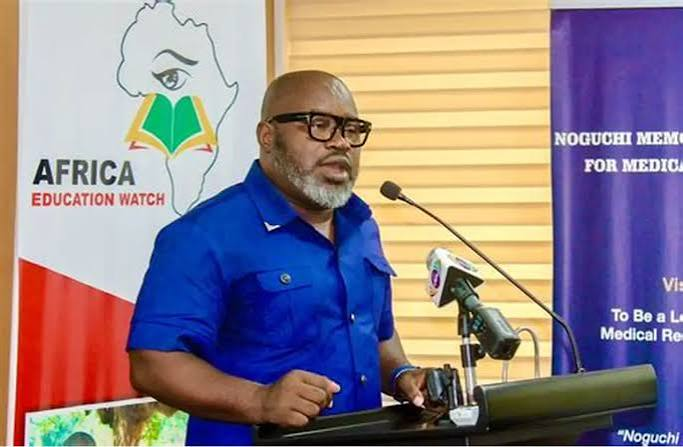
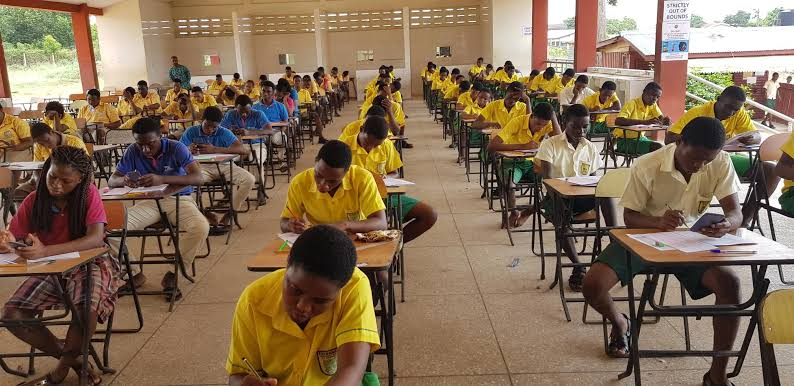
Africa Education Watch (Eduwatch) has raised significant policy concerns over the Ministry of Education’s disclosure that 54,985 candidates who sat the 2026 Basic Education Certificate Examination (BECE) did not qualify for placement into public Senior High Schools (SHS) or Technical and Vocational Education and Training (TVET) institutions, calling for clearer and more consistently applied academic qualification standards under the Free SHS/TVET programme.
Eduwatch argued that the scale of unplaced candidates raises an important policy question regarding the specific academic criteria currently used to determine qualification for placement, particularly around how Grade 9 performance in English Language and Mathematics has historically been treated within the system.
According to Eduwatch, the treatment of candidates who obtain Grade 9 in English Language or Mathematics has varied considerably from year to year, with Grade 9 used in some years to exclude candidates from placement, while in other years, candidates with the same grade have still been admitted into secondary education.
The organisation warned that this inconsistency creates ongoing uncertainty for candidates, parents and schools alike, undermining public confidence in how placement decisions are made each academic year.
“Such inconsistencies create uncertainty for candidates, parents and schools, and underscore the need for a clearly defined and consistently applied qualification standard within the Free SHS/TVET policy framework,”
Eduwatch

Free SHS Policy Should Reflect Universal Access Goals
Eduwatch situated its concerns within the broader context of Ghana’s Free Secondary Education policy, which has been in place since 2017 with the stated objective of making secondary education the minimum human capital foundation for every Ghanaian child.
The organisation argued that the definition of qualification for placement should increasingly reflect the country’s gradual transition toward universal secondary education, in which every basic school graduate has a seamless pathway into an appropriate second-cycle option, whether general secondary education or TVET, in line with international best practice.
Precedent From 2019 Worth Revisiting
To support its recommendations, Eduwatch pointed to a similar situation in 2019, when 38,355 candidates failed to qualify for placement under comparable circumstances. According to the organisation, government at the time supported affected public school candidates to return to and be mainstreamed into JHS 3, allowing them to prepare for and rewrite the BECE.
Eduwatch argued that a similar intervention should now be considered for the 54,985 candidates affected in 2026, incorporating targeted learning-improvement support alongside government absorption of the cost of resitting the examination.
“A similar intervention should be considered by the Ministry of Education for the 54,985 candidates affected in 2026, including targeted learning-improvement support and government absorption of the cost of resitting the examination,”
Eduwatch
Eduwatch’s Three-Point Call to the Ministry
Based on these concerns, Eduwatch outlined three specific recommendations for the Ministry of Education. First, the organisation called for the Ministry to clearly define and formally publish the minimum academic qualification required for Free SHS/TVET placement within the broader policy framework, in order to ensure transparency, consistency and predictability for all stakeholders going forward.
Second, Eduwatch called on government to provide targeted learning-improvement support to affected public-school candidates, while absorbing the financial cost of allowing them to resit the BECE, mirroring the intervention adopted in 2019.
Third, the organisation urged the Ministry to progressively align the country’s qualification and placement framework with the broader objective of achieving universal transition from basic to secondary education, whether through general secondary education or TVET pathways, ensuring that no qualified basic school graduate is left without a clear route into further education.
Taken together, Eduwatch’s recommendations point to a broader call for structural clarity within Ghana’s placement system, one that would reduce the uncertainty currently faced by candidates and families each examination cycle.
With the Ministry of Education yet to respond publicly to Eduwatch’s specific proposals, attention will likely turn to whether government considers a 2019-style intervention for this year’s affected candidates, and whether a clearer, published qualification standard is eventually adopted to guide future placement exercises.
READ MORE: Coalition Of Unpaid Teachers Demands 14 Months’ Salary Arrears