
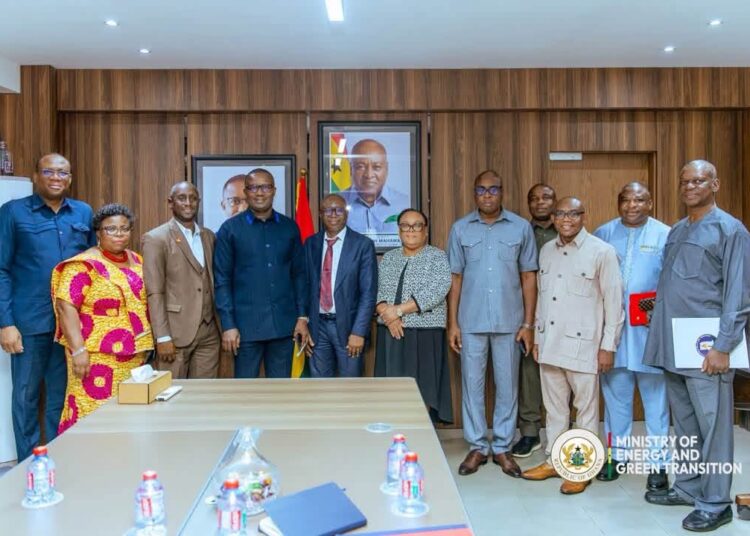
The government is preparing to expand renewable-energy use across Ghana’s public universities as part of efforts to reduce reliance on conventional electricity sources and strengthen the contribution of higher education institutions to the country’s energy transition.
The initiative emerged from discussions between Minister for Energy and Green Transition, Dr John Abdulai Jinapor, and the Vice Chancellors Ghana, where both sides explored stronger collaboration between academia and the energy sector on research, innovation and knowledge exchange.
The proposed programme will see solar power systems installed at academic facilities across public universities, enabling institutions to meet part of their electricity requirements from renewable sources.
The government also intends to complement the installations with all-in-one solar-powered streetlights across university campuses.
The move could give universities a more direct role in Ghana’s transition towards a more diversified electricity system, particularly as institutions with large campuses, lecture facilities, laboratories, administrative buildings and student accommodation represent significant electricity consumers.
Solar Investment To Support Campus Energy Needs
Dr Jinapor said the government’s plans are intended not only to increase renewable-energy deployment but also to create space for universities to contribute more meaningfully to Ghana’s wider energy transformation.

“Government intends to provide solar power systems for academic facilities across public universities, enabling these facilities to meet their electricity needs through renewable energy.”
Dr John Abdulai Jinapor, Minister for Energy and Green Transition
The planned solar systems would provide universities with an additional source of electricity while potentially reducing their exposure to fluctuations in conventional power costs.
The extent of the savings, however, would ultimately depend on the scale of the installations, the electricity demand of individual institutions, system performance and how the projects are financed and maintained.
The proposed solar-powered streetlights would similarly extend renewable-energy deployment beyond academic buildings into campus infrastructure, potentially reducing the electricity required for conventional outdoor lighting.
More importantly, the initiative places public universities within the practical implementation of Ghana’s energy-transition agenda rather than treating them solely as observers of policy.
Academia Positioned As Energy Transition Partner
The discussions also focused on research and innovation, highlighting the potential for universities to support the development of solutions suited to Ghana’s specific energy challenges.
Dr Jinapor said collaboration between government, industry and academia would be important in building the knowledge and technical capacity required to support the country’s transition.

“Our universities have an important role to play in this transformation, and Government will continue to create the enabling environment for academia to contribute meaningfully to Ghana’s energy future.”
Dr John Abdulai Jinapor
That role could extend beyond consuming renewable electricity. Universities can serve as testing grounds for energy technologies, centres for energy research and training, and sources of technical expertise for the wider power sector.
The intersection is particularly relevant as Ghana seeks to increase renewable-energy penetration while maintaining reliability and managing the intermittency associated with variable renewable sources such as solar.
Campus-level deployment could therefore provide an opportunity to demonstrate how solar generation, energy efficiency, storage and smart-energy management can work together within large institutional facilities.
Research And Energy Policy Converge
The government’s engagement with Vice Chancellors Ghana reflects a broader recognition that Ghana’s energy transition will require more than infrastructure investment.
Research institutions will be increasingly important in areas such as renewable-energy technologies, battery storage, energy efficiency, grid management, data systems and climate-related technologies.
For universities, the planned installations could also create practical environments in which students and researchers interact with operating renewable-energy systems rather than studying the technologies only in theory.

Dr Jinapor said the government was committed to creating the conditions for this closer relationship between academia and the energy sector.
The proposed programme consequently has two dimensions: using renewable energy to meet institutional electricity needs while strengthening universities as participants in Ghana’s broader energy transformation.
If implemented effectively, the initiative could turn public university campuses into visible demonstrations of Ghana’s renewable-energy ambitions, while creating opportunities for research, skills development and innovation around the systems being deployed.
For Ghana’s energy transition, that combination matters. The country will need both more clean electricity infrastructure and the human and institutional capacity to operate, innovate and expand it.
READ ALSO: Zelenskyy Bemoans International Community’s Response To Russia’s Attacks