Government reaffirms its commitment to transforming Ghana’s industrial sector through reliable energy, digital innovation, local value addition and targeted support for strategic industries.
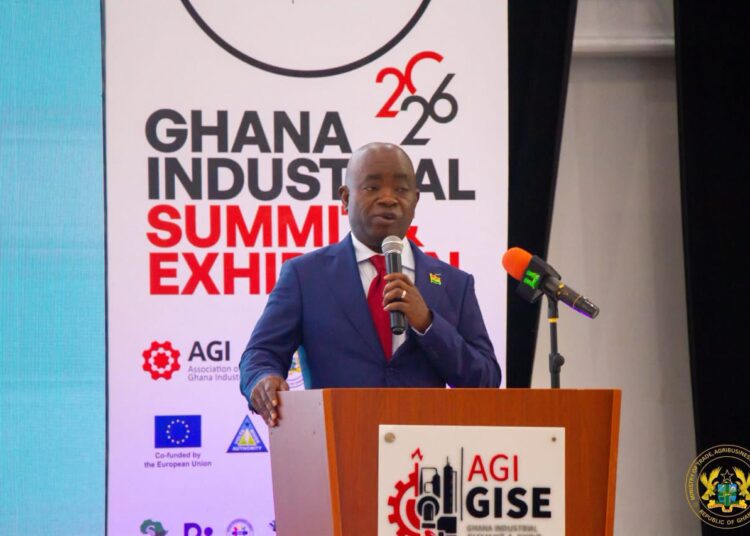
The Deputy Minister for Trade, Agribusiness and Industry, Hon. Sampson Ahi, says this at the 2026 Ghana Industrial Summit & Exhibition under the theme: “Driving Sustainable Export-Led Industrial Growth through Energy Reliability and Digital Innovation”.
Delivering the speech on behalf of the Minister for Trade, Agribusiness and Industry, Hon. Elizabeth Ofosu-Adjare, at the 2026 Ghana Industrial Summit and Exhibition (GISE) in Accra.
Hon. Ahi says Government is shifting from policy formulation to implementation through initiatives targeting textiles and garments, pharmaceuticals, automotive components and agribusiness.
“Government says it is moving beyond industrial policy formulation to implementation, with targeted interventions in textiles, pharmaceuticals, automotive components and agribusiness aimed at strengthening Ghana’s manufacturing base and export capacity.”
Hon. Ahi
Government Prioritising Reliable Energy, Digital Innovation and Local Value Addition
Hon. Ahi says government is prioritising reliable energy, digital innovation and local value addition as key pillars of its strategy to make Ghanaian industries more competitive.
One of industry’s most persistent constraints, the cost of power, is being addressed through a 1.5GW renewable energy pipeline dedicated to industrial use.
The initiative is aimed at providing a more stable and affordable power supply for manufacturers, agro-processors and other energy intensive industries. “It is our direct response to what the business community has repeatedly identified as its most pressing constraint,” he says.

He says the intervention forms part of government’s broader strategy to create conditions that enable businesses to invest with confidence, produce competitively and create jobs.
Hon. Ahi says initiatives such as the 24-Hour Economy, Rapid Industrialization for Jobs Initiative and Feed the Industry Programme are aimed at boosting production, creating jobs and increasing Ghana’s export competitiveness.
He explains that the newly established 24-Hour Economy Authority, together with the Ghana Local Value Addition Rebates, is expected to support enterprises involved in processing, manufacturing and value addition through fiscal incentives, tax relief and duty-free machinery imports.
24-Hour Economy Targets 1.7million Jobs
The 24-Hour Economy framework, he adds, is targeting the creation of approximately 1.7 million jobs over four years through continuous production, logistics and services. He says the Rapid Industrialization for Jobs Initiative focuses on strategic value chains where Ghana has comparative advantage.
While the ‘’Feed the Industry Programme’’ uses contract farming to create a reliable supply link between farmers and processing plants. For 2026, specific arrangements have been finalised to supply Ekumfi Fruit and Juices Limited in the Central Region, ensuring the facility operates at optimal capacity.
This model is intended to be replicated across other fruit processing and agro-industrial hubs to stabilize the supply chain and improve farmer incomes. He reiterates that industrial transformation begins with value addition.
For far too long, African economies have exported raw commodities only to import finished products at many times their value, and Ghana is working deliberately to change this dynamic.
According to him, strategic sectors such as cocoa, cashew, shea, palm oil, coconut and cassava are benefiting from renewed investments, expanded processing capacity and stronger market linkages all part of government’s broader agenda to ensure domestic producers capture more value from Ghana’s natural resources.
The Made-In-Ghana Focuses on Competiveness
The Minister’s speech also highlights the Made-in-Ghana Programme, which focuses on enhancing the competitiveness of locally manufactured brands, with the Ministry intending to invest heavily in the certification of local products and consumer awareness campaigns to shift consumption patterns toward domestic goods.

This initiative is a critical component of the national strategy to generate US$10 billion in non-traditional export (NTE) revenue by 2030.The President of the Association of Ghana Industries (AGI), Rd. Pharma Kofi Nsiah-Poku, calls for policy consistency, regulatory clarity and improved access to industrial financing.
He urges stakeholders to translate discussions at the summit into concrete actions to address energy challenges, promote digital transformation and strengthen Ghana’s export strategy.
Dr. Nsiah-Poku says despite progress on taxes and exchange rate stability, unfair trade practices and the influx of cheap imports remain among the biggest threats to domestic industry.
He says government’s 24-hour economy will be a major game changer if industry is incentivized well enough to scale, but there will be no basis for industry to produce more if local markets are flooded with cheap imports.
AGI to Support Government Fight Against Illicit and Substandard Goods
He pledges AGI support to government in intensifying the fight against illicit and substandard goods, describing the path to recovery as shared responsibility. The EU Ambassador to Ghana, H.E. Rune Skinnebach, says the EU is keen to see more “Made in Ghana” products on European markets.
He says the EU remains committed to supporting Ghana’s industrial ambitions and helping local businesses access international markets. He says Ghana’s commitment to value addition, standards and sustainability aligns with EU trade priorities.
The ninth GISE, organized by the AGI, brings together government, businesses and development partners to promote investment, innovation and export-led industrial growth.
The summit serves as a platform for aligning the Ministry’s priorities with its medium term development objectives, ensuring that trade, agribusiness, and industry together constitute a major pillar of the national economy.
Participants discuss digitization of business processes, streamlined customs procedures, strengthened quality standards, and measures requiring exporters to repatriate earnings through licensed banks within 100 days of shipment a step that restores confidence in the foreign exchange system.
Hon. Ahi concludes that Government is ready to work with the private sector to build a resilient, sustainable and globally competitive industrial sector capable of driving sustainable export led growth for Ghana.