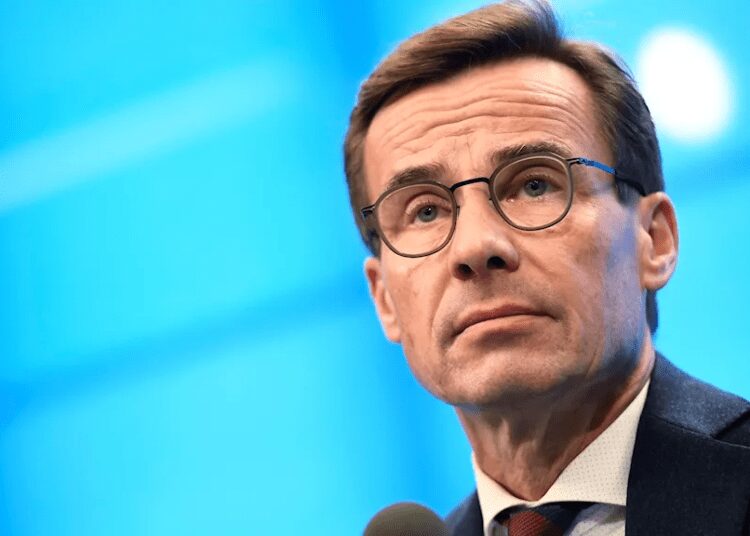
Sweden’s Prime Minister, Ulf Kristersson has resigned from office after final election results confirmed that his right-leaning political bloc lost last Sunday’s parliamentary election to four left-leaning parties.
The final count showed the opposition bloc securing a narrow majority, winning by 50,359 votes.
The four left-leaning parties are set to hold 176 seats in the new parliament, compared with 173 seats for Kristersson’s three-party coalition and the far-right Sweden Democrats, which were expected to join the administration after the election under the Tidö bloc.
The result gives former Prime Minister Magdalena Andersson’s Social Democrats the largest number of seats of any individual party, with 99 seats. However, the party itself lost eight seats compared with the 2022 election.
Andersson now faces the task of forming a government amid differences within the wider left-leaning bloc.
The opposition’s narrow lead had initially remained uncertain as the early results were counted. It was confirmed after ballots that had not reached polling stations by election day were included in the final tally, including votes cast from overseas.
Following confirmation of the result, Kristersson submitted his resignation, acknowledging the difficult conditions the close election had created for the formation of a new government.

In a letter posted on X, Kristersson said that the tight result “may have complicated the conditions for the new government to be formed.”
He said that cooperation among parties in parliament would be necessary to secure the appointment of a new prime minister and establish a government capable of passing a budget. “Constructive openness from the parties in parliament will now be needed for a prime minister to be accepted, and for a new government to be able to receive support for its state budget,” Kristersson said.
He also called for discussions among all parliamentary parties to find a way through the political deadlock and create the conditions for a stable and effective administration.
Kristersson said that the parliamentary Speaker would oversee the next stage of the government formation process. “In order for that work to begin immediately, I hereby request to be relieved of my duties as Prime Minister,” he concluded.
Kristersson’s resignation marks the beginning of a new phase of negotiations over Sweden’s next government, with Andersson’s Social Democrats emerging as the largest party but the broader opposition bloc facing the challenge of maintaining unity.
The composition of the new parliament means that negotiations will be necessary before a government can be formed and secure sufficient parliamentary support for its budget.
Andersson Pledges Sweden A “New Direction”
Meanwhile, Magdalena Andersson pledged in a speech posted on social media to lead Sweden in what she described as a “new direction” after the election victory of the four-party left-leaning bloc.
“The Swedish people have voted for a new direction for our country. Voted for unity and against division.
“The Swedish people have voted to move Sweden forward, and I want to realise the new direction that you have voted for.”
Magdalena Andersson
As political talks begin over the formation of the next government, Andersson said she wanted to move the country away from political confrontation and toward greater cooperation among key parties.
She said that she wanted to lead Sweden “away from conflicts from the sake of conflicts, and in a direction based on unity.”
Andersson also called on political parties to put their partisan interests aside during the negotiations. “It is up to all political parties to put the party politics aside and put Sweden and the Swedish people first,” she iterated.
She highlighted climate policy, schools, healthcare and social care among the areas where she wants to pursue changes to the policies of the outgoing government.
Her comments come as she prepares for potentially complicated negotiations with other parties in the left-leaning bloc. While the bloc secured a narrow parliamentary majority, differences between its constituent parties could affect the formation and stability of the next government.
Kristersson had held out the prospect of Cabinet seats for the Sweden Democrats this time, if the governing coalition won. However, it was a disappointing election for the Sweden Democrats, who dropped into third place behind the outgoing prime minister’s Moderates and took 62 seats, 11 fewer than four years ago.
Andersson faces the task of overcoming differences in the opposition bloc. The Center Party, which aligned with the left because it does not wish to govern with the Sweden Democrats, also doesn’t want to go into government with the Left Party at the other end of the spectrum.
The Speaker of parliament will now oversee the process of identifying a candidate capable of securing sufficient parliamentary support to become Prime Minister.
READ ALSO: Carney Backs Canada-EU Associate Membership