TotalEnergies is set to raise $1.8 billion from Global Infrastructure Partners (GIP), part of BlackRock, through an agreement that allows the French energy company to unlock capital from some of its oil and gas infrastructure interests across Africa.
The transaction, announced on Friday, September 18, will provide TotalEnergies with the upfront capital in exchange for payments to GIP linked to future volumes transported through the infrastructure covered by the agreement.
The arrangement gives TotalEnergies access to capital without an outright sale of the underlying infrastructure, while giving GIP exposure to revenues generated as hydrocarbons move through the assets over a period of up to 15 years.
The companies have not disclosed which infrastructure assets or African countries are covered by the agreement.
That leaves the precise scope of the transaction unclear, and means individual projects in TotalEnergies’ African portfolio cannot automatically be identified as part of the deal.
For Ghana, however, the transaction offers a useful perspective on the growing importance of finding new ways to finance energy infrastructure at a time when governments and companies across Africa face substantial investment requirements.
Unlocking Value From Existing Infrastructure
The agreement represents a financing structure built around the future economic value of infrastructure already connected to energy production and transportation.
Rather than receiving returns principally from the direct ownership of the infrastructure, GIP will receive payments linked to the volume of products transported through the assets.
TotalEnergies, meanwhile, receives capital immediately while retaining exposure to the infrastructure.
TotalEnergies Chief Financial Officer Jean-Pierre Sbraire said the arrangement would allow the company to realise value from its existing African infrastructure portfolio.
“We are pleased to strengthen our relationship with GIP through this infrastructure agreement which crystallizes the value of some of our midstream infrastructure assets in Africa. The agreement allows us to unlock value from infrastructure that supports our African activities while bringing forward capital through a long-term arrangement linked to future volumes transported through the relevant assets.”
The structure is significant because it separates part of the value of infrastructure from the broader financial performance of the oil and gas projects it supports.
For an energy company with extensive production and transportation assets, infrastructure can generate relatively predictable revenue when volumes remain sufficiently strong.
That makes those future cash flows potentially attractive to long-term infrastructure investors.
The model also allows the asset owner to raise capital without necessarily surrendering ownership of the infrastructure itself.
TotalEnergies has not disclosed how it intends to use the $1.8 billion.
Ghana’s Infrastructure Question
The financing approach comes at a time when Ghana is also seeking greater investment in the infrastructure underpinning its petroleum sector.
Ghana’s challenge is not identical to TotalEnergies’ position. TotalEnergies is monetising infrastructure within a large multinational portfolio, while Ghana’s priority is to develop infrastructure that can strengthen domestic energy security and reduce exposure to external supply disruptions.
The connection is therefore principally about financing.
Ghana has been seeking to increase the use of locally produced crude by domestic refineries while strengthening storage, transportation and other infrastructure across the petroleum value chain.
The country’s dependence on imported petroleum products has made infrastructure a particularly important component of energy security.
Reliable storage provides a buffer against disruptions.
Efficient transportation reduces logistical costs.
Domestic refining can reduce dependence on imported finished products.
But each requires capital, and the availability of public financing is constrained by Ghana’s broader fiscal position.
This is where structures that allow infrastructure to attract private investment become increasingly relevant.
The TotalEnergies transaction demonstrates one possible principle: infrastructure can be treated as an income-generating asset whose future cash flows can support financing.
That does not mean Ghana could simply reproduce the TotalEnergies-GIP structure.
The viability of such arrangements depends on the nature of the asset, expected throughput, contractual arrangements, regulatory conditions and the reliability of the revenues supporting the investment.
For Ghana, those conditions would need to be carefully established before similar structures could support strategic petroleum infrastructure.
Africa’s Existing Assets Gain New Importance
TotalEnergies’ African portfolio illustrates why infrastructure has become increasingly important to energy companies operating on the continent.
In Angola, the company is already producing significant volumes of crude and has said it and its partners intend to invest $10 billion in projects over the next five years.
The company is also pursuing developments that make use of infrastructure already in place.
One example is the Acacia-5 discovery on Block 17, which TotalEnergies plans to connect to the existing Pazflor floating production, storage and offloading facility.

The approach is designed to avoid the need for an entirely separate production system for a relatively small discovery.
TotalEnergies expects Acacia-5 to add around 6,000 barrels per day to Block 17 production.
The company has also agreed to acquire a 40% operated interest in exploration Blocks 17/25 and 32/21 in Angola’s Lower Congo Basin.
Their proximity to existing TotalEnergies-operated infrastructure could potentially allow future discoveries to be connected to established facilities.
The commercial logic is straightforward: where infrastructure already exists, new production can potentially be brought online without replicating the full cost of developing standalone facilities.
But these projects should not be interpreted as confirmation that they are included in the GIP agreement.
TotalEnergies has not identified the infrastructure covered by the transaction.
EACOP Highlights Scale Of African Investment
Another major infrastructure interest held by TotalEnergies is the East African Crude Oil Pipeline (EACOP).
TotalEnergies holds a 62% interest in the project, which is designed to transport crude from Uganda’s Lake Albert region to Tanzania’s Chongoleani peninsula near the port of Tanga.
The pipeline stretches approximately 1,443 kilometres and is designed to transport up to 246,000 barrels of crude per day.
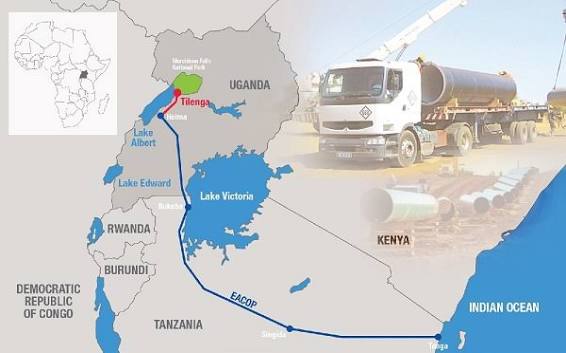
EACOP is being developed by TotalEnergies alongside Uganda National Oil Company, Tanzania’s state petroleum company and China’s CNOOC.
The project was reported to have reached 92.7% completion earlier in September.
Its scale demonstrates the capital intensity of moving African crude from inland production areas to international markets.
It also reinforces the importance of infrastructure in determining whether petroleum resources can ultimately translate into economic value.
Nevertheless, EACOP, like the company’s Angolan assets, should not be assumed to form part of the GIP transaction unless TotalEnergies identifies it as one of the covered assets.
Infrastructure Financing Beyond Oil Production
The broader significance of the agreement lies in the changing relationship between energy companies and infrastructure investors.
Infrastructure traditionally formed part of the capital base required by oil and gas companies to develop and transport their production.
Increasingly, however, infrastructure itself is becoming an investment proposition.
For investors such as GIP, long-term exposure to infrastructure-linked cash flows can provide a way of participating in the energy sector without necessarily taking direct exposure to every aspect of commodity-price risk.
For energy companies, monetising infrastructure can provide liquidity while allowing them to retain operational involvement and exposure to future activity.
That distinction could become increasingly relevant across Africa.
The continent needs investment in pipelines, terminals, storage facilities, gas infrastructure, electricity networks and other systems required to move energy from where it is produced to where it is consumed.
Public financing alone is unlikely to meet all those requirements.
The challenge is therefore to create projects with revenue models sufficiently transparent and predictable to attract long-term private capital.
Ghana faces the same broader investment challenge in its own energy sector.
The country is seeking to strengthen domestic petroleum infrastructure while also expanding natural gas utilisation, renewable energy and electricity infrastructure.
Those priorities compete for limited public resources.
A stronger private investment framework could help ease that constraint, provided strategic national interests remain protected.
Commercial Returns And Energy Security
There is, however, a balance to be maintained.
Energy infrastructure is not purely a financial asset.
Some infrastructure exists because it serves a strategic national purpose, even where the direct commercial return may be limited.
This is particularly relevant to Ghana’s petroleum storage and transportation network.
The commercial viability of an asset must therefore be considered alongside its role in protecting supply during periods of disruption.
That creates a different investment challenge from simply maximising financial returns.
Any infrastructure-financing model adopted in Ghana would need to establish who carries the operational risk, how investors are compensated, how tariffs are determined and how access to strategically important infrastructure is governed.
It would also need to avoid creating arrangements that make essential energy services unnecessarily expensive.
The TotalEnergies transaction does not answer those questions for Ghana.
What it does show is that established energy infrastructure can have a value that extends beyond the balance sheet of the company that owns it.
That value can potentially be converted into capital when future cash flows are sufficiently predictable.
A Financing Model Worth Watching
For TotalEnergies, the immediate benefit is clear: $1.8 billion in upfront capital from infrastructure interests while payments to GIP are spread over a period of up to 15 years and linked to future transportation volumes.
The company has not provided details on the use of the proceeds or identified the assets involved.
That makes it too early to determine the full financial or strategic implications of the transaction for any particular African country or project.
But the deal comes at a time when African energy infrastructure requires large and sustained investment.
For Ghana, the relevance is not that the country is directly involved in the TotalEnergies-GIP agreement.
It is that the transaction provides another example of how private capital can be brought into infrastructure by giving investors exposure to future, asset-linked revenues.
As Ghana works to strengthen refining, storage, crude supply and other parts of its petroleum value chain, the ability to develop commercially credible infrastructure projects will increasingly matter.
The country’s energy-security ambitions will require more than policies designed to reduce imports or increase domestic production.
They will also require infrastructure capable of moving, storing and processing energy reliably.
The TotalEnergies transaction therefore offers Ghana a financing lesson rather than a direct precedent: strategic infrastructure does not necessarily have to rely entirely on conventional public expenditure or corporate balance sheets.
Where the underlying assets can generate reliable cash flows, institutional investors may have a role in bringing forward the capital needed to expand energy systems.
The difficult part for Ghana will be designing those arrangements so that investment, commercial sustainability and national energy security reinforce rather than undermine one another.