
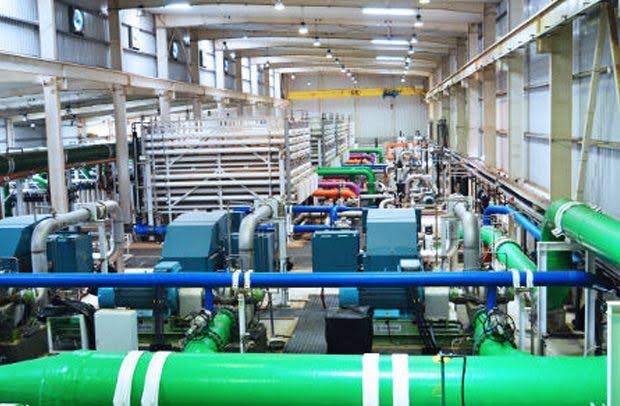
The Government of Ghana says it is making significant progress in talks to buy the Teshie desalination plant, a move aimed at avoiding a US$235 million arbitration payout to the plant’s developer.
The Office of the Attorney-General disclosed the negotiations in a statement issued in Accra on Wednesday, September 23, 2026, responding to an International Chamber of Commerce (ICC) award against Ghana Water Company Limited (GWCL).
The talks with Befesa Desalination Developments Ghana Ltd began before the tribunal delivered its final decision, according to the statement. The government is now banking on a purchase deal to replace the cash award with full state ownership of the facility and to bring the plant back to full operation.
Government Bets on Purchase Deal for Teshie Desalination Plant
The Attorney-General’s office made clear that the arbitration outcome has not derailed the negotiations. “The award notwithstanding, significant progress has been made in the negotiations for the purchase of the plant to avoid the payment of the said $235 million,” the statement said.
The proposed acquisition would give the state full ownership of the Teshie desalination plant. Officials say it would also help restore the facility’s operations, which the government wants concluded within the shortest possible time so the plant can return to full operation.

The strategy effectively seeks to convert a legal liability into a public asset. Rather than paying the award in cash to a company that has exited the arrangement, the state would take control of the infrastructure itself.
Why Ghana Owes US$235 Million Over the Plant
The pressure behind the talks comes from ICC Case No. 29029/CPB. Befesa and Standard Bank of South Africa Limited initiated the arbitration against Ghana Water on October 23, 2024, following the termination of the Water Purchase Agreement (WPA) that governed the plant.
The tribunal found that Befesa had validly terminated the WPA and was entitled to contractual termination payments. It awarded the claimants US$235 million, net of taxes, including pre-award interest calculated up to March 31, 2026.
The clock has not stopped there. Further interest on the debt component began accruing from April 1, 2026, meaning every month without a settlement adds to what Ghana owes. That running cost gives the government a strong incentive to close the purchase quickly.
The Vaultz News has examined how the award deepens Ghana’s fiscal exposure as the government manages competing demands on public finances.
Tribunal Rejects US$402 Million Unpaid Charges Claim
The Attorney-General’s statement also highlighted a claim Ghana avoided. Befesa and its co-claimant had sought approximately US$402 million in water charges they said GWCL failed to pay, in addition to the termination payments.
“The Tribunal held that Claim 1 and Claim 2 could not be recovered cumulatively,” the statement said. With the tribunal settling on termination payments, the greater demand fell away. The Attorney-General’s office used the rejected US$402 million figure as its benchmark and calculated that the final award represented 58.4 percent of the monetary claim.
That percentage carries its own cost. The tribunal ordered Ghana Water to reimburse 58.4 percent of the claimants’ reasonable defence and representation costs, a sum the statement did not quantify.
State Guarantee Raises the Stakes for Government
The government’s direct involvement in the purchase talks reflects its own legal exposure. In a parallel arbitration, ICC Case No. 29030/CPB, Befesa pursued the Republic of Ghana under the state guarantee that backed the water purchase arrangement.
According to the Attorney-General, the tribunal’s award in that case substantially followed the decision against Ghana Water and principally held the state liable for the utility’s obligations.
The finding means the burden of the Teshie desalination plant award does not rest on GWCL alone. The state stands behind the debt, so a failure to settle would ultimately fall on the national purse. A successful acquisition would therefore protect both the utility and the government from the full weight of the award.
Beyond the numbers, the negotiations carry consequences for water supply in the capital. The Teshie desalination plant serves parts of eastern Accra, and the government has tied its purchase plan directly to getting the facility working at full capacity again.
For residents and businesses in the communities the plant supplies, the pace of the talks matters. A concluded deal would put the facility under state control and, by the government’s account, set the stage for restored operations.
Key Questions Remain Unanswered
The Attorney-General’s statement left several questions open. It did not disclose the proposed purchase price or whether the government expects that price to fall below the US$235 million award. It also gave no indication of how the acquisition would be financed or when officials expect to sign a final agreement.
The statement did not say whether the ongoing negotiations would suspend the interest accruing on the award, nor whether Standard Bank of South Africa, as co-claimant in the GWCL case, is party to the purchase discussions.

The coming weeks will test whether the government can turn its stated progress into a signed deal. A concluded purchase would allow Ghana to sidestep the US$235 million payout, take ownership of a strategic water asset and restart supply to eastern Accra.
A delay would leave the award, the state guarantee and the growing interest bill hanging over the public purse. For now, the government is racing to close the deal before the cost of waiting climbs any higher.
READ ALSO: 66 Years After Nkrumah, Mahama Delivers Ghana’s 25th UN Address