The Institute of Economic Affairs (IEA) has firmly rejected the government’s stance on constitutional amendments concerning natural resource ownership, insisting that all mineral deposits, water bodies, and public lands must vest directly in the people of Ghana rather than the executive presidency.
Responding through press conference to official executive pushback against proposed reforms to Article 257(6) of the 1992 Constitution, the think tank countered the state’s assertion that existing fiduciary arrangements sufficiently safeguard public interest.
The policy organization maintains that shifting legal custody directly to the citizenry establishes an unequivocal public trust framework, compelling state institutions to manage Ghana’s wealth transparently for both current generations and posterity.
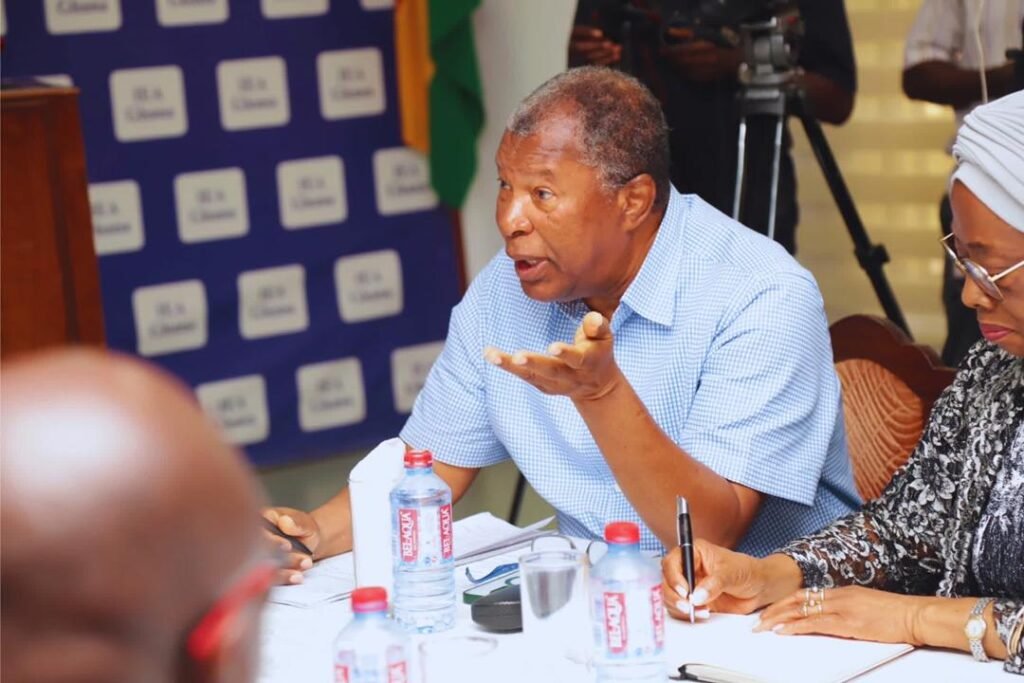
“The IEA supports a clearer public ownership framework under which public lands vest directly in the people of Ghana and be managed by the Lands Commission on their behalf, while natural and mineral resources should likewise vest in the people of Ghana and be managed by an appropriate authority established by the constitution on their behalf. This approach would make explicit the principle that Ghana’s lands and natural resources constitute a national patrimony belonging to the people and must be managed for the benefit of both present and future generations so that we living now will be compelled to leave something of value for those following us.”
Justice Sophia Akuffo, IEA Fellow and former chief justice
Expanding on its principled objection, the IEA contends that the government’s reliance on ordinary statutory legislation to elaborate public trust principles leaves finite national assets vulnerable to political exploitation and administrative abuse.
The government had previously turned down the Constitutional Review Commission’s recommendation to amend Article 257(6), arguing that public lands are already constitutionally vested in the President in a fiduciary capacity without personal title or beneficial interest.
However, the think tank asserts that legislative measures alone cannot substitute for explicit constitutional ownership guarantees.
Under the IEA’s proposed governance structural overhaul, public lands would be held in trust for the citizenry and administered directly by the Lands Commission, while natural and mineral resources would be overseen by an independent constitutional body established specifically on behalf of the sovereign people.
Reforming Executive Control and the Lands Commission Governance Structure
Beyond the broad debate on resource sovereignty, the dispute highlights deep structural defects within Ghana’s primary land administration apparatus.
Under the existing 1992 constitutional setup, the President exercises extensive patronage power by directly appointing members of the Lands Commission.
This centralized authority covers the appointment of the chairperson, the chief administrator, and institutional representatives nominated by bodies such as the National House of Chiefs, the Ghana Bar Association, the Ghana Institution of Surveyors, regional commissions, and the Town and Country Planning Department.

To insulate resource governance from executive influence, legal policy advisors recommended stripping out these rigid institutional listings under Articles 258, 259, and 264.
Replacing exhaustive constitutional prescriptions with a dynamic Act of Parliament would allow legislature to define qualifications, appointments, and operational compositions tailored to modern governance demands. Such structural flexibility ensures that regulatory authorities operate with absolute autonomy, safeguarding the extractive sector from partisan interference.
The Imperative for a Constitutional Public Trust Model in Resource Management
The urgent necessity for this constitutional overhaul stems from decades of resource misallocation, environmental degradation, and the systemic failure of fiduciary accountability.
In the extractive sector, vesting absolute legal sovereignty in the executive office has historically created an environment where resource concessions can be granted without sufficient accountability to host communities.
Transitioning to a true public trust model establishes a legally binding obligations framework that prevents temporary custodians from depleting non-renewable mineral reserves without securing long-term economic returns.

Furthermore, establishing that natural deposits form an inviolable national patrimony provides crucial legal leverage for environmental protection and generational equity.
When resources belong explicitly to the people, present administrators are legally bound to conserve ecological systems and build enduring wealth for future generations.
Codifying this principle within the supreme law of the land rather than relying on amendable parliamentary statutes guarantees that public heritage remains protected against shifting political interests.
Securing Intergenerational Equity and National Assets for Tomorrow
Ultimately, the debate over Article 257(6) represents a pivotal moment for Ghana’s extractive and natural resource policy.
Without constitutional entrenchment, public assets remain exposed to governance vulnerabilities that statutory frameworks cannot permanently resolve.
By demanding direct citizens’ ownership managed by constitutional bodies, the IEA seeks to establish a permanent framework of generational stewardship.
Ensuring that current generations extract mineral wealth with mandatory accountability guarantees that the nation leaves tangible assets, environmental stability, and economic legacy for those who follow.
READ ALSO: EOCO Links Baffour Awuah Arrest Attempt To Ongoing Investigation