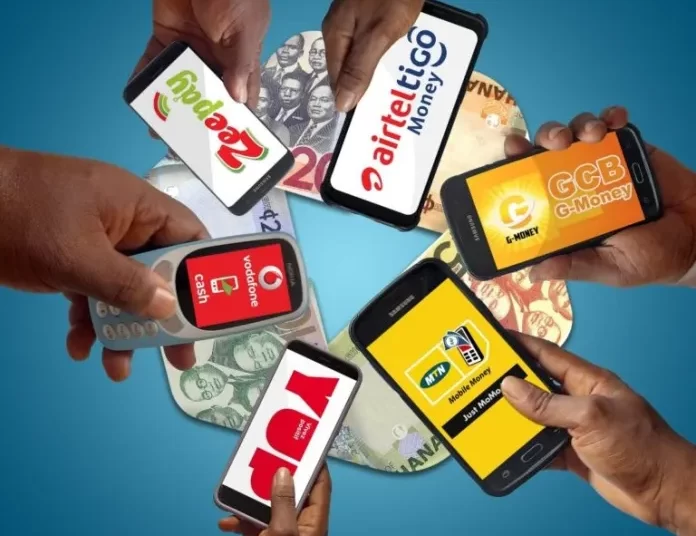
Ghana’s mobile money industry is rapidly becoming one of the most powerful forces in the country’s financial system, with the total value of transactions reaching GH¢3.8 trillion as of August 2026.
The latest figures from the Bank of Ghana show that mobile money is no longer simply a convenient way to send small amounts of money, pay bills or receive funds. The sheer value moving through mobile money platforms points to a major transformation in how individuals and businesses conduct financial transactions.
The development also highlights the growing importance of financial technology as more economic activity shifts away from conventional banking channels and onto digital platforms.
According to the September 2026 Bank of Ghana Summary of Economic and Financial Report, total mobile money transaction value stood at GH¢446.2 billion in January 2026.
That figure edged up to GH¢446.6 billion in February before rising sharply to GH¢484.6 billion in March. Transaction value climbed further to GH¢493.2 billion in April and reached GH¢494.0 billion in May.
Although June recorded a marginal decline to GH¢492.9 billion, the market quickly regained momentum. Transactions rose to GH¢509.4 billion in July before reaching GH¢518.8 billion in August.
The August figure represents the highest monthly transaction value recorded during the period covered by the data.
GH¢4.54trn annual record could face another challenge
The latest performance comes after mobile money recorded a massive expansion in 2025.
According to the data provided, total mobile money transaction values increased by 50.8% in 2025 to GH¢4.54 trillion, compared with GH¢3.01 trillion in 2024.
That means the industry has already moved through a substantial portion of the previous year’s transaction value within just eight months of 2026.
The continued monthly increases could therefore put another annual record within reach.
While transaction values do not represent economic output or income earned by mobile money providers, they demonstrate the enormous volume of financial activity being processed through electronic money platforms.
The trend also reflects how deeply mobile money has become embedded in everyday economic activity.
Millions of accounts keep Ghana’s MoMo economy moving
The Bank of Ghana data further shows that active mobile money accounts stood at 26.4 million as of August 2026.
This compares with 85.8 million registered mobile money accounts.
The gap between registered and active accounts remains significant, but the number of active accounts still represents a substantial user base supporting the country’s rapidly expanding digital payments ecosystem.
Mobile money has become an important financial tool across different segments of society. Individuals use the platforms to transfer funds, pay for goods and services, receive salaries and support family members.
Businesses, meanwhile, increasingly rely on digital payments to collect revenue, settle transactions and interact with customers.
The convenience of completing transactions without visiting a bank branch has helped mobile money become part of the daily routine of millions of people.
Fintech opportunities continue to expand
The growth in transaction value is also creating a larger opportunity for fintech companies operating around payments, digital banking, merchant services and financial inclusion.
As more money moves electronically, demand can increase for services that make payments faster, safer and more efficient.
The expanding transaction ecosystem also creates opportunities for businesses that provide digital financial infrastructure, payment solutions, data analytics and tools for merchants.
According to the 2025 Payment Systems Oversight Annual Report, the acceleration in transaction values underscored the increasing importance of e-money platforms in supporting economic transactions.
That observation captures a significant shift in Ghana’s financial ecosystem.
Mobile money platforms are no longer operating on the margins of the financial sector. They have become an important channel through which economic transactions take place.
Traditional banking faces a changing financial landscape
The surge in mobile money activity also raises questions about the relationship between digital finance and traditional banking.
Banks remain central to savings, credit, investment and other formal financial services. However, mobile money has changed how many people access and move money.
A customer can transfer funds, make payments or receive money without physically entering a bank branch. This convenience has particularly strengthened digital payment adoption among consumers and businesses that value speed and accessibility.
The growing transaction volumes could encourage banks and fintech companies to deepen partnerships, develop more digital products and compete for customers through increasingly convenient payment services.
Ghana’s digital finance revolution gathers pace
With GH¢3.8 trillion already recorded in mobile money transaction value by August 2026, the sector has demonstrated remarkable momentum.
The monthly increase from GH¢446.2 billion in January to GH¢518.8 billion in August shows how quickly transaction activity can expand within a single year.
As digital payments become increasingly integrated into commercial and personal transactions, Ghana’s financial system is likely to see even greater interaction between banks, fintech companies, mobile money operators and merchants.
The figures ultimately point to a financial system where the movement of money is becoming increasingly digital, immediate and accessible.
READ ALSO: Qatar Urges Gaza Recovery and Palestinian Statehood