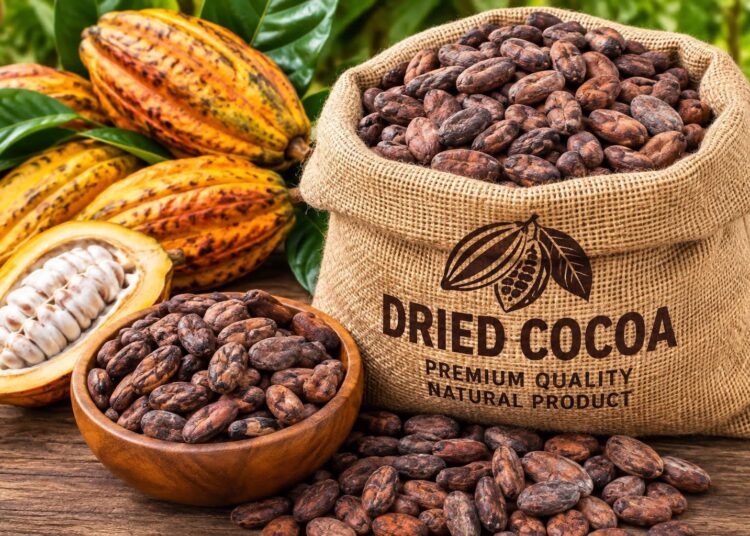
The Young Cocoa Farmers Association (YONCOF) is expressing concern over the newly announced producer price of cocoa for the 2026/2027 crop season, saying the GH¢63 increase per 64-kilogramme bag does not adequately reflect the rising cost of production.
In a press statement, the Association says it accepts the new producer price but remains dissatisfied with the level of the increase. The statement follows the opening of Ghana’s 2026/2027 cocoa season, with the Ghana Cocoa Board (COCOBOD) increasing the producer price from GH¢41,392 to GH¢42,400 per tonne.
The new price translates into GH¢2,650 per 64-kilogramme bag, up from GH¢2,587 previously.
‘’Our concern is largely centred on production costs facing cocoa farmers. We cocoa farmers are dealing with expenses related to labour, fertiliser, chemicals, transportation and farm maintenance, which it says continue to place pressure on farm incomes. Our Expectation was for a Price that Adequately Reflects the Rising cost of Cocoa Production.”
YONCOF
The GH¢63 increase represents about 2.4 percent when measured against the previous producer price per bag. At the tonne level, the increase is GH¢1,008, moving the producer price from GH¢41,392 to GH¢42,400.
COCOBOD says the new producer price represents 71.18 percent of the realised gross Free-on-Board (FOB) value of cocoa. The pricing arrangement is being implemented under the Ghana Cocoa Board Act, 2026 (Act 1182), which provides that cocoa farmers receive a minimum of 70 percent of the realised gross FOB value.
However, the Young Cocoa Farmers Association says the price needs to be considered alongside the actual expenses involved in producing cocoa. It says profitability is important if Ghana is to attract younger people into cocoa farming and retain farmers already operating in the sector. “Our Position Has Always Been Clear, Farmers Deserve a Fair and Meaningful Price,” YONCOF says
The Sustainability of Ghana’s Cocoa Producer Pricing
The Association also links the issue of producer pricing to the future sustainability of Ghana’s cocoa industry. It argues that young people are more likely to consider cocoa farming as a viable business when the returns adequately compensate for their investment, labour and resources.
It adds that cocoa farming needs to be approached as an economic enterprise capable of generating sustainable income rather than being maintained simply as a traditional occupation. “The Returns on their Investment, Labour and Resources must be Meaningful,” the Association says.
The concerns come at a time when Ghana’s cocoa industry is undergoing significant financial and structural changes. COCOBOD says the 2026/2027 pricing arrangement forms part of wider reforms aimed at improving the financial sustainability of the sector, strengthening governance, increasing transparency and improving returns to farmers.
Beyond the producer price, COCOBOD says it is continuing productivity enhancement programmes intended to reduce the production burden on farmers. These include the provision of free fertiliser, free hybrid cocoa seedlings and the Cocoa Disease and Pest Control Programme.
The interventions are designed to improve yields while reducing some of the costs associated with cocoa production.
The financing of cocoa purchases is also becoming a major component of the sector’s current reforms. Cocoa Capital PLC, a wholly owned subsidiary of COCOBOD, is seeking to raise up to GH¢16.3 billion through a domestic cocoa notes programme.
About GH¢14 billion is planned through commercial paper to support cocoa purchases, while GH¢2.3 billion is earmarked for medium- to long-term financing, including refinancing existing obligations.
The financing initiative comes after challenges surrounding cocoa-sector funding contributed to uncertainty over the timing of purchases in the previous season.For farmers, however, the level and timing of payment remain important considerations.
YONCOF says the effectiveness of the new producer price should ultimately be measured by whether farmers can cover production expenses, make a reasonable profit and reinvest in their farms. “The true test of the new price will be whether farmers can produce cocoa, make a reasonable profit, receive payment promptly,” the Association says.
The Sector is also Facing Production Related Challenges
COCOBOD has previously pointed to weather conditions, disease, ageing farms and illegal mining as factors affecting cocoa production prospects. Reports indicate that Ghana’s 2026 cocoa production reaches 771,000 metric tonnes, while COCOBOD is targeting 683,000 metric tonnes for 2027.
Meanwhile, Ghana is strengthening traceability ahead of the European Union Deforestation Regulation, which is expected to take effect for cocoa exports from December 30, 2026.
COCOBOD says the Ghana Cocoa Traceability System is fully deployed across cocoa-growing areas and is intended to help Ghana supply cocoa that can be traced and verified as deforestation-free, child-labour-free and legally produced.
YONCOF is also acknowledging Parliament for its intervention following its earlier call for the timely commencement of the 2026/2027 purchasing season. The Association says young cocoa farmers remain committed to the future of Ghana’s cocoa industry despite their concerns over the new price.
“This Marginal Increase Does Little to Improve the Economic Position of Cocoa Farmers,” The debate over the GH¢2,650 producer price therefore places farmer income, production costs, sector financing and productivity at the centre of discussions about the future of Ghana’s cocoa industry as the new crop season gets underway.
READ ALSO:Ghana Banks Near Crucial NPL Target With August Improvement