
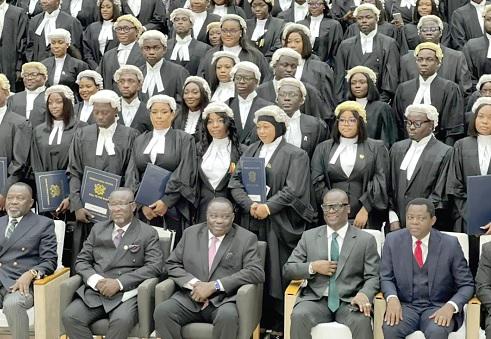
Chief Justice of the Republic of Ghana Paul Kwadwo Baffoe-Bonnie has urged Ghana’s newest lawyers to serve people who cannot afford expensive legal services. He made the appeal at the 2026 call to the Bar on Friday, October 9, 2026, organised by the General Legal Council at the ICGC Christ Temple on Teshie Bush Road in Accra.
Justice Baffoe-Bonnie argued that the law exists ultimately for people, and he sketched the faces of those it must reach, from a woman losing her land to a prisoner without a lawyer. He insisted that the most important case of a lawyer’s career may never reach the headlines.
“Go where the law is needed. Stand with the person who has no voice. Speak for the person who does not know the language of the courtroom.”
Chief Justice Paul Kwadwo Baffoe-Bonnie
Justice Baffoe-Bonnie grounded his appeal in a simple premise. “The law exists ultimately for people,” he stated. He then asked the new lawyers to picture the people behind the profession.

Somewhere in Ghana, he said, a woman’s small piece of land is being taken by someone with greater money, greater influence or simply greater power. Somewhere else, a young girl’s dignity and future may depend on whether anyone speaks for her.
He added a dismissed worker, a prisoner who cannot afford a lawyer, a family fighting over the only property their parents left behind, a small businessman whose livelihood is threatened and a child whose voice nobody has thought important enough to hear.
Those Who Never Enter the Great Halls
The Chief Justice told the class that these people will probably never attend the ceremonies that celebrate the profession. He stated: “These people may never enter the great halls in which we celebrate the legal profession, but they are the reason the profession matters.”
He told the lawyers not to define success by the size of an office or the height of a fee. The profession, in his telling, earns its worth by serving those with the least power. Justice Baffoe-Bonnie reminded the new lawyers that recognition and importance are different things.
He observed that “the most important case of your career may not be the one that makes the newspaper headlines.” It may instead be the case of one ordinary person who comes to a lawyer because he has nowhere else to go.
He placed a value on that service that numbers cannot capture. “If you help that person obtain justice, you may have done something more valuable than winning 100 cases for applause,” he declared.
Competence Behind Compassion
The Chief Justice warned that goodwill alone is not enough. Compassion must come with competence, he insisted. Lawyers must read widely, know the law, understand its history and purpose, write clearly, prepare thoroughly and listen carefully. Confidence, he cautioned, will not make up for inadequate preparation.
He also asked for advocacy that is fearless but never abusive. A lawyer should represent a client faithfully, he explained, and a lawyer is never above the law but under a higher obligation to it.

Justice Baffoe-Bonnie connected the record class of 1,568 lawyers to the needs of ordinary citizens. More lawyers, he suggested, can mean more people who can use the law “to open doors which poverty, ignorance, or privilege has kept shut.”
He asked the new lawyers to remember what the law is for. In his words, the law “must remain a shield for those who have little power of their own and not a sword for the powerful.”
He ended by urging them to ask a harder question than what the law can do for them. He asked them to consider what they can do with the law for Ghana.
READ ALSO: Energy Minister Commends NPA Chief On Petroleum Market Stability