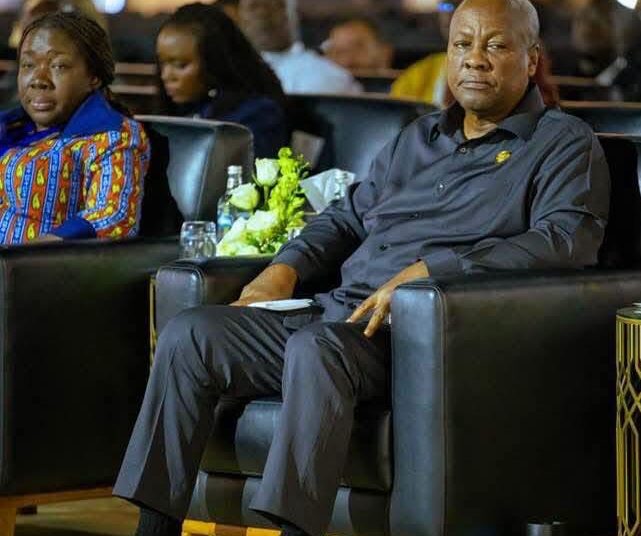
President John Dramani Mahama has commended the Minister for Trade, Agribusiness and Industry, Elizabeth Ofosu-Adjare, for her efforts to address operational challenges facing manufacturers, as the government intensifies its drive to expand domestic production, attract investment and create jobs.
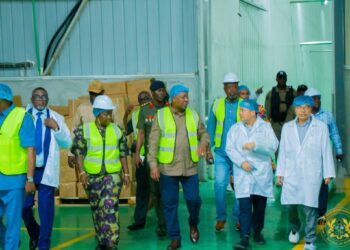
The President gave the commendation during a working visit to Kasapreko PLC’s manufacturing facility in Accra where he highlighted the importance of strengthening collaboration between government and the private sector to accelerate industrial development.
He said the redesignation of the Ministry of Trade as the Ministry of Trade, Agribusiness and Industry reflected the government’s intention to give manufacturing businesses greater representation in policymaking and ensure that their concerns received the necessary attention.
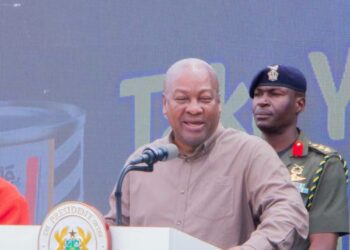
”Previously, trade was virtually the only engagement the Ministry was involved in. But now industries have a voice in their Ministry, and happily, they have a Minister who is hardworking and energetic, so they take all their complaints to her.”
President of Ghana, John Dramani Mahama
The President cited the Minister’s engagement with manufacturers over challenges involving water supply, land acquisition and other operational constraints that could affect production, investment decisions and industrial expansion.
His comments highlight the government’s broader industrialisation agenda, which seeks to position local enterprises to produce competitively for both domestic consumption and export markets.
For manufacturers, reliable access to water and electricity, suitable industrial land, efficient logistics and predictable regulations remain important considerations in determining production costs and the capacity to expand operations.
MoTAI Positioning as a Commercial Hub
The Ministry of Trade, Agribusiness and Industry has a mandate to promote a competitive, technology driven industrial sector capable of supporting economic growth, employment creation and value addition.
Its policy direction also seeks to strengthen Ghana’s position as a manufacturing and commercial hub in West Africa.
The Minister expressed gratitude to President Mahama for his personal commitment to industrial development, describing his involvement as an important source of support for businesses seeking to increase production and explore new markets.
She said the government’s objective extended beyond replacing imported products with locally manufactured alternatives to building industries capable of generating foreign exchange through exports.
”The President gives us support to industry. He is there personally to lend support, and we see the level at which he is bringing industry forward, making sure that we do not only produce for import substitution but also produce for export.”
Minister for Trade, Hon. Elizabeth Ofosu-Adjare
The emphasis on export oriented manufacturing comes as Ghana seeks to increase the contribution of locally processed and manufactured products to international trade.
In February 2026, the Ministry announced plans to implement an Accelerated Export Development Programme aimed at diversifying the country’s export base beyond traditional commodities, strengthening domestic production and expanding market opportunities for Ghanaian businesses.
Encouraging Industrial Competitiveness
The programme forms part of a wider policy direction intended to encourage value addition, improve industrial competitiveness and create stronger links between production, investment and international markets.
For Ghanaian manufacturers, export expansion can provide opportunities to increase production volumes, achieve economies of scale and diversify revenue sources.
However, businesses must also contend with financing costs, infrastructure constraints, regulatory requirements and competition from imported products.
Kasapreko PLC’s operations provided an example of the potential of indigenous manufacturing businesses to expand beyond the domestic market. Founded in 1989, the company has developed from a small enterprise into a major Ghanaian beverage manufacturer, producing alcoholic and non-alcoholic beverages across several product categories.
Its portfolio includes herbal based beverages, bitters, gin, whisky and carbonated soft drinks. The company reports that its products reach more than 16 countries.
The company’s growth reflects the opportunities available to local enterprises that invest in production capacity, product development and distribution while developing brands for domestic and international consumers.
Its recent expansion has also included a major capital-raising exercise through the Ghana Stock Exchange, demonstrating how access to the capital market can support investment in manufacturing infrastructure.
According to reports, Kasapreko PLC’s initial public offering attracted approximately GH¢1.72 billion in investor demand, representing a subscription rate of 246 per cent. The company subsequently raised GH¢700 million, which President Mahama said was being invested in a new factory at Adeiso.
The President welcomed the company’s expansion, linking increased manufacturing capacity to the creation of employment opportunities, particularly for young people entering the labour market.
The investment also illustrates the potential for Ghanaian-owned companies to mobilise domestic capital to finance industrial expansion rather than relying exclusively on traditional sources of funding.
Chief Executive Officer of Kasapreko PLC, Richard Adjei, also commended the Trade Minister for engaging with the company and helping to address operational difficulties affecting its activities.
He cited challenges involving water supply, electricity and cross-border trade, noting that the Minister’s interventions had helped bring some of the concerns facing manufacturers to the attention of the relevant authorities.
”Since she came, I must say that we have taken a lot of complaints to her from Ghana Water, power issues and cross border issues, and she has been very helpful.”
CEO of Kasapreko PLC, Richard Adjei
The Extension for Exporters
Mr Adjei also highlighted the extension of the period for exporters to repatriate export proceeds from 60 to 90 days, describing the adjustment as an important measure for businesses operating in international markets.
The longer period is intended to provide exporters with additional time to receive payments from overseas buyers and complete transactions, potentially easing some of the cash-flow pressures associated with cross-border business.
For companies seeking to expand exports, payment timelines can influence working capital management, production planning and the ability to meet financial obligations while waiting for proceeds from international sales.
The concerns raised by Kasapreko underscore the importance of addressing practical barriers to industrial growth alongside broader economic policies designed to attract investment.
President Mahama’s commendation of the Minister therefore places renewed attention on the role of effective government-business engagement in supporting Ghana’s manufacturing sector.
As the government pursues its industrialisation and export-development objectives, the ability to translate policy commitments into practical improvements in infrastructure, trade facilitation and the business environment will remain critical to helping local manufacturers expand production, compete in international markets and create sustainable employment.
READ ALSO:CAGD Processes 52,000 Teacher Promotions; Validated Payments Due October 16