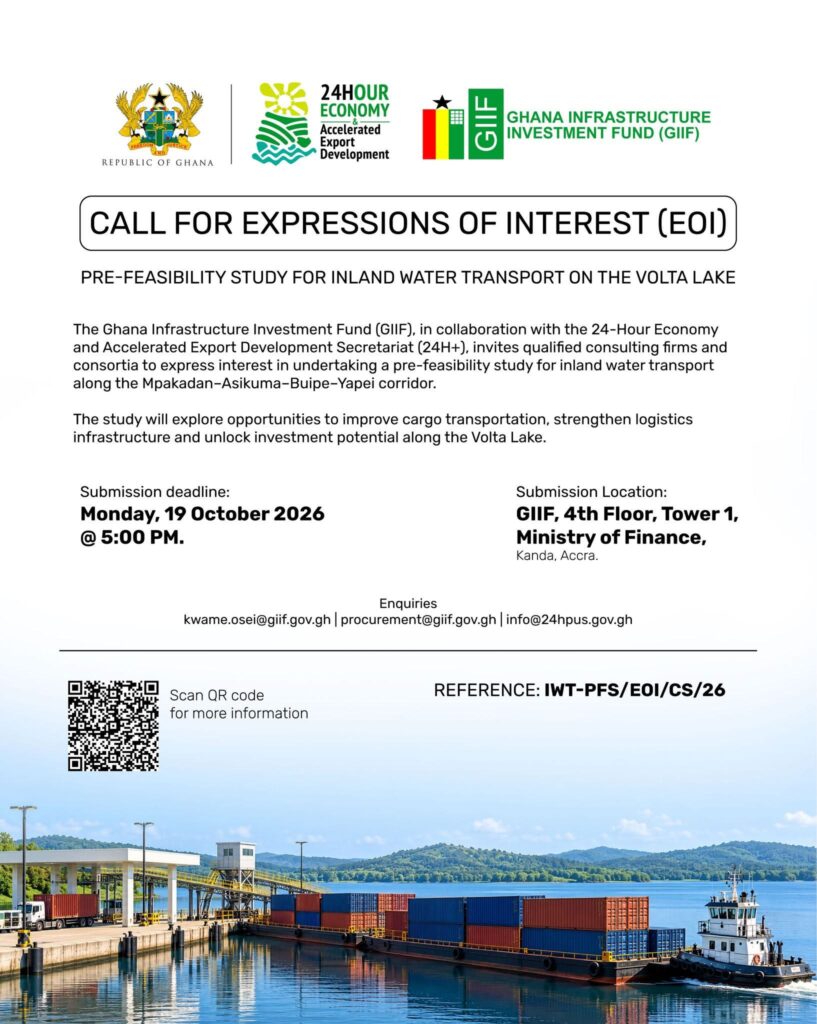
The Ghana Infrastructure Investment Fund (GIIF), in collaboration with the 24-Hour Economy and Accelerated Export Development Secretariat (24H+), is seeking qualified consulting firms to undertake a pre-feasibility study for developing inland water transport.
The pre- feasibility study is going to be along the Mpakadan,Asikuma,Buipe and Yapei corridor on the Volta Lake, in a move aimed at strengthening Ghana’s freight transport infrastructure and unlocking new economic opportunities.
The assignment will assess the potential for transporting transit containers, bulk fuel and other cargo along the north–south corridor, providing a technical and economic basis for future investment decisions.
The findings are expected to guide the government and its partners on infrastructure requirements, financing arrangements and opportunities for private-sector participation in developing the inland water transport system.
According to the official request for expressions of interest, the procurement carries reference number IWT-PFS/EOI/CS/26. Interested firms and consortia are required to submit their expressions of interest by 5 p.m. on Monday, October 19, 2026, as the government advances efforts to integrate inland waterways with rail and road transport.
“The findings will help 24H+, GIIF and government agencies make investment decisions, structure financing, and work with development finance institutions and private partners.”
Ghana Infrastructure Investment Fund (GIIF)
The initiative comes as Ghana explores ways to improve the movement of goods between southern commercial centres and northern production and distribution markets, while reducing pressure on the country’s road network.
Volta Lake Corridor Targets Freight Efficiency
The proposed corridor builds on the Volta Lake’s longstanding role in Ghana’s inland transport system.
The lake, one of the country’s major water transport resources, connects communities and commercial centres across several regions and offers opportunities for moving bulk cargo over long distances.
The Volta Lake Transport Company (VLTC), which operates under the Volta River Authority (VRA), already provides north–south cargo services between Akosombo and Buipe.
Its operations include the transportation of petroleum products, solid cargo and passengers, demonstrating that inland water transport is an established component of Ghana’s logistics network rather than an entirely new concept.
The company’s published service information identifies a 415-kilometre connection between Akosombo and Buipe. Its operations include the transportation of liquid cargo, such as petroleum products, as well as solid cargo and scheduled passenger services.
The proposed Mpakadan, Asikuma, Buipe and Yapei corridor would build on this existing foundation by examining the infrastructure and operational requirements for a more integrated freight system.
In September 2026, the government planned to develop a new port at Mpakadan to facilitate the transfer of containers from rail to barges on the Volta Lake.
The proposed arrangement would enable goods arriving at Tema Port to move by rail to Mpakadan, continue by water to Buipe and then travel by road to destinations in northern Ghana and neighbouring landlocked countries.
The development could create a more coordinated logistics chain, allowing different transport modes to complement one another rather than relying predominantly on road haulage.
“The system would enable cargo arriving at the Tema Port to be transported by rail to Mpakadan, transferred onto barges through the Volta Lake to Buipe, and subsequently moved by road to destinations in northern Ghana and neighbouring landlocked countries.”
Ghana Infrastructure Investment Fund (GIIF)
Study to Assess Infrastructure and Investment Needs
The pre-feasibility study will examine whether the proposed corridor can support commercially viable inland freight operations and identify the investments required to make the system operationally efficient.
According to the procurement notice published by the 24H+ Secretariat, the assignment will assess existing infrastructure at Mpakadan, Asikuma, Buipe, Yapei and other potential sites. Consultants will also investigate navigability, seasonal changes in lake levels, environmental conditions, freight demand and traffic forecasts.
These assessments are important because the economic potential of inland water transport depends on more than the availability of navigable water. Ports must have suitable loading and unloading facilities, vessels must be appropriate for the cargo involved, and access roads and rail connections must allow goods to move efficiently between transport modes.
The study will also develop technical options and cost estimates for rehabilitating existing facilities, upgrading infrastructure or constructing new ports. Financial and economic analysis will help determine whether anticipated cargo volumes and operational revenues can justify the proposed investments.
Institutional and regulatory arrangements will form another component of the assessment, including the respective roles of the Ghana Ports and Harbours Authority (GPHA), the VRA and the Ghana Maritime Authority.
The consultants are also expected to undertake preliminary environmental and social impact assessment scoping, identify climate-related risks and prepare a roadmap for subsequent project development.
These measures will help establish whether the proposed corridor can attract sustainable investment while meeting operational, safety and environmental requirements.
The procurement notice states that interested firms must demonstrate relevant experience in transport infrastructure or inland waterway studies, including port, waterway and multimodal projects in sub-Saharan Africa or comparable settings.
Multidisciplinary teams with transport economists, port engineers, environmental and social specialists, and financial analysts are expected to strengthen submissions.
Economic Opportunities and Implementation Challenges
If supported by the findings, an expanded inland water transport system could create opportunities for logistics companies, shipping operators, port service providers, cargo handlers and businesses operating along the corridor.
Agriculture is one sector that could benefit from improved freight connectivity. Producers and traders in northern Ghana transport agricultural commodities to markets and processing centres across the country.
A reliable water-based freight option could provide an alternative for suitable bulk commodities, potentially improving access to larger markets and supporting agro-industrial investment.
Manufacturers, fuel distributors and construction companies could also benefit from a more diversified transport network, depending on the cargo-handling capacity, reliability and commercial competitiveness of the proposed system.
However, these benefits are not automatic, a 2023 Ghana transport scoping study published through the United Kingdom’s High Volume Transport Applied Research Programme identified poor infrastructure and services, fragmented institutional coordination, insufficient financing and inadequate transport demand data as key constraints affecting inland water transport and north–south connectivity.
Research published in the International Journal of Transportation Science and Technology in 2021 similarly identified administrative, technical, market and logistics challenges affecting Ghana’s inland water transport operations.
The study highlighted the need for improved infrastructure, navigational maintenance, regulation and integrated transport planning.
These findings reinforce the importance of the proposed pre-feasibility exercise. Reliable demand forecasts will be necessary to establish whether sufficient cargo exists to support regular services, while infrastructure assessments must determine the improvements needed to ensure safe and dependable operations throughout the year.
The financial analysis will also need to consider the costs of vessels, port facilities, cargo-handling equipment, maintenance and connections to road and rail networks.
“The study will provide a basis for assessing the corridor’s commercial viability, infrastructure requirements and financing options before major investment decisions are taken.”
Ghana Infrastructure Investment Fund
The initiative also aligns with the broader Volta Economic Corridor agenda, which seeks to use the lake and adjoining areas to support industrialisation, agricultural production, exports and employment.
In August 2026, the VRA, GIIF and 24H+ had begun negotiations on a master concession agreement intended to establish a commercial and legal framework for developing the corridor with private investment.
For GIIF and 24H+, the immediate priority is to establish the technical, economic, environmental and financial case for the proposed inland water transport system.
Qualified consulting firms must submit three hard copies of their expressions of interest, one original and two copies, alongside an electronic copy on a pen drive. Submissions must be delivered in a sealed envelope marked “EOI: GIIF IWT-PFS/EOI/CS/26” to the Chief Executive Officer of GIIF, Fourth Floor, Tower 1, Ministry of Finance, Tumu Avenue, Kanda, Accra.
The deadline is 5 p.m. on October 19, 2026. Only shortlisted firms will be invited to submit technical and financial proposals, with selection conducted under the Public Procurement Act, 2003 (Act 663), as amended.
The study represents an important preparatory step towards determining whether the Volta Lake can support a more competitive, integrated and commercially sustainable freight transport network for Ghana.
READ ALSO:NPP Communications Director Cites Disqualification For Campaign Ban Breaches