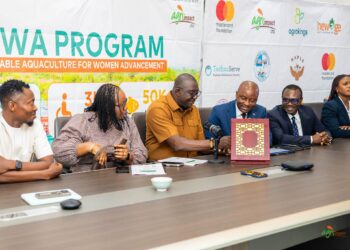
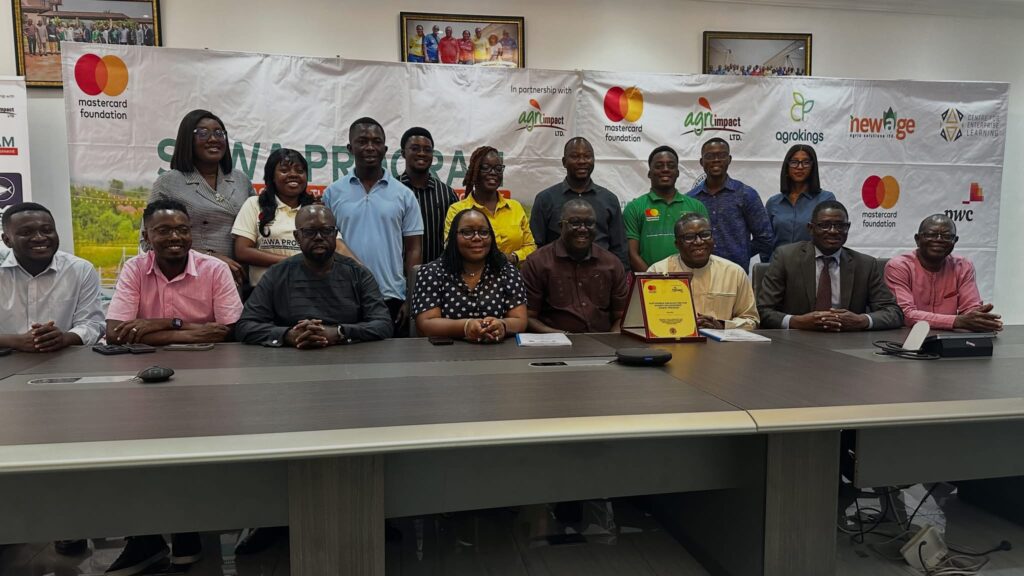
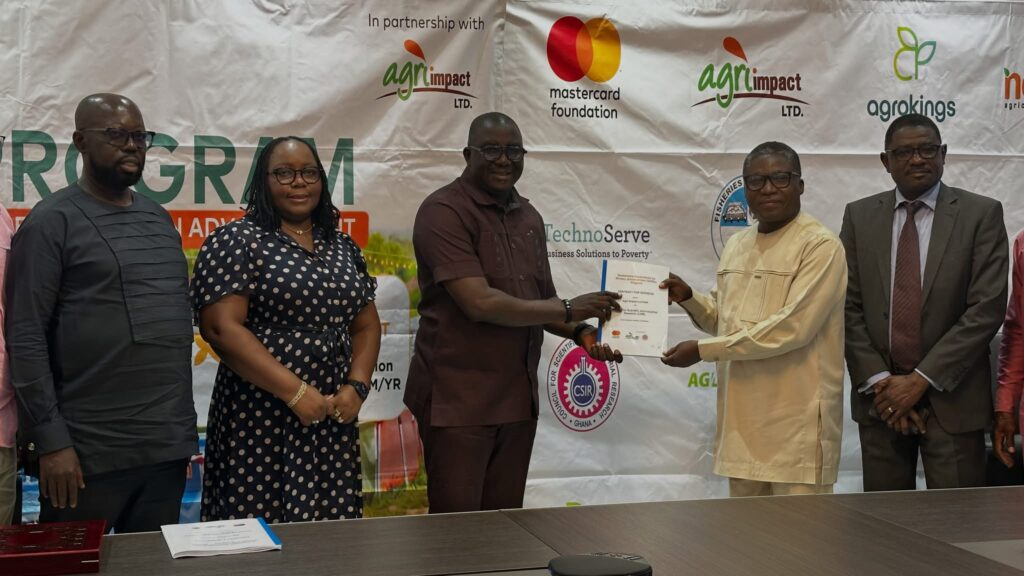
The Council for Scientific and Industrial Research (CSIR) and Agri-Impact Limited have formalised a strategic partnership under the Sustainable Aquaculture for Women Advancement (SAWA) Programme, strengthening efforts to translate agricultural research and innovation into commercially viable opportunities within Ghana’s aquaculture industry.
The agreement, sealed through the signing of a programme implementation contract, establishes a framework for collaboration between the country’s leading scientific research institution and the agribusiness development company to accelerate the adoption of research driven technologies, improve fish production and expand economic participation among young women.
Speaking at the engagement, Group Chief Executive Officer of Agri-Impact Limited, Dr. (h.c.) Daniel Fahene Acquaye, emphasised the importance of moving research innovations beyond institutional documentation into practical applications that can generate commercial value and employment.
“What we are talking about is from files to fields. Research outputs that are all in folders and in files. We are moving them to fields.’’
Group C.E.O of Agri-Impact Limited, Dr. (h.c.) Daniel Fahene Acquaye
The partnership forms part of the broader four-year SAWA Programme, an initiative of the Mastercard Foundation in partnership with Agri-Impact, running from 2026 to 2030.
It seeks to address longstanding constraints within Ghana’s aquaculture value chain by connecting scientific research, enterprise development, technical expertise and market opportunities.
Dr. Acquaye explained that the collaboration would create opportunities for CSIR to commercialise innovative technologies and make research outputs accessible to businesses and entrepreneurs, particularly young people and women seeking opportunities within the agricultural sector.
Commercialising Research for Industry Growth
The partnership addresses a persistent challenge in Ghana’s agricultural development: the gap between scientific research and its practical adoption by industry.
Although research institutions continue to develop technologies and innovations to improve agricultural productivity, translating these findings into commercially sustainable enterprises requires stronger connections between researchers, investors, agribusinesses and producers.
Director-General of CSIR, Prof. Paul Pinnock Bosu, welcomed the partnership, acknowledging Agri-Impact and the Mastercard Foundation for recognising the contribution of scientific research to agricultural and agribusiness development.
He described the arrangement as an important opportunity to strengthen the relationship between research institutions and private sector operators.
“This is a very unique opportunity and, like you rightly said, in the past we had a system where we did a research and then we hoped that industry would come and pick it up and use it.”
Director-General of CSIR, Prof. Paul Pinnock Bosu
His remarks highlighted the limitations of a traditional research-to-industry approach, in which scientists developed innovations but depended largely on businesses to independently identify, adopt and commercialise them.
The CSIR–Agri-Impact arrangement provides an opportunity for a more coordinated approach, with research expertise connected directly to implementation structures, production systems and market requirements.
For CSIR, the collaboration also creates a pathway to increase the practical value of its research portfolio by supporting the deployment of technologies that can improve aquaculture production, strengthen processing and enhance the competitiveness of local agribusinesses.
SAWA Targets 60,000 Jobs for Women
Beyond research commercialisation, the partnership is expected to contribute to SAWA’s wider objective of creating 60,000 dignified and fulfilling work opportunities for young women aged 18 to 35 across Ghana’s aquaculture value chain.
The programme specifically targets the inclusion of 3,000 young women with disabilities, positioning gender inclusion and economic empowerment at the centre of its implementation strategy.
It also aims to contribute 50,000 metric tonnes of fish to Ghana’s aquaculture production, with particular attention to tilapia and catfish, two of the country’s major farmed fish species.
Dr. Acquaye stressed that young people, especially women, would be central to the deployment of research innovations under the programme.
“Our target is young people of Ghana, especially young women. So we are going to open your files, open your folders, unpack what is in there that have been folded. Let’s unfold them and deploy them.”
Group C.E.O of Agri-Impact Limited, Dr. (h.c.) Daniel Fahene Acquaye
Its implementation involves Agri-Impact as the lead organisation, working with strategic partners including TechnoServe, Newage Agric Solutions, AgroKings Limited, the Fisheries Commission and other industry stakeholders. CSIR provides additional research and technical support.
The programme also incorporates Adwenepa Hubs, designed to provide technical assistance, hatchery services and other production support to aquaculture businesses and farmer clusters.
Boosting Domestic Fish Production
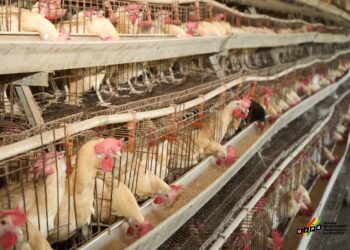
The partnership comes at a time when Ghana continues to pursue increased domestic fish production to strengthen food security, improve nutrition and reduce dependence on imported fish.
According to the National Development Planning Commission’s 2024 Annual Progress Report, Ghana’s aquaculture production increased from approximately 116,108 metric tonnes in 2023 to 121,809 metric tonnes in 2024.
Despite this improvement, production remained below the national target of 145,500 metric tonnes for 2024, highlighting the need for investments in productivity, technology, infrastructure and technical capacity.
The report also indicates that Ghana spent approximately GH¢1.26 billion on frozen fish imports in 2024, demonstrating the commercial opportunity for expanding domestic production and strengthening local supply chains.
For CSIR and Agri-Impact, the collaboration therefore presents an opportunity to connect scientific innovation with the production demands of an industry that has significant potential for employment creation and private sector investment.
Prof. Bosu also expressed appreciation to the Mastercard Foundation and Agri-Impact for recognising the role of CSIR in advancing agriculture and agribusiness development.
“Let me also add my voice to the appreciation to the Mastercard Foundation for making this possible and your good selves, Agri-Impact, for recognising the role that CSIR plays in agriculture and agribusiness development in the country.”
Director-General of CSIR, Prof. Paul Pinnock Bosu,
The success of the partnership will ultimately depend on how effectively research innovations are transferred into production systems, adopted by businesses and converted into sustainable commercial activities.
READ ALSO:Ghana’s Credit Market Rebounds as Lending Rates Fall Sharply