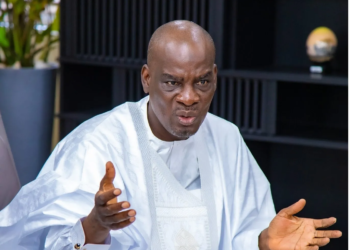

Ghana’s Finance Minister Dr Cassiel Ato Forson leads former Vice-President and the New Patriotic Party’s 2028 flagbearer, Dr Mahamudu Bawumia, by 55.6% to 38.4% in a hypothetical 2028 presidential contest, according to September 2026 polling data released by Global InfoAnalytics Executive Director Mussa Dankwa.
The results show Dr Ato Forson maintaining leads among voters prioritising the economy, jobs and cost of living, while Dr Bawumia records a marginal advantage on education. The findings also reveal differences in the two candidates’ reported support among younger voters aged 16 to 34.
“Fresh data from the September 2026 poll is shining more light on the 2028 elections if it were held today.”
Executive Director for Global InfoAnalytics Mussa Dankwa
Although Dr Ato Forson leads Dr Bawumia in the overall youth matchup, the former Vice-President leads among young respondents who identify education as their most important concern.
A separate comparison involving NDC National Chairman Johnson Asiedu Nketia also highlights education as a key point of difference between the two possible NDC contenders and Dr Bawumia.
The breakdown by voters’ leading policy concerns provides further insight into the overall figures. Among respondents who identify the economy as their most important issue, Dr Ato Forson leads with 63.3%, while Dr Bawumia receives 32.5%.
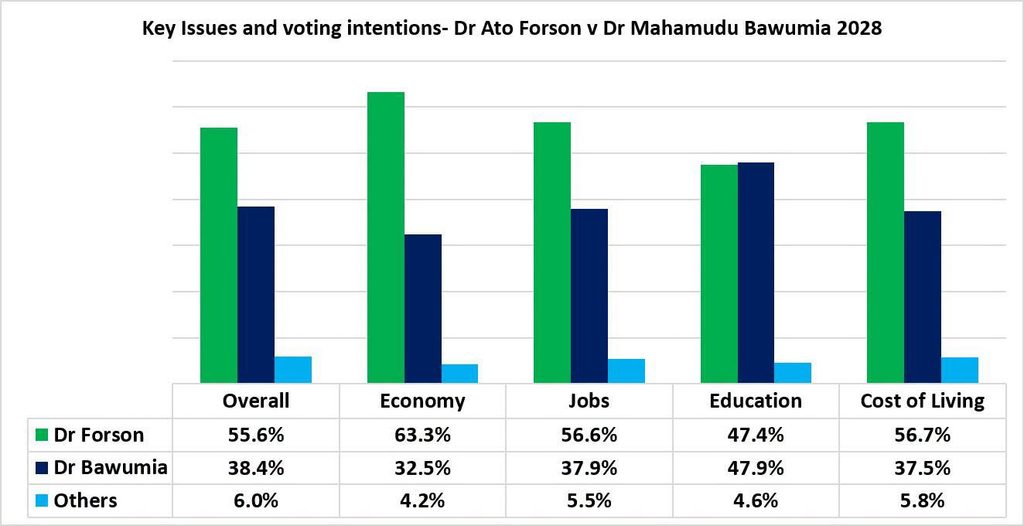
On jobs, the Finance Minister records 56.6%, compared with Dr Bawumia’s 37.9%. The difference narrows considerably among voters prioritising education, where Dr Bawumia edges Dr Ato Forson by 47.9% to 47.4%. The half-percentage-point gap represents an almost even division between the two candidates in that category.
The cost-of-living results show another wider difference. Dr Ato Forson records 56.7%, against Dr Bawumia’s 37.5%, among respondents who identify rising living costs as their principal concern.
These findings show that the overall lead is accompanied by differences across the four issues identified in the survey as voters’ leading priorities: the economy, jobs, education and cost of living.
Youth Voters Also Place Forson Ahead
The results among voters aged 16 to 34 follow a broadly similar pattern, with Dr Ato Forson recording 53.6% against Dr Bawumia’s 39.6% in the overall hypothetical matchup.
On the economy, Dr Ato Forson leads with 58.9%, compared with 36.1% for Dr Bawumia. The jobs figures are also in Dr Ato Forson’s favour, with the Finance Minister receiving 56.4% and the former Vice-President 36.9%.

Education again produces a different result. Among younger respondents who identify education as their leading concern, Dr Bawumia records 52.7%, while Dr Ato Forson obtains 41.8%. The former Vice-President also trails Dr Forson among young voters prioritising cost of living, where the figures stand at 56.8% and 36.6%, respectively.
The youth results therefore show Dr Ato Forson leading Dr Bawumia overall and among respondents prioritising three of the four issues. However, Dr Bawumia records higher support among younger voters who place education at the top of their concerns.
Asiedu Nketia Comparison Highlights Similar Education Challenge
The survey also examines a separate hypothetical contest between Asiedu Nketia and Dr Bawumia. Across all voters, Asiedu Nketia receives 49.3%, compared with Dr Bawumia’s 41.1%, while other candidates account for 9.6%.
Among respondents prioritising the economy, Asiedu Nketia leads with 58.0%, against Dr Bawumia’s 35.0%. On jobs, his support stands at 51.6%, while Dr Bawumia records 40.3%.

Education reverses the pattern, with Dr Bawumia receiving 52.5% and Asiedu Nketia 38.9%. On the cost of living, Asiedu Nketia leads with 50.1%, compared with 39.4% for Dr Bawumia.
Among younger voters, Asiedu Nketia records 45.9%, while Dr Bawumia obtains 42.8%. Asiedu Nketia leads on the economy, 52.5% to 39.3%, and jobs, 49.7% to 39.5%. Dr Bawumia, however, leads among young respondents prioritising education by 56.6% to 34.0%. On cost of living, Asiedu Nketia records 46.6%, compared with Dr Bawumia’s 40.3%.
The comparison shows that Dr Ato Forson and Asiedu Nketia register different overall margins against Dr Bawumia. It also identifies education as an area where Dr Bawumia records higher support among respondents who prioritise the sector, particularly in the Asiedu Nketia matchup.
Education Remains a Distinctive Issue in the Poll
Mr Dankwa’s analysis identifies education as a significant point of difference in both hypothetical matchups. While Dr Ato Forson leads Dr Bawumia overall and among voters prioritising three key issues, Dr Bawumia holds a marginal advantage on education. The difference is wider in the separate comparison with Asiedu Nketia.
However, the figures do not establish why respondents selected particular candidates or assess their respective education policies. They measure stated voting preferences among people who identify education as their most important concern.
The results also do not establish how these preferences may change as the 2028 election approaches. They represent responses collected during the September 2026 survey period.
According to the survey description, Global InfoAnalytics conducted the September 2026 study using stratified random sampling across Ghana’s 16 regions, combining face-to-face and telephone interviews.
The stated sample comprised 1,500 respondents, including 737 men, representing 49.1%, and 763 women, representing 50.9%. The survey reported a 95% confidence level and a margin of error of plus or minus three percentage points.
Overall, the September figures provide a snapshot of hypothetical voting preferences, showing Dr Ato Forson ahead of Dr Bawumia in the nationwide matchup while highlighting education as a contrasting issue across the voter groups examined.
READ ALSO: Benjamin Boakye Urges Fiscal Modeling Over ‘Gold Rhetoric’