Ghana is calling on European and international investors to move beyond raw mineral extraction and partner with African countries to build industries that create jobs, transfer technology and retain more economic value on the continent.
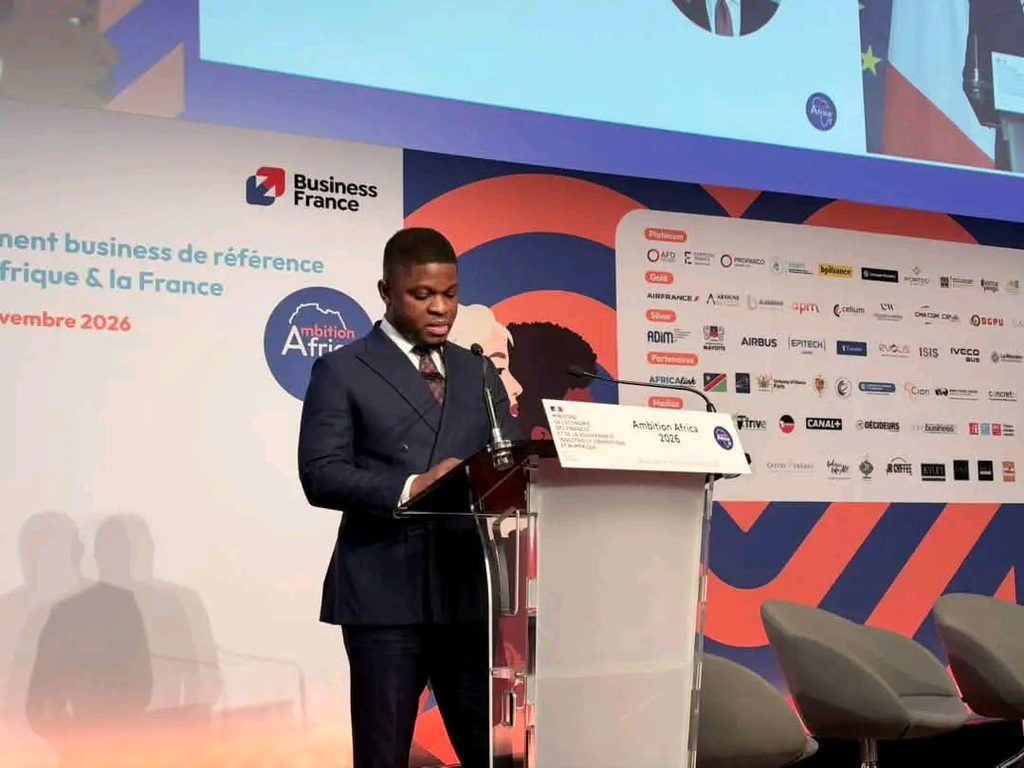
Chief Executive Officer of the Ghana Gold Board (GoldBod), Sammy Gyamfi, made the appeal while addressing the Ambition Africa business forum in Paris, France, where he proposed a new investment partnership built around what he described as “Fair Return for Fair Value.”
Speaking on the theme, Africa’s Minerals, Africa’s Future: A New Pact for Investment, Economic Transformation and Shared Prosperity, Mr. Sammy Gyamfi argued that Africa’s mineral wealth must translate into meaningful economic opportunities, particularly for its growing youth population.
He highlighted the continent’s employment challenge, noting that between 10 million and 12 million young Africans enter the labour market annually, while only about three million formal jobs are created.
“Young Africans who ask not for charity, but for opportunity; not for sympathy, but for partnership. These young Africans are Africa’s greatest resource.”
Mr. Sammy Gyamfi, CEO of GoldBod
Drawing attention to the contrast between Africa’s abundant natural resources and limited industrial development, Mr. Gyamfi maintained that exporting minerals without processing them locally would do little to transform African economies.
Africa’s mineral wealth must translate into lasting prosperity
Mr. Sammy Gyamfi attributed the continent’s employment difficulties partly to structural weaknesses in its economies, including limited industrial capacity, insufficient large-scale businesses and inadequate long-term investment.
He stressed that mineral extraction alone could not guarantee national prosperity, arguing that countries must measure the success of their natural resources by the industries, businesses and employment opportunities developed around them.
“Mineral wealth does not automatically become national wealth. And so we must ask not only how much we extracted, but what we built with it,” he emphasised.
GoldBod’s CEO, Mr. Sammy Gyamfi
He further explained that Africa needed investment in processing, manufacturing and other downstream industries to reduce its dependence on exporting raw materials and importing finished products.
According to the African Development Bank, between 10 million and 12 million young Africans enter the labour market annually, against approximately three million formal jobs created each year. This employment gap reinforces the need for productive industries capable of absorbing the continent’s expanding workforce
GoldBod reforms strengthen Ghana’s gold export performance
Using Ghana as an example, Mr. Gyamfi highlighted the establishment of GoldBod as part of efforts to formalise the artisanal and small-scale mining (ASM) gold trade and recover revenue previously lost through smuggling.
He referenced a SWISSAID analysis that identified a 229-tonne discrepancy, valued at approximately US$11.4 billion, between Ghana’s reported gold exports and corresponding imports declared by trading partners between 2019 and 2023.

According to Mr. Sammy Gyamfi, reforms introduced through GoldBod had helped increase officially recorded ASM gold exports from 63 tonnes in 2024 to approximately 104 tonnes in 2025, generating US$10.8 billion in foreign exchange. He added that between January 1 and October 20, 2026, GoldBod had aggregated and exported another 85.4 tonnes, valued at US$11.6 billion.
The figures were independently reported by the Ghana Gold Board and corroborated by media reports. Describing the development as a production clawback, Gyamfi explained that the increased exports did not necessarily represent newly produced gold, but rather previously existing supplies brought into the formal economy.
He also highlighted local refining as an important part of Ghana’s value-addition strategy. According to the CEO, approximately 27 tonnes of artisanal and small-scale mining gold had been refined locally in 2026, although the figure was not independently confirmed in the available sources.
GoldBod invites investors into refining and jewellery manufacturing
Looking beyond gold exports, Gyamfi encouraged international investors to explore opportunities in responsible mining, mercury-free processing, refining, jewellery manufacturing and gold trading.
He specifically promoted the proposed Ghana Gold Souk initiative, an industrial hub intended to support jewellery production and fabrication, with partnerships expected to begin in 2027.
The initiative builds on GoldBod’s wider efforts to develop Ghana’s downstream gold industry. The Board has already introduced licensing arrangements for jewellery manufacturers, fabricators and refineries under the Ghana Gold Board Act, 2025 (Act 1140).

Mr. Gyamfi maintained that investment partnerships must deliver benefits to both parties, with African countries providing resources, labour and opportunities while investors contribute capital, expertise, technology and access to international markets.
Europe urged to build mutually beneficial African partnerships
The GoldBod CEO argued that cooperation between Africa and Europe must evolve beyond the traditional exchange of African raw materials for imported finished products.
He maintained that European capital and technology could complement Africa’s natural resources, skilled workforce and entrepreneurial potential to establish industries that generate shared economic benefits.
He also acknowledged that investors deserved competitive returns and that African governments had a responsibility to create favourable conditions for businesses to thrive.
“History will judge us not only by the tonnes we extracted or the huge profit we recorded on our books or in our bank accounts. History will judge us by what we built with them,” he remarked.
Mr. Sammy Gyamfi, GoldBod CEO.
Mr. Gyamfi concluded by inviting investors to participate in building Africa’s industrial future, urging both continents to invest, produce, process and prosper together.
READ ALSO: Ghana TVET Reforms Target Skills, Equipment and Infrastructure