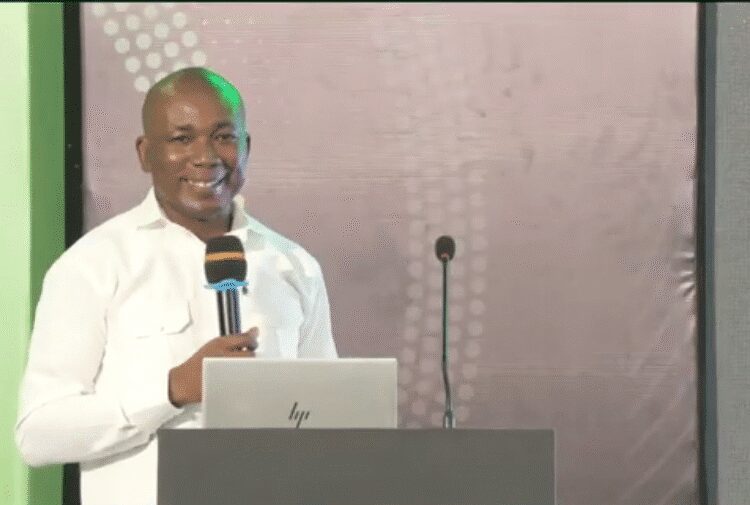
Professor Godfred Bokpin has revealed that the sustainability of Ghana’s fiscal consolidation path to economic growth depends on conditions like effective management of the fiscal space and therapy side effects.
In a presentation delivered at the Deloitte Economic Dialogue – 2026 National Budget Discussion, themed, ‘Charting Ghana’s economic path: policies, progress, and opportunity,’ the Professor of economics and finance explained Ghana’s outlined growth and sustainability path in the 2026 Budget.
“This is the first time, actually, since 1992, that the government has decided to live within its means rather than explaining the revenue shortfall through higher borrowing. But the next important question is, can we continue on this path? Because when we see the side effect of the medicine you are administering, when the side effect tends to be more, what do you do? You re-adjust.”
Professor Godfred Bokpin
Revenue underperformance has characterized Ghana’s economy, for which reason the government, through the 2026 Budget, is seeking to recalibrate the fiscal framework for 2026. The government is on a conscious path now to live within its means, compared to previous acts of borrowing to explain revenue shortfalls.
He pointed out that “so far, revenue shortfall is around GhȻ 7.7 billion, but they [the government] sought to undo that through higher or greater expenditure cuts.”
Fiscal Consolidation
Fiscal consolidation is the process of reducing the government’s budget deficit and debt to ensure long-term public financial stability. This strategy can be achieved through three means: “revenue-based [increase revenue] or expenditure-based [spending cut], or mixed [combination of the two].”
Policy implementations like increasing taxes, improving tax collections, reforming social programs, and controlling government spending are ways of achieving fiscal consolidation.
“The problem we [Ghana] had with the IMF-supported program was that it was heavily revenue-based. And we [government and experts] felt that would hurt the economy more. So, what the government has done from 2025 is to actually recalibrate the fiscal framework [the fiscal consolidation] from revenue-based to expenditure-based.
“So, you see that there are greater expenditure cuts to drive the fiscal consolidation rather than pushing for more taxes and higher revenue. This is very good.”
Professor Godfred Bokpin
Administering the Shock Therapy
The government administered a ‘shock therapy’ this year, which Prof. Bokpin described as “a medicine but with its own side effects.”
The strategy comprised steep government spending cuts to reduce the fiscal deficit and stabilize the economy, accompanied by certain tax removals to stimulate private sector growth. This will further constrain inflation and contribute to the expansion of the economy, with a risk of reduced employment in the public sector.
According to Prof. Bokpin, “the shock therapy essentially was to reduce our [Ghana’s] gross financing needs, which essentially means that the government will borrow less. It will be less in the market in terms of accepting treasury bill auctions, dropping significantly the treasury bill rates.”
As part of the expenditure containment, he explained that “the results of the shock therapy are a fiscal savings of over 8.8 billion Ghana cedis in lower interest payments from the first three quarters of 2025.”
The Government’s Re-adjustments
The 2026 Budget was meant to re-adjust the fiscal framework to entrench growth, according to the Economist. The re-adjustment, however, is founded on the established framework in 2025 to further expand the economy and reduce some of the constraints in the economy in 2026.
Prof. Bokpin outlined some of the 2025 impressive foundational frameworks. For the first three quarters of 2025, Ghana’s primary balance was a positive 0.7% of GDP. He reiterated that Ghana has done more than what the IMF program stipulated: a promise to achieve a primary balance surplus of 1.5% of GDP, but the government has achieved 1.6%.
The government had also amended the Public Financial Management Act (providing for the establishment of an independent fiscal council), just to give a legal base for its current fiscal activities. The government again hoped to achieve a debt-to-GDP ratio of 45% by 2034, which the calibration of 1.5% of GDP will support or lessen.
Prof. Bokpin lamented that “if you have huge infrastructure deficits and you are promised by law to do a primary balance surplus of 1.5% of GDP, if your revenue is not doing well, then you have to cut towards expenditure. But we also need the government to spend appropriately to stimulate what?”
He described this as the tricky part that the government has to work at as they navigate forward, “because after two years, people will look beyond stability and will ask for growth, they will ask for job-based growth.”
However, viewing GDP growth from the expenditure side revealed a more private or household consumption stimulation at 8.2% compared to 5.5% growth in 2024, he declared. With the government being the biggest consumer in the economy, the steep expenditure cut is reducing growth. Though “Ghanaians are celebrating it, it’s coming at a cost,” he stated.
“The price is that we [the government] are sacrificing some growth that could have come, but in the interim, we’ll say that is a good price, provided that we [the government] will use the fiscal space for growth-enhancing spending going forward.”
Professor Godfred Bokpin
The numbers showed that “GDP from the government side shrank from 4.6% in 2024 to 3.7% in 2025. The government’s expenditure also dipped by 0.2% of GDP in Q2. On a month-on-month basis, July GDP growth for 2024 was 8.3% and the same period in 2025 was 4.5%. That is the sharp deceleration.”
The government, on this basis, had to re-adjust to reflect the impact of fiscal consolidation. Therefore, the 2026 Budget increased Capital Expenditure (CAPEX) allocation to GH¢57.5 billion from GH¢33 billion in 2025. This reflects the government’s commitment to growth-driving investments.
According to Prof. Bokpin, the fiscal consolidation path is sustainable provided the fiscal space is managed effectively.
READ ALSO: Market Anchor Under Pressure as 2027–2030 Bonds Dominate 61% of Trades