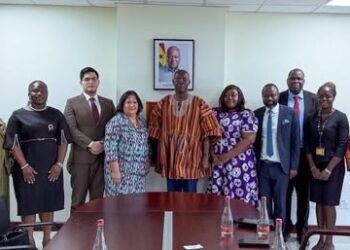

The Governor of the Bank of Ghana (BoG), Dr Johnson Asiama, has announced plans for a specialised policy workshop aimed at strengthening Ghana’s Domestic Gold Purchase Programme (DGPP) and aligning it more closely with international best practices.
The proposed engagement will be organised jointly by the Bank of Ghana, the Ghana Gold Board (GoldBod) and the Ministry of Finance, and is expected to bring together policymakers, regulators, industry experts and other key stakeholders involved in Ghana’s gold value chain.
“The Bank of Ghana, together with GoldBod and the Ministry of Finance, intends to organise a targeted policy workshop to examine how this national programme can be improved in line with best practices adopted elsewhere.”
Dr Johnson Asiama, Governor of the Bank of Ghana (BoG)

Dr Asiama made the announcement while addressing participants at the 77th Annual New Year School at the University of Ghana on Tuesday, January 6, where he reflected on the role of the DGPP in stabilising the economy during a period of severe macroeconomic stress.
According to the Governor, the Domestic Gold Purchase Programme was introduced at a time when Ghana was grappling with significant economic challenges, including foreign exchange shortages and heightened currency volatility.
He explained that the programme was conceived as a strategic intervention to help rebuild reserves and restore confidence in the economy. Despite facing implementation hurdles, Dr Asiama said the initiative has delivered meaningful benefits.
Focus on Best Practices and Refinement
The planned workshop, Dr Asiama noted, will focus on assessing the design, governance and operational structure of the DGPP, with the aim of strengthening its effectiveness and long-term sustainability.
By engaging a broad range of stakeholders, the Central Bank hopes to draw lessons from comparable programmes globally while tailoring reforms to Ghana’s unique institutional and market conditions.
The Governor stressed that refining the DGPP is not about abandoning the programme, but about improving it to ensure it continues to deliver value to the economy.
Dr Asiama highlighted the role of the Ghana Gold Board in improving coordination across the gold sector. He said the establishment of GoldBod has enhanced oversight and alignment among institutions involved in gold trading, export and reserve accumulation.
He also pointed to the introduction of a gold foreign exchange auction as a significant step toward improving transparency and efficiency in the intermediation of gold-related FX flows.
According to him, these reforms have helped address longstanding structural gaps in the gold sector while supporting broader macroeconomic objectives.
Embedding Gold for Reserves in National Policy

The BoG Governor further stressed the importance of embedding the Gold for Reserves programme more firmly within the broader Government of Ghana policy framework.
He argued that the programme should be viewed as a shared national responsibility rather than one concentrated within a single institution. Sustainability, he said, will depend on coordinated institutional ownership and clear policy alignment.
Dr Asiama noted that such an approach would help insulate the programme from policy uncertainty while strengthening accountability and long-term planning.
“We welcome informed discussions, evidence-based analysis, and diverse perspectives on important interventions such as the DGPP.”
Dr Johnson Asiama, Governor of the Bank of Ghana (BoG)
The Governor said the planned workshop would provide an opportunity to address concerns, share insights and build consensus around the programme’s future direction.
Building Reserves and Reducing Dollar Dependence

The Domestic Gold Purchase Programme, launched by the Bank of Ghana on June 17, 2021, is a cornerstone of Ghana’s strategy to build foreign exchange reserves through domestic sourcing of gold.
The programme also seeks to reduce reliance on the US dollar, support exchange rate stability and formalise activities in the small-scale mining sector by offering fair prices and a reliable market for gold.
By discouraging smuggling and keeping more gold within the formal economy, the DGPP aims to ensure that Ghana derives greater national benefit from its mineral resources.
Since its introduction, the programme has contributed to a sharp rise in Ghana’s gold reserves. Official data show that gold holdings increased from 8.74 tonnes in 2021 to more than 34 tonnes by 2025.
Dr Asiama said this expansion has strengthened Ghana’s external buffers and supported broader macroeconomic stability, particularly during periods of currency pressure.
As the Bank of Ghana prepares to review and refine the DGPP, the Governor expressed confidence that continued collaboration among institutions will help maximise the programme’s impact and reinforce Ghana’s long-term economic resilience.
READ ALSO: Asantehene Touts “Stronger Values” Over Force During Historic Police HQ Visit