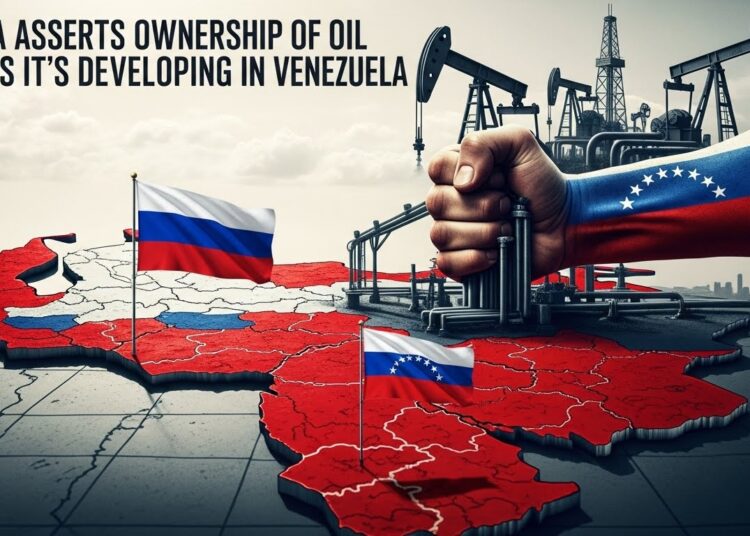
Russia has firmly asserted ownership of all oil assets developed by its state-owned company in Venezuela, a move that underscores intensifying geopolitical competition over the crisis-hit South American nation’s vast energy resources.
The declaration follows comments by U.S. President Donald Trump suggesting that American and Western oil companies could soon play a major role in reviving Venezuela’s oil industry.
In a statement carried by Russia’s state news agency TASS, Roszarubezhneft made it clear that its holdings in Venezuela remain firmly under Russian state control. The company stressed that its assets were acquired legally and transparently, dismissing any suggestion that control could shift under renewed Western engagement.
“All assets of Roszarubezhneft JSC in Venezuela are the property of the Russian state, having been acquired by the Russian side under market conditions.”
Roszarubezhneft
The company added that the transactions complied fully with Venezuelan law, international regulations and bilateral agreements between Moscow and Caracas.
Sanctions, Restructuring and Strategic Continuity
Roszarubezhneft was incorporated in 2020 as a direct response to U.S. sanctions imposed on Rosneft, Russia’s energy giant, over its involvement in Venezuelan oil trading.
Following those sanctions, Roszarubezhneft acquired Rosneft’s Venezuelan assets, effectively shielding Russia’s strategic oil interests from further restrictions.
Owned by a unit under Russia’s Ministry of Economic Development, Roszarubezhneft now operates five oil-producing joint ventures with Venezuela’s state oil firm, PDVSA.
Despite years of economic decline and sanctions pressure on Venezuela, Russia has maintained a steady presence in the country’s energy sector, positioning itself as a long-term partner rather than a short-term opportunist.
The company reaffirmed its commitment to expanding operations, stating that it would continue to focus on “the sustainable development of joint oil production projects, infrastructure, and an effective response to emerging challenges.”
US Signals Interest as Tensions Escalate
The renewed assertion from Moscow comes at a time of escalating tension between Washington and Caracas.
Since the beginning of the year, the United States has dramatically intensified pressure on Venezuela’s leadership, capturing President Nicolás Maduro and flying him to New York to face drug-trafficking charges. The move sent shockwaves through diplomatic and energy circles worldwide.
The U.S. has also seized a Russia-flagged oil tanker in the North Atlantic following a high-profile pursuit that reportedly began near Venezuelan waters late last year.
These actions have raised concerns about the security of energy shipments and the broader implications for global oil markets.
President Trump has hinted that U.S. and Western oil companies could help revive Venezuela’s struggling oil sector, an industry crippled by sanctions, mismanagement and underinvestment.
While no formal agreements have been announced, such comments have fueled speculation about a potential reshaping of influence in one of the world’s most resource-rich countries.
Moscow Pushes Back Against Western Influence
Russia’s response signals a clear intention to resist any dilution of its position in Venezuela’s oil industry. By publicly restating ownership and legality, Moscow appears determined to preempt any narrative that could legitimize Western entry at Russia’s expense.
Although Russian President Vladimir Putin has not publicly commented on Maduro’s arrest, the Russian Foreign Ministry swiftly reacted, “strongly urging the American leadership” to release Maduro and his wife immediately after their extraction from Venezuela.
The unusually sharp language highlighted how closely Moscow links Venezuela’s political stability to its own strategic interests.
For Russia, Venezuela represents more than an energy investment. It is a geopolitical foothold in the Western Hemisphere, a counterweight to U.S. influence, and a long-term bet on global oil demand.
Oil, Power and a Shifting Global Energy Map
Venezuela holds the world’s largest proven oil reserves, yet its production remains a fraction of its potential due to sanctions and infrastructure decay.
As global energy markets adjust to geopolitical fragmentation, control over future supply has become as important as current output.
Russia’s insistence on ownership reflects a broader global trend where energy assets are increasingly treated as instruments of state power rather than purely commercial ventures.
With oil markets already sensitive to geopolitical shocks, any sustained standoff involving Venezuela, Russia and the United States could have far-reaching consequences.
For now, Roszarubezhneft’s message is unambiguous. Russia intends to remain a central player in Venezuela’s oil future, regardless of shifting political winds in Washington.
As global powers reposition themselves around strategic energy assets, Venezuela once again finds itself at the crossroads of oil, diplomacy and power politics.
READ ALSO: Analyzing the Game-Changing GoldBod, Putting Loss in Perspective