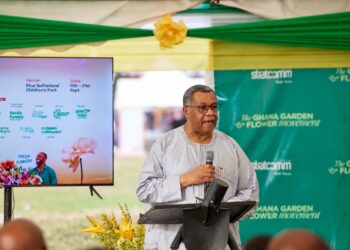

In a bold move to cement Ghana’s status as the industrial heartbeat of West Africa, the Ghana Free Zones Authority (GFZA) has successfully courted top-tier Indian manufacturers during a high-profile investment mission to Surat.
Led by the Authority’s Chief Executive Officer, Dr. Mary Awusi, the delegation leveraged the 2nd Edition of the SGCCI Global Village, Global Exchange and Trade Exhibition to pitch Ghana’s Special Economic Zones (SEZs) as the premier destination for Indian capital and technology transfer.
The mission comes at a time when the Mahama administration is aggressively pursuing its “Resetting for Growth” agenda. By targeting Surat – India’s “Diamond City” and a burgeoning hub for textiles and engineering – the GFZA is looking to tap into a sophisticated industrial ecosystem that mirrors Ghana’s own aspirations for value-added manufacturing.
“Dr. Awusi highlighted Ghana’s strategic location, investor-friendly policies, and the incentives offered under the Free Zones regime, positioning Ghana as a competitive gateway to regional and global markets.
“The engagement provided participants with practical insights into market entry opportunities and the Government of Ghana’s industrialisation agenda”
Ghana Free Zones Authority
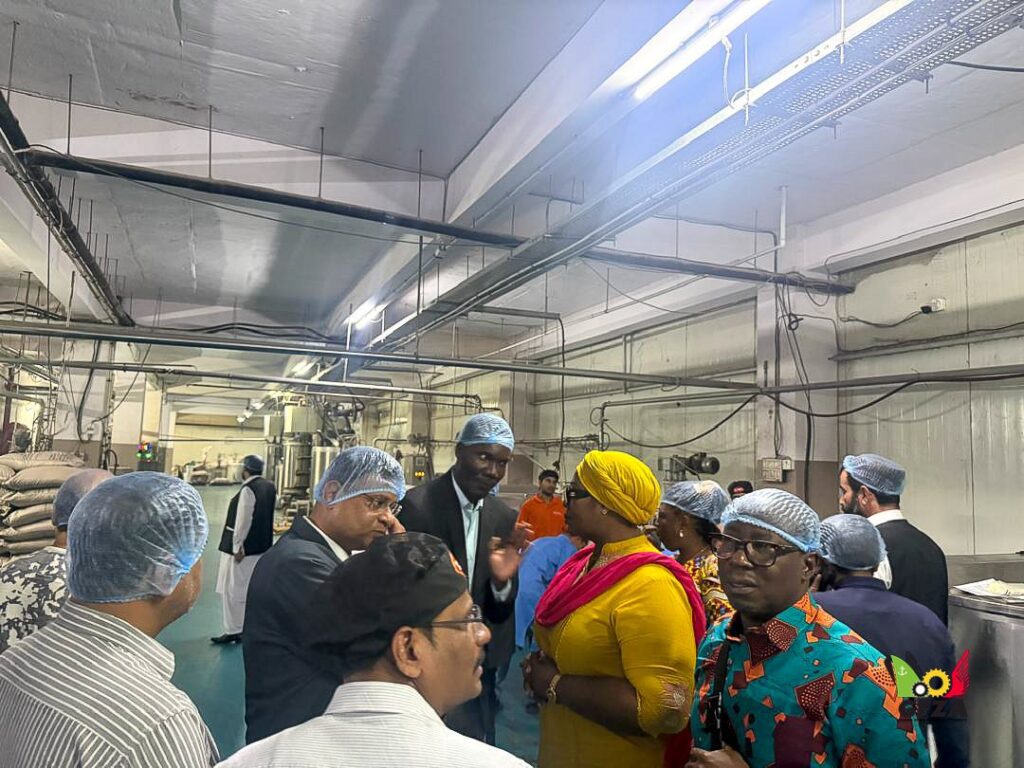
According to the Authority, the mission went beyond boardroom presentations, with Dr. Awusi undertaking strategic site visits to some of Surat’s most promising industrial players.
Among these were T-Con Food, a prominent chocolate manufacturer, and Axabull Industries Pvt Ltd, a leader in the lubricants and engine oil sector. Both companies represent “low-hanging fruit,” for Ghana’s industrial strategy: T-Con Food offers potential for local cocoa value addition, while Axabull could support the growing automotive and logistics sectors under the 24-Hour Economy policy.
According to GFZA reports, both firms expressed “strong interests” in establishing operations in Ghana. For Indian investors, the attraction lies in the AfCFTA framework, which allows goods produced in Ghana’s Free Zones to reach a 1.3 billion-person market with minimal tariff barriers.
The India-Ghana Corridor
The mission’s success was bolstered by the active participation of the Ghana High Commission in India. Mr. Nana Kojo Asiedu, 1st Secretary for Trade, Tourism, and Culture, reinforced the government’s commitment to “Aftercare” services – a critical factor for foreign investors who often fear bureaucratic bottlenecks.
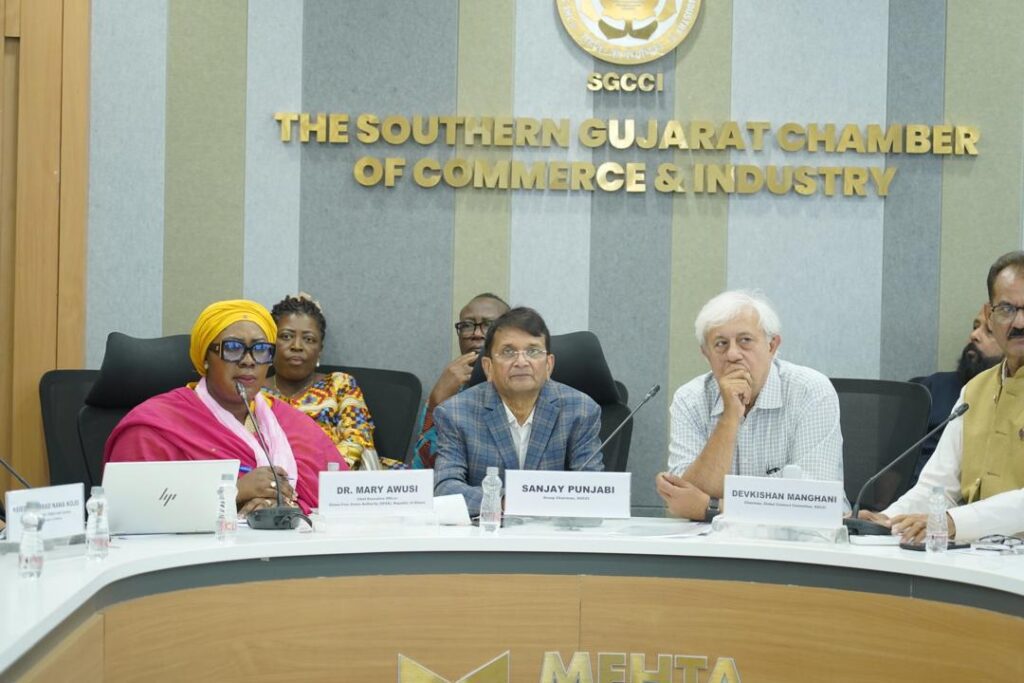
By presenting a unified front, the GFZA and the High Commission assured the Surat Chamber of Commerce and Industry (SGCCI) that their investments would be protected by robust legal guarantees and tax holidays, including the 100% exemption on duties for imported raw materials used in export production.
“Mr. Nana Kojo Asiedu reinforced Ghana’s value proposition and assured investors of the High Commission’s commitment to supporting and facilitating their investment processes in Ghana, providing the institutional support available to prospective investors”
Ghana Free Zones Authority
The most tangible outcome of the Surat engagement was the announcement of a reciprocal visit.
In collaboration with the SGCCI, the GFZA is preparing to host a 20-member business delegation from India in February 2026. This “inward mission” will allow prospective investors to conduct firsthand site inspections of the Tema and Enchi industrial parks, meeting with local stakeholders to finalize their market entry strategies.
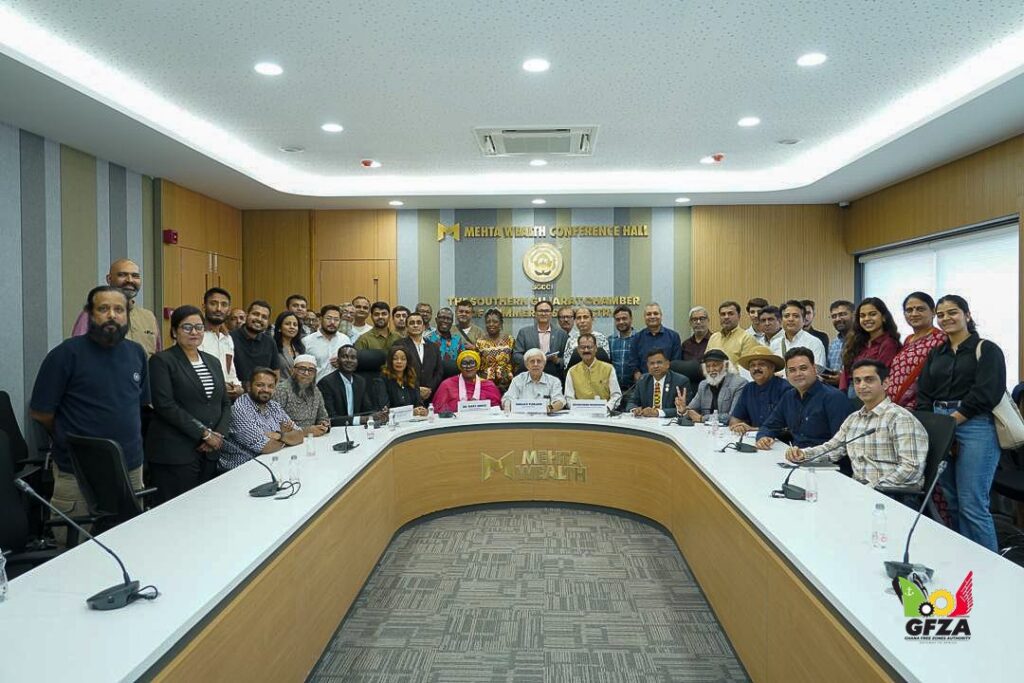
This proactive approach by Dr. Mary Awusi underpins a new era for the GFZA – one where the Authority does not just wait for investors to arrive but actively seeks them out in the world’s most dynamic industrial clusters.