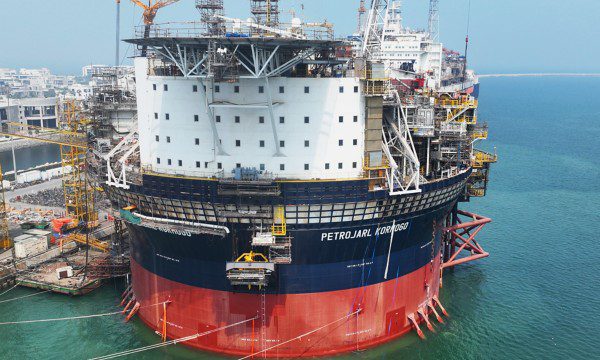
The Congo LNG project has achieved a major milestone with the first LNG cargo from the Nguya FLNG facility, strengthening global gas supply and boosting Congo’s energy ambitions.
The ceremony, held in Pointe-Noire, was attended by President Denis Sassou N’Guesso and Eni’s Chief Executive Officer, Claudio Descalzi, signaling the official start-up of gas exports under Phase 2 of the Congo LNG project.
Speaking at the ceremony, Eni CEO Claudio Descalzi highlighted the significance of the partnership underpinning the project.
“Today we reach a very important milestone thanks to the relationship of trust built with the country’s institutions and local communities.”
Eni CEO Claudio Descalzi
Descalzi noted that Eni had taken a long-term view of gas development in the Republic of Congo, investing in domestic gas utilization well before exports were on the horizon.

“We have been the only company to invest in gas to develop the domestic market and to reduce routine flaring,” he stated, emphasizing that early decisions made over two decades ago laid the groundwork for today’s export capability.
The milestone represents more than the departure of an inaugural cargo. It underscores the growing role of the Congo LNG project in global gas markets at a time when energy security and supply diversification remain top priorities for Europe and other regions.
For Eni, the start-up of Phase 2 marks a critical advance toward its long-term ambition of expanding its liquefied natural gas portfolio to 20 million tonnes per annum by 2030.
The company is leveraging the flexibility and competitiveness of floating LNG facilities to rapidly bring gas resources to market while diversifying supply sources geographically.
The Congo LNG project is now firmly positioned as a cornerstone of that strategy, reinforcing Eni’s aspiration to build a leading role in the global LNG market through equity production rather than relying solely on third-party supply.
Record-Breaking Delivery of Phase 2
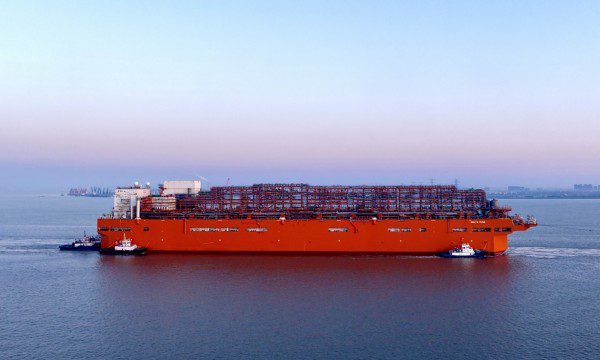
Phase 2 of the Congo LNG project has been delivered at a pace that sets a new benchmark for the industry.
Construction of the Nguya FLNG unit began less than three years ago, with start-up achieved just 35 months later, an execution speed rarely matched in large-scale LNG developments.
According to Descalzi, the rapid delivery has had immediate international implications.
“Phase 2 was delivered in record time compared with industry averages, increasing gas availability on international markets and contributing to Italian and European energy security, while at the same time generating concrete benefits for the local economy.”
Eni CEO Claudio Descalzi
With the completion of Phase 2, the Congo LNG project has reached a total liquefaction capacity of 3 million tonnes per annum, equivalent to around 4.5 billion cubic metres of gas each year.
The project draws on gas resources from the Nené and Litchendjili fields, located within the offshore Marine XII license.
This expanded capacity builds on the foundation laid by Phase 1, which came on stream in December 2023 using the Tango FLNG unit.
That first phase itself was delivered in just over a year after project definition, demonstrating Eni’s ability to fast-track complex offshore developments.
Balancing Global Supply and Local Value
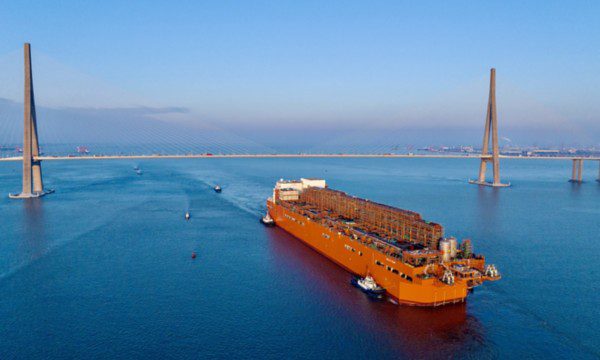
Beyond exports, the Congo LNG project illustrates how gas resources can be transformed into strategic value for both producing countries and international markets.
Eni has positioned the project as cost-competitive while maintaining strong environmental performance, particularly through efforts to curb routine flaring and maximize gas utilization.
The Republic of Congo continues to benefit directly from Eni’s gas operations. The company supplies gas to the Congo Power Plant, which generates about 70 percent of the country’s electricity, and supports the strengthening of the national high-voltage transmission network.
Eni’s roots in the Republic of Congo date back to 1968, making it one of the country’s longest-standing energy partners.
In 2025, Eni’s equity production stood at around 70,000 barrels of oil equivalent per day, with expectations that output will rise to approximately 110,000 kboed in 2026 as gas projects ramp up.
Beyond hydrocarbons, Eni is also advancing energy transition initiatives, including an agri-feedstock project that integrates Congo into the biofuels value chain.
The company has framed this effort as a lever for agro-industrial development and economic diversification, alongside community-focused programmes that improve access to energy, water, healthcare and local livelihoods.
The first LNG cargo from the Nguya FLNG facility is a defining moment for the Congo LNG project, cementing the Republic of Congo’s role in global gas supply chains.
READ ALSO: Finance Ministry Relocates to Kanda to Boost Efficiency