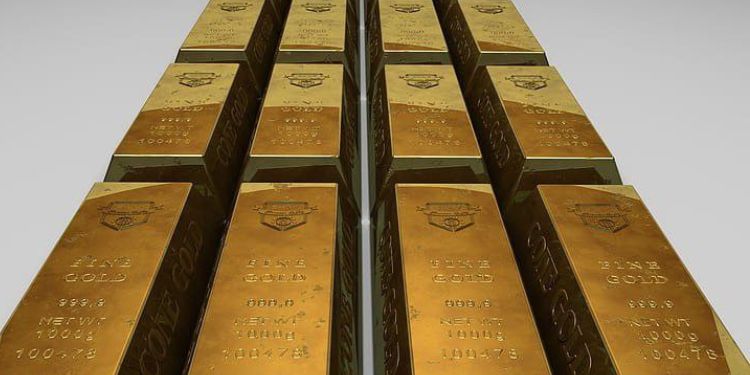
Global bullion market has witnessed a strategic recovery as gold prices climbed 1% to approximately $5,190 per ounce.
This upward trajectory follows a period of heightened market volatility, primarily driven by a “mix of trade drama and global uncertainty” that has forced investors back into safe-haven assets.
While the metal successfully regained much of Tuesday’s losses, the broader rally remains partially checked by fading expectations of a Federal Reserve rate cut, as US officials point toward a steady labor market and persistent inflationary pressures.
“Any Country that wants to ‘play games’ with the ridiculous supreme court decision, especially those that have ‘Ripped Off’ the U.S. for years, and even decades, will be met with a much higher Tariff, and worse, than that which they just recently agreed to.”
Donald Trump
The current price action is inextricably linked to the aggressive protectionist stance of US President Donald Trump, whose 10% global tariff officially took effect this Tuesday.
The administration has already signaled a move to hike these levies to 15% in a persistent effort to revive a “tariff agenda” that recently faced setbacks in the Supreme Court.
Beyond the trade theater, the extractive industry is closely monitoring the “delicate US-Iran nuclear talks,” where Tehran’s pledge to do “whatever it takes” to secure an agreement has added another layer of geopolitical complexity.
This environment of investor caution, characterized by “geopolitical jitters,” underscores gold’s enduring role as a hedge against systemic risk.
Economic Implications for the Ghanaian Extractive Sector

For Ghana, Africa’s leading gold producer, the surge toward $5,200 per ounce presents a transformative fiscal opportunity. Meanwhile, analyst believed the recent happenings is a massive windfall for the country.
With gold already accounting for over 57% of total export revenue, this price appreciation is expected to significantly bolster the nation’s gross international reserves, which reached a record $13.8 billion in 2025.
The “bull market” effectively acts as a tailwind for the government’s revenue mobilization efforts, particularly as the state prepares to implement a new sliding-scale royalty regime.
Under the proposed fiscal reforms, Ghana aims to replace its fixed royalty rate with a graduated scale of 5% to 12%, specifically designed to capture windfall gains when prices exceed $4,500 per ounce.
While industry giants like Gold Fields have already reported a 26% jump in royalty payments reaching nearly $99 million in 2025 a sustained price of $5,190 would trigger the maximum collection brackets.
This influx of hard currency is critical for stabilizing the Cedi and narrowing the budget deficit, provided the state can balance these “aggressive rate increases” without deterring long-term investment in new projects like Newmont’s Ahafo North.
Strengthening the National Gold Buffer

The price rally further validates the strategic operations of the Ghana Gold Board (GoldBod), which has been instrumental in formalizing the artisanal and small-scale mining (ASM) sector.
By offering competitive, market-linked pricing, GoldBod successfully diverted 103 metric tonnes of gold into official channels in 2025, generating approximately $10.8 billion in non-debt foreign exchange.
As global tensions keep prices elevated, the incentive for local miners to bypass smuggling routes in favor of official domestic purchase programs strengthens.
However, experts warned that the “uncertainty over next tariff moves” and global trade measures could eventually dampen physical demand if a full-scale trade war triggers a global slowdown.
For now, the Bank of Ghana is leveraged to benefit from its gold-for-oil and gold-purchasing programs, using the current price surge to build a robust “buffer against external shocks.”
The focus for 2026 remains on hitting the national production target of 6.5 million ounces to fully capitalize on this historic gold bull run.
READ ALSO: Merz Calls For Collaboration With China