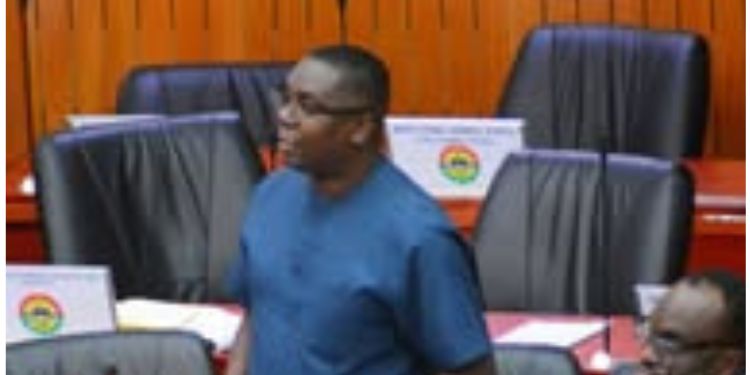
Minority in Parliament has raised significant concerns regarding the government’s proposed Ghana Accelerated National Reserve Accumulation Policy (GANRAP), specifically demanding transparency on the financing mechanisms for gold purchases.
Dr. Gideon Boako, the Deputy Ranking Member on the Finance Committee, questioned the logic of the current administration’s decision to liquidate existing gold reserves while simultaneously advocating for a policy of aggressive gold accumulation.
The opposition argued that while shoring up the economy through gold is a commendable goal, the lack of a clear “composition-mix ratio” between gold and traditional foreign exchange (FX) reserves threatens the country’s monetary solidity and market confidence.
“Gold reserves is not the same as foreign exchange reserves, although gold reserves can be liquidated to get foreign exchange, so we need to have clarity on that. It is also important to know from the Minister’s presentation, and that is lacking, how we are going to finance the purchases of this gold.”
Dr. Gideon Boako

Dwelling on these concerns, the Minority highlighted a disconnect between the government’s stated policy and its executive actions, noting that the Gold Board (GoldBod)formerly the Precious Minerals Marketing Company (PMMC) lacked the direct government financing initially promised to Parliament.



Instead of the budgetary provisions being utilized as intended, Dr. Boako revealed that the Bank of Ghana (BoG) has been the primary source of funding, effectively “pumping money” to sustain the board’s operations which brought about $214m losses.
This internal financing structure has come under fire as the opposition seeks to understand whether the nation is transitioning to a 100% gold-backed reserve system or maintaining a strategic balance with fiat currency to ensure essential market liquidity.
Structural Discrepancies in Forex Interventions
A primary point of contention remains the efficiency of the government’s recent foreign exchange interventions compared to previous administrations.
Dr. Boako pointed out that the current government has utilized over $10 billion in foreign exchange interventions to achieve a relatively modest appreciation of the Cedi moving the rate from approximately $14 to between $11 and $12.
In contrast, he noted that the previous government managed to reduce the rate from $16 to$14 without the need for such massive capital injections or additional tax burdens.
This disparity raises questions about the long-term sustainability of the GANRAP framework if the cost of stabilizing the currency remains disproportionately high relative to the results achieved.
The Evolution of GoldBod and Financing Integrity

The transition from the PMMC to the Gold Board was envisioned as a strategic move to formalize artisanal and small-scale mining (ASM) and secure a steady supply of gold for the central bank.
However, the “lack of clarity” regarding how future purchases will be financed remains a major hurdle for legislative approval. While the government claims GoldBod is an institutional upgrade designed to maximize national sovereignty over mineral resources, the Minority insists that the “Minister never acted” on the promise of direct state financing.
By relying on the Bank of Ghana’s balance sheet, the policy risks creating “structural and accounting challenges” that could draw scrutiny from international bodies like the IMF, as seen in recent discussions regarding the central bank’s audited accounts and reported trading losses.
Enhancing Policy Through Transparency

Providing the requested clarity on the “balancing-mix” and funding sources is not merely a political requirement but a technical necessity to enhance the GANRAP’s effectiveness.
Clearer guidelines would allow market players to predict liquidity levels more accurately, thereby reducing the volatility of the Cedi.
Furthermore, establishing a transparent financing bridge for GoldBod independent of the central bank’s emergency buffers would safeguard the BoG’s independence and prevent the “pumping” of money from fueling inflationary pressures.
For GANRAP to thrive in a “globally changing economic system,” it must bridge the gap between physical gold accumulation and the immediate liquidity needs of the Ghanaian economy.
READ ALSO: Surging Global Gold Prices Fortified Ghana’s 2025 Export Revenue – Ato Forson