
Liberal Democrats leader, Sir Ed Davey has called on the UK government to start building its own nuclear deterrent to end the UK’s reliance on US.
Speaking at the Liberal Democrat spring conference in York, Sir Ed Davey said that the government’s reliance on US support for the supply and maintenance of Trident missiles poses a serious threat to the UK’s national security.
“Britain’s nuclear deterrent must be genuinely, verifiably ours not dependent on Trump or whoever his successor may be. Trump has proven we can’t rely on America as a dependable ally. Britain has the best scientists, the best engineers, the best builders in the world. So let’s get building our own, truly independent nuclear deterrent here in the UK.”
Sir Ed Davey
The United Kingdom has maintained nuclear weapons since the Cold War and remains one of the world’s recognized nuclear-armed states under the framework of the United Nations nuclear order. Britain’s current nuclear deterrent is built around a fleet of submarines armed with Trident II D5 ballistic missiles.
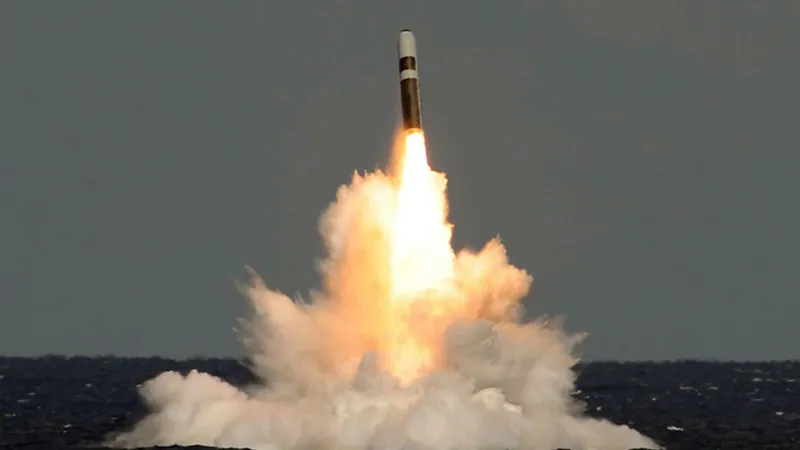
While UK maintains full operational control over the use of its nuclear warheads, the missile system itself is produced and supported through cooperation with the United States. This long-standing arrangement has formed the backbone of the UK’s strategic deterrence posture for decades.
A spokesperson from the Ministry of Defence indicated that UK’s deterrent is what guarantees the country’s national security, stating that, “As the 2025 Strategic Defence Review made clear, a modernized nuclear deterrent will remain the cornerstone of the UK’s defence, and our commitment to NATO and global security.”
The Path Ahead for UK’s Nuclear Deterrence
Nuclear deterrence remains one of the most significant elements of UK’s defence policy and plays an important role in its strategic posture within the North Atlantic Treaty Organization (NATO).
The United Kingdom is one of only three nuclear-armed members of the alliance, alongside the United States and France, giving it a unique position within European security architecture.
The United Kingdom’s nuclear deterrent relies on a fleet of ballistic-missile submarines that operate undetected for extended periods. These submarines carry nuclear warheads on long-range missiles capable of striking targets thousands of kilometres away.
Currently, four Vanguard-class submarines operated by the Royal Navy provide this capability. Each submarine carries multiple missiles fitted with a British-designed nuclear warhead. The fleet is based at HM Naval Base Clyde in Scotland, the operational hub for the UK’s nuclear submarines.
Continuous at-sea deterrence ensures that one submarine is always on patrol while others undergo maintenance, training, or preparation. This approach guarantees the United Kingdom a secure second-strike capability, a key element of nuclear deterrence.
Maintaining a submarine at sea at all times prevents the country’s nuclear capability from being neutralized by a surprise attack.
The submarines are built in the United Kingdom, primarily at shipyards in Barrow-in-Furness, a longstanding centre of the country’s submarine construction industry.
These facilities have produced multiple generations of nuclear-powered submarines and remain among the most specialized naval engineering centres in Europe.
The Dreadnought programme, one of the British government’s largest defence projects, is underway to replace the Vanguard-class submarines, the largest ever Royal Navy submarines at over 150m long capable of launching Trident II D5 missiles.
The new submarines are expected to enter service in the early 2030s and will maintain continuous at-sea deterrence into the latter half of the century.
However, the Leader of the Liberal Democrats opposes the current approach, arguing that, with Trident replacement planned for the 2040s, the UK should prioritize domestic spending rather than relying on the US.
He noted that France has always maintained a fully independent nuclear system, demonstrating that a sovereign British capability is achievable.
He further argued that the government can maintain the current weapons system domestically and, in the long term, produce a fully British-made replacement.
The UK government through the Ministry of Defence in justifying UK’s Nuclear deterrent explained that in an evolving, and deteriorating, global security environment our nuclear deterrent has never been more important.
“The UK must show it can and will defend itself and its Allies in all circumstances, even the most extreme. The UK is undergoing a major renewal programme. In doing so, we are re-prioritizing the UK’s defence nuclear enterprise in a way not seen since the end of the Cold War. The decisions that we are taking, and the investments that we are making, to sustain our nuclear deterrent are necessary and in response to the evolving global security environment and the actions of others.”
Ministry of Defence
READ ALSO: Guterres Urges Renewed Global Action To Confront Islamophobia