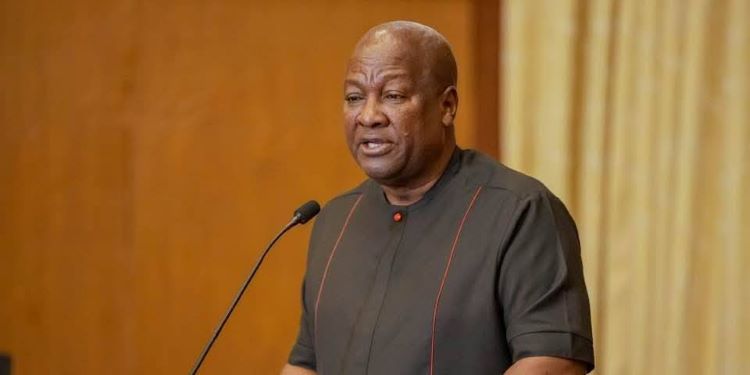
President John Dramani Mahama has announced the allocation of 1% of Ghana’s Gross Domestic Product (GDP) to commercial agriculture and industrialization, designating the Northern Region as the nation’s primary agro-industrial and Sahelian trade corridor.
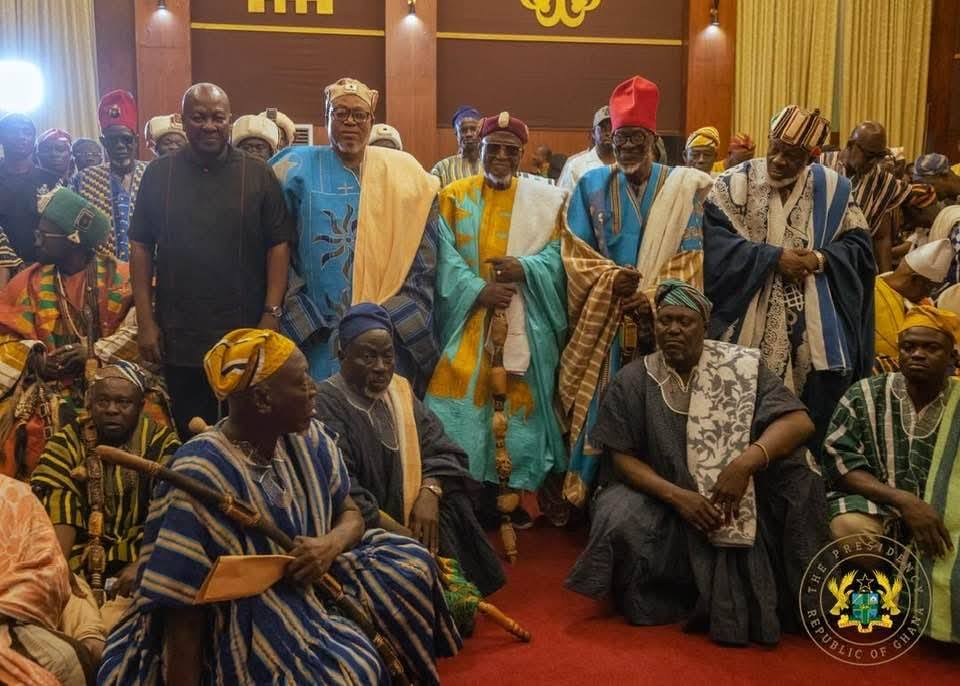
This fiscal shift, unveiled during a courtesy call on the Northern Regional House of Chiefs on May 15, 2026, underscores Ghana’s immediate transition from the concluded International Monetary Fund (IMF) Extended Credit Facility (ECF) to a new Policy Coordinating Instrument (PCI).
The administration is moving to operationalize the 24-Hour Economy Initiative through large-scale agribusiness and localized industrial restoration by carving out a dedicated investment buffer within the national budget.
“We’ve concluded the IMF programme. One of the major investments we’re going to make in the programme that is taking over from the Extended Credit Facility that has just ended is creating space for the investment of 1% of GDP in key areas. And one of the areas that has been identified is commercial agriculture”
President John Dramani Mahama
The conclusion of the IMF Extended Credit Facility is a pivotal moment in Ghana’s macroeconomic trajectory, especially as the transition to a PCI framework allows the state greater flexibility in directing capital toward high-growth sectors that were previously constrained by restrictive credit conditions.

President Mahama’s decision to prioritize 1% of GDP – a multi-billion cedi commitment – specifically for commercial agriculture, denotes a departure from subsistence-level support toward a full-scale industrialization of the value chain.
For the Northern Region, which possesses the country’s most vast arable landmass, this policy identifies the territory not just as a breadbasket, but as the engine of Ghana’s post-IMF transformation. The strategic positioning of the Northern Region is central to the Accelerated Export Development Programme.
The President framed the region as a nexus for agri-processing and agribusiness, leveraging its geographical proximity to the Sahelian markets. Under the 24-Hour Economy framework, the objective is to ensure that processing facilities operate beyond standard daylight hours to maximize output and meet the growing demand for exports.
This industrial push is intended to convert raw agricultural produce into high-value processed goods, thereby retaining a larger share of the value chain within the regional economy.
President Mahama’s vision positions the Northern Region as a logistics and trade corridor, investing in roads, irrigation, and energy access to build the physical infrastructure necessary to facilitate the movement of goods from Northern Ghana into Burkina Faso, Mali, and Niger.
This strategy transforms the region into a gateway for regional trade, effectively decoupling its economic fate from purely domestic consumption and linking it to the broader West African export market.
Restoration and Continuity
A significant element of the President’s address was the commitment to “capture the vision again,” referencing the era of the Nasia Rice Factory and other defunct industrial landmarks – historical anchors that serve as policy blueprints for the current administration’s Local Industrialisation drive.
The government is attempting to restore a lost legacy of food security by focusing on areas where the Northern Region previously demonstrated comparative advantage – such as large-scale rice and grain production. Yet the restoration of these industrial nodes is not merely a nostalgic exercise but a technical requirement for reducing Ghana’s import bill.
President Mahama clarified that the 1% GDP investment will target the revitalization of irrigation schemes and the establishment of modern processing plants that mirror the functionality of previous state-led successes but with modern efficiency. The approach is geared towards tangible capital injections into infrastructure that directly support farmers, traders, and local youth.
The shift to the Policy Coordinating Instrument (PCI) is the technical mechanism that makes this 1% GDP allocation possible. Unlike the ECF, which focused on aggressive fiscal consolidation and debt management, the PCI is designed to facilitate policy credibility while allowing the state to invest in productive sectors.
President Mahama’s emphasis on “creating space” highlighted a deliberate effort to protect development spending from the cyclical volatilities of the global market, directing this space toward commercial agriculture and betting on a multiplier effect: increased food security leads to lower inflation, which in turn stabilizes the cedi and creates a more predictable environment for the 24-Hour Economy.
The Northern Region, with its vast arable lands, is the primary beneficiary of this macroeconomic pivot, with the current investment in health care, education, roads, irrigation, and energy access within the region being a secondary infrastructure layer that supports the primary industrial goal.
READ ALSO: Davido Hosts Glamorous Special Screening for Nigerian Rom-Com ‘Call of My Life’